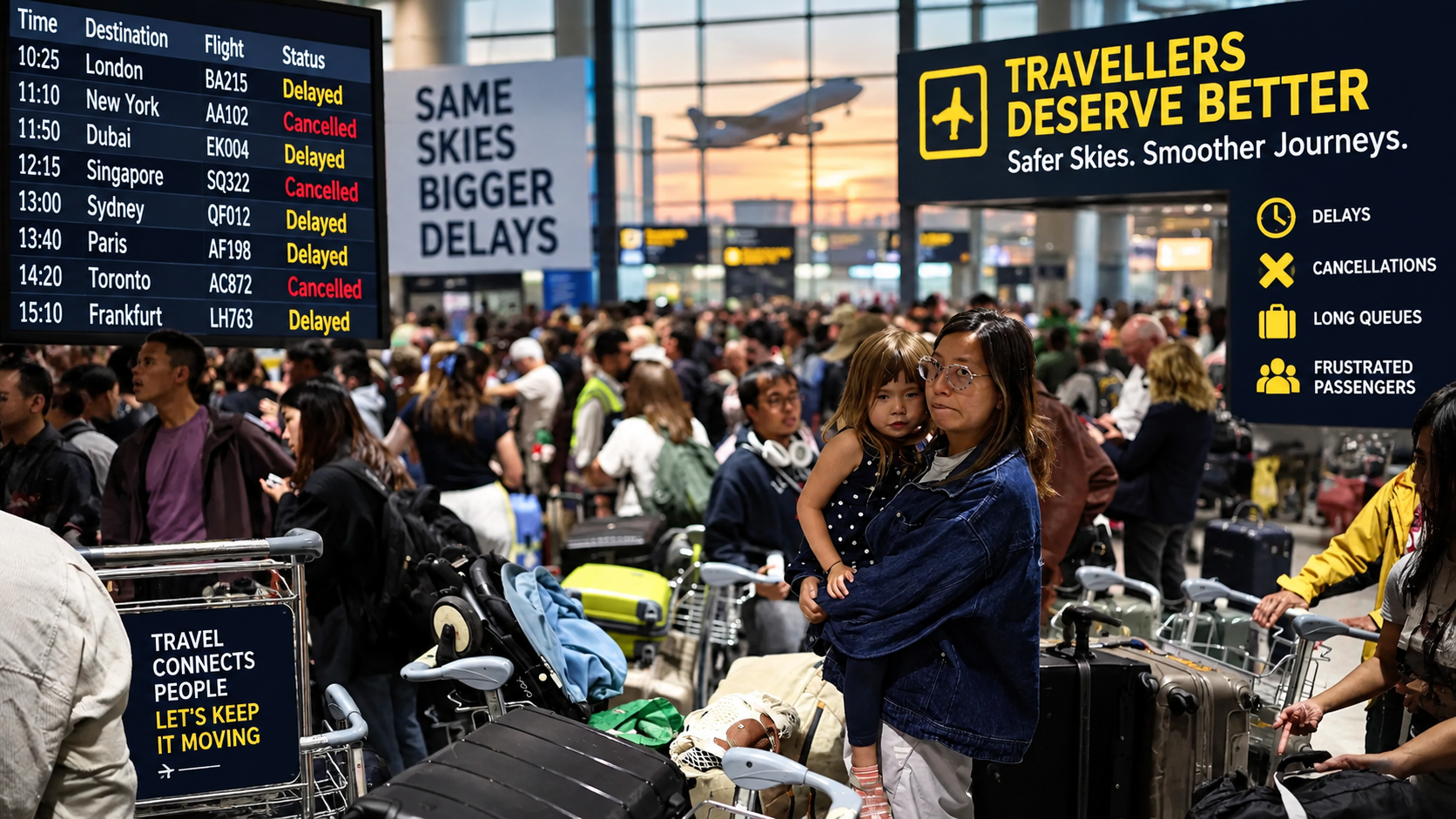
Air travel is supposed to make the world feel smaller. A passenger can board a plane in one country and arrive in another continent within hours. Modern aviation has transformed business, tourism, family connections and international trade.
Yet when air traffic systems begin to struggle, that convenience can disappear remarkably quickly.
Flights are delayed. Departures are cancelled. Connections are missed. Airport terminals fill with frustrated passengers. Airlines scramble to rearrange schedules. Ground crews work under pressure. Air traffic controllers face increasingly complex workloads. And travellers are often left wondering how a system designed around precision can become so fragile.
Recent concerns about air traffic disruption have once again raised questions about whether aviation systems in the UK and elsewhere have enough resilience to cope with unexpected pressure. While the exact causes of individual incidents can vary, the broader problem is not unique to one country.
Air traffic disruption can happen for many reasons, including severe weather, staffing shortages, technical problems, airport congestion, aircraft availability issues and knock-on effects from earlier delays.
The important question is no longer simply why one particular disruption happened.
It is whether the aviation industry has built systems capable of recovering quickly when something goes wrong.
Passengers do not expect perfection. They understand that storms happen, aircraft develop technical problems and safety must come first.
What becomes unacceptable is when relatively small problems turn into hours of confusion, repeated cancellations, poor communication and disruption that continues long after the original issue has passed.
Air travel depends on hundreds of moving parts working together. When one part fails, the consequences can spread rapidly.
That is why the growing conversation around air traffic meltdowns deserves attention.
What Is an Air Traffic Meltdown?
An air traffic meltdown is not simply a delayed flight.
Delays are a normal part of aviation.
A meltdown occurs when disruption becomes widespread enough to affect multiple parts of the aviation network at once.
This may involve:
- Large numbers of delayed flights
- Widespread cancellations
- Aircraft and crews being displaced
- Airports becoming overcrowded
- Missed connections
- Baggage delays
- Long queues
- Reduced capacity
- Difficulties communicating accurate information to passengers
The defining feature is often the knock-on effect.
A flight delayed by one or two hours can create problems for the next flight involving the same aircraft and crew.
That flight may then leave late.
The aircraft arrives at another airport behind schedule.
Its next departure is delayed.
Passengers miss connections.
The disruption continues.
What began as one relatively small problem can therefore develop into a network-wide issue.
Why Aviation Networks Are So Vulnerable
Modern aviation operates on extremely tight schedules.
Aircraft often fly several sectors in a single day.
Crews have carefully managed working hours.
Airport gates are booked according to specific schedules.
Runways and airspace have limited capacity.
Ground handling teams need to be available at precise times.
Baggage systems have to move thousands of items through airports efficiently.
When everything works, the system is remarkably impressive.
But efficiency can come at a cost.
A system operating close to capacity has less room to absorb unexpected disruption.
That is why resilience is just as important as efficiency.
The Butterfly Effect of Flight Delays
One delayed aircraft can affect an entire day’s schedule.
Consider a simple example.
A plane scheduled to depart at 8 a.m. is delayed by weather.
Instead of leaving at 8, it departs at 10.
The aircraft was supposed to operate another flight at noon.
It cannot reach the next airport in time.
That departure is delayed.
Passengers on that flight miss connecting services.
The aircraft arrives late at its next destination.
Ground crews now have less time to prepare it for another departure.
The delay continues.
This is known as a knock-on effect, and it is one of the biggest reasons aviation disruption can grow rapidly.
Staffing Pressures
People are one of the most important components of aviation.
Air traffic controllers, pilots, cabin crew, engineers, ground handlers, dispatchers and airport staff all have essential roles.
When staffing levels are under pressure, the system becomes less flexible.
A shortage does not necessarily mean workers are simply absent.
Staffing challenges can involve training pipelines, scheduling constraints, fatigue management, recruitment difficulties and the time required to develop experienced professionals.
Air traffic control is a particularly specialised area.
Training a new controller takes significant time, and the work requires concentration, technical knowledge and adherence to strict safety procedures.
There is no quick solution to a shortage of highly trained personnel.
Technology Failures Can Have Huge Consequences
Modern aviation depends heavily on technology.
Air traffic systems, airport databases, communication networks, baggage systems, airline scheduling platforms and passenger information systems all need to function.
When technology works, passengers may barely notice it.
When it fails, the impact can be immediate.
A technical problem may stop airlines from processing passengers efficiently.
A system outage can affect flight information.
Communication problems can slow operations.
Even a partial failure can create confusion if staff no longer have access to the information they normally rely upon.
This raises an important question for the industry:
How resilient are these systems when technology fails?
Backup systems are essential, but they also need to be tested regularly.
The Weather Factor
Weather will always be a major variable in aviation.
Thunderstorms, heavy snow, strong winds, low visibility and other conditions can reduce airport capacity.
The important point is that weather itself is not necessarily evidence of poor planning.
Aviation is built around safety.
If conditions are dangerous, reducing operations is the correct decision.
The bigger challenge comes afterward.
How quickly can airlines and airports recover once the weather improves?
A resilient system should be able to absorb disruption and gradually return to normal operations without creating unnecessary additional chaos.
Airport Congestion
Airports can also become overwhelmed when too many aircraft and passengers are concentrated in a limited period.
Runways have finite capacity.
Gates are limited.
Security checkpoints have maximum throughput.
Baggage systems can process only a certain number of bags at a time.
Even road access to airports can become congested.
When demand consistently approaches or exceeds available capacity, relatively small disruptions can have much larger effects.
This is why infrastructure investment matters.
Adding capacity is not always simple, particularly at major airports where expansion can involve environmental, political and planning considerations.
But long-term passenger demand cannot be managed entirely through short-term fixes.
The Human Cost of Aviation Chaos
Flight delays are more than an inconvenience.
For some passengers, disruption can mean missing a wedding, arriving late for a funeral, losing a business opportunity or spending an unexpected night in an unfamiliar city.
Families travelling with children can find airport disruption particularly difficult.
Passengers with reduced mobility may face additional complications.
People on tight budgets can struggle with unexpected accommodation, food and transport costs.
Not everyone can simply absorb another day of travel.
This is why communication matters so much during disruptions.
Passengers cannot control the weather or a technical failure.
But they can be given accurate information and reasonable support.
Communication Is Part of the Service
One of the most common frustrations during major disruptions is not simply the delay itself.
It is uncertainty.
Passengers want to know:
What happened?
How long will the delay last?
Is the flight still operating?
Will there be another aircraft?
What happens to the connecting flight?
Where should passengers go?
What support is available?
When information is unclear or constantly changing, frustration increases.
Airlines and airports should therefore treat communication as part of operational resilience.
Clear information can reduce confusion even when the underlying problem cannot immediately be fixed.
Silence makes disruption feel worse.
Why Passengers Often Blame Airlines
From a traveller’s perspective, an airline is usually the most visible part of the system.
Passengers buy a ticket from an airline.
They check in through the airline.
They receive messages from the airline.
So when something goes wrong, the airline becomes the natural target for frustration.
But aviation disruption can involve multiple organisations.
Air traffic management providers, airports, airlines, ground handling companies, security systems and weather conditions can all contribute.
That does not remove an airline’s responsibility to look after its customers.
It does, however, show why some disruptions cannot be solved by a single organisation acting alone.
The Need for Better Contingency Planning
Aviation authorities and companies should not only prepare for normal operations.
They should also plan for failure.
What happens if a major computer system goes offline?
What happens if staffing drops unexpectedly?
What happens if an airport loses capacity?
What happens if thousands of passengers are suddenly stranded?
Contingency plans should be practical rather than merely theoretical.
They should be tested through realistic exercises.
Staff should understand their roles.
Backup systems should be maintained.
Communication channels should be clearly defined.
The ability to recover should be treated as seriously as the ability to operate normally.
Lessons From Other Industries
Aviation is not alone in dealing with complex systems.
Power networks, hospitals, telecommunications and financial systems all face similar resilience challenges.
One lesson from other industries is that redundancy matters.
If one component fails, another should be capable of taking over.
This can be expensive.
But the cost of resilience needs to be compared with the cost of repeated large-scale disruption.
Aviation is a critical part of modern economies.
Major airports are not merely travel facilities.
They support tourism, logistics, trade and international business.
Keeping them resilient is therefore an economic priority as well as a passenger-service issue.
Are Modern Aviation Systems Too Optimised?
One uncomfortable question is whether parts of the aviation industry have become too focused on efficiency.
Tighter schedules can improve aircraft utilisation.
Higher airport throughput can increase capacity.
Smaller buffers can make operations more productive.
But fewer buffers also mean less room for error.
A system that works perfectly under ideal conditions may not perform well under stress.
The goal should not be maximum efficiency at any cost.
It should be sustainable efficiency supported by enough resilience to handle disruption.
Why Recovery Speed Matters
Passengers cannot expect every disruption to be prevented.
They can reasonably expect the system to recover.
Recovery means restoring aircraft schedules, repositioning crews, clearing airport queues, managing missed connections and giving passengers usable information.
The faster and more organised that recovery is, the less serious the final impact becomes.
This is why two airports can experience similar initial disruptions but produce very different passenger experiences.
One recovers efficiently.
The other experiences cascading failures for hours or even days.
What Could Improve Air Travel Resilience?
Several areas deserve attention.
Investment in Air Traffic Management
Modern air traffic systems require continued investment and staff development.
Better Staffing Planning
Aviation employers need long-term strategies for recruiting, training and retaining skilled workers.
Stronger Backup Systems
Critical digital systems should have robust contingency options.
More Operational Buffer
Schedules may need enough flexibility to absorb small disruptions before they become major ones.
Better Passenger Communication
Real-time, accurate information can significantly reduce confusion.
Stronger Coordination
Airlines, airports and air traffic management organisations need to coordinate closely during major incidents.
Smarter Data Use
Forecasting tools can help identify emerging bottlenecks before they become severe.
None of these solutions is simple.
But long-term improvement rarely comes from one simple fix.
What Passengers Can Do
Passengers also have some practical tools available.
Checking flight status before leaving for the airport can help.
Allowing extra time for important journeys can reduce the risk of missed connections.
Travel insurance may provide useful protection depending on the policy.
Passengers should also keep essential medication, identification documents and basic necessities in their hand luggage rather than checked baggage.
But these measures have limits.
Travellers should not be expected to solve systemic aviation problems themselves.
Personal preparedness can reduce inconvenience.
It cannot replace reliable infrastructure.
The Bigger Question
The most important question after every major aviation disruption should not simply be:
“Who is to blame?”
It should be:
“What failed, why did it fail, and why did the system struggle to recover?”
Blame can be emotionally satisfying.
Lessons are more useful.
A transparent investigation should look at the sequence of events rather than focusing on one visible failure.
Was the problem technical?
Was staffing insufficient?
Was the airport operating too close to capacity?
Were communication systems overwhelmed?
Did one failure trigger another?
Were contingency plans activated quickly enough?
These questions can produce meaningful improvements.
Air Traffic Meltdowns Are Not Just a UK Problem
The headline behind this article makes an important point.
Air traffic disruption is not confined to the UK.
Complex aviation networks around the world face many of the same vulnerabilities.
Weather can disrupt operations in the United States.
Staffing shortages can affect airports elsewhere.
Technology failures can occur in any country.
Congestion can develop wherever demand exceeds infrastructure.
The location changes.
The underlying challenge remains the same.
Modern aviation has become so interconnected that a disruption in one part of the system can quickly create consequences elsewhere.
What the Future of Aviation Should Look Like
The ideal aviation system is not one where nothing ever goes wrong.
That is unrealistic.
The better goal is an aviation system that responds intelligently when something does go wrong.
Passengers should receive accurate information quickly.
Airlines should have realistic recovery plans.
Airports should have enough flexibility to handle unexpected pressure.
Air traffic systems should have reliable backups.
Staff should have the training and resources necessary to manage disruption safely.
And lessons from previous incidents should lead to measurable improvements.
Conclusion
Air traffic meltdowns are not limited to one country, one airport or one airline.
They are a symptom of how complicated modern aviation has become.
The industry moves millions of passengers through tightly coordinated systems involving aircraft, crews, air traffic controllers, airport infrastructure, technology, weather forecasting, baggage operations and ground handling.
When one part breaks down, the effects can spread quickly.
That does not mean disruption can be eliminated completely.
Weather will still happen.
Technical problems will still occur.
Unexpected events will still test the network.
But chaos should not become the default response.
A resilient aviation system should be capable of absorbing problems, communicating clearly and recovering quickly.
Passengers deserve more than apologies after a breakdown.
They deserve evidence that lessons have been learned.
Air travel depends on trust. People trust that a system costing billions of pounds and involving thousands of professionals can get them where they need to go safely and with reasonable reliability.
Maintaining that trust requires investment, planning, coordination and accountability.
The objective should not be perfect aviation.
It should be resilient aviation.
Because when the next major disruption arrives—and eventually, another one will—the difference between a difficult day and a full-scale meltdown will depend on how prepared the system is to respond.
This website is proudly managed by Shunya Digit.