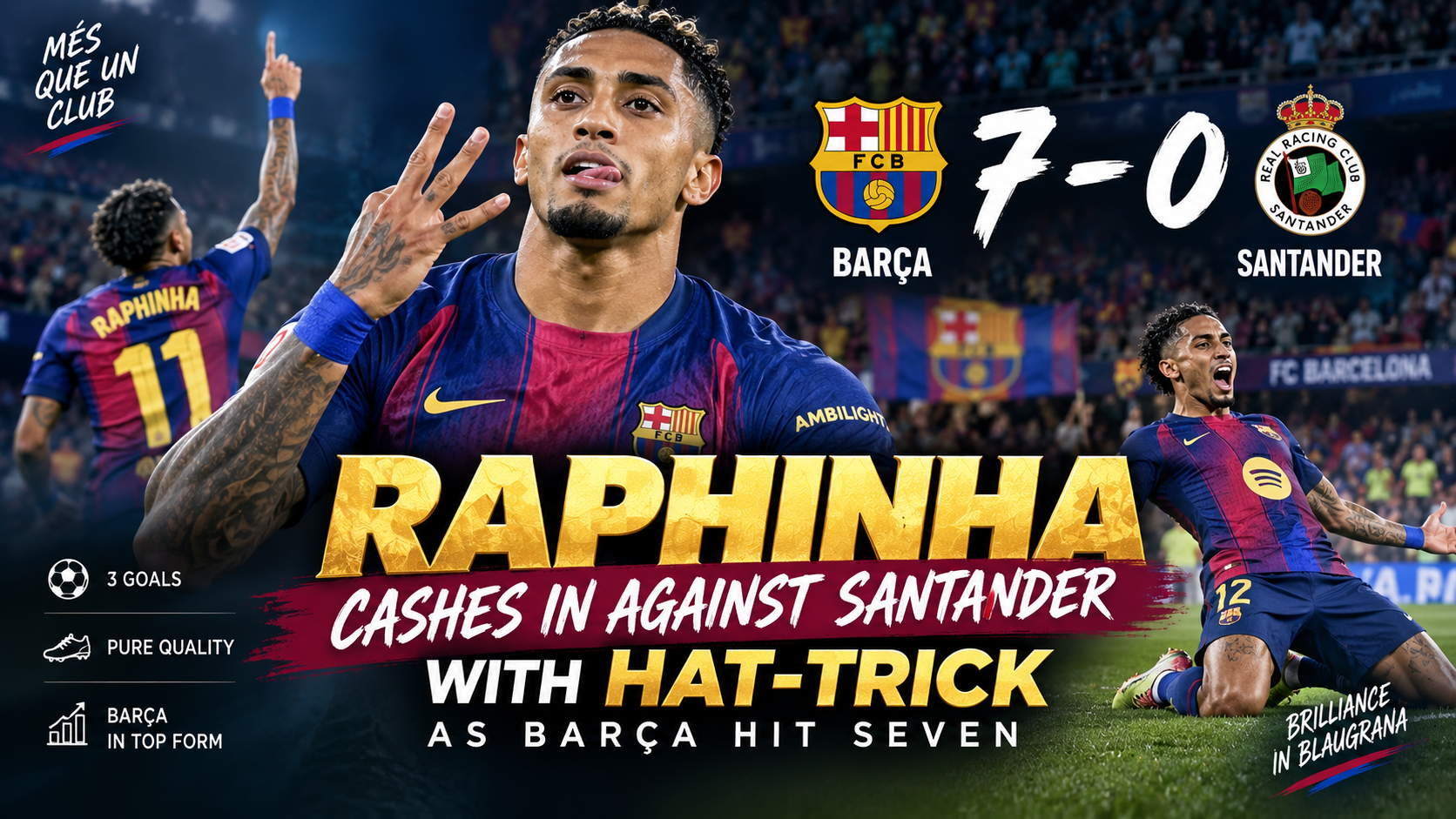
Raphinha produced a standout attacking performance as Barça overwhelmed Santander 7-0, with the Brazilian forward scoring a hat-trick in a match that showcased Barcelona’s attacking quality.
A seven-goal performance naturally becomes the main headline, but Raphinha’s contribution made the victory particularly memorable. His three goals put him at the centre of the result and provided a clear demonstration of the attacking threat he can create when given opportunities in dangerous areas.
For Barcelona, a result of this scale is more than simply a large scoreline. It offers an opportunity to assess attacking movement, finishing, creativity and the way the team converts pressure into goals.
For Raphinha, meanwhile, a hat-trick is an individual milestone that adds another memorable chapter to his Barcelona career.
This article looks at the reported 7-0 victory over Santander, Raphinha’s hat-trick, Barcelona’s attacking performance and the wider significance of a result in which the Catalan side found the net seven times.
Note: This article is based on the match headline supplied with the request. Live web verification is unavailable in this chat, so exact competition, date, minute-by-minute goal timings and additional match statistics are not presented as independently verified facts.
Raphinha Steals the Spotlight
Whenever a player scores three goals in one match, attention naturally turns toward that individual.
Raphinha’s hat-trick against Santander made him the defining figure of Barça’s seven-goal performance.
A hat-trick requires more than simply being in the right place once. It demands finishing quality, movement and the ability to take advantage of opportunities throughout a match.
For an attacking player, a three-goal performance can also provide a major confidence boost.
Raphinha has built his reputation around his energy, direct running and willingness to attack defenders. When those qualities combine with efficient finishing, he can become one of Barcelona’s most dangerous attacking outlets.
Against Santander, that attacking threat translated into three goals.
What a Hat-Trick Means for Raphinha
Scoring three times in a single match is one of the clearest ways for an attacking player to leave a mark on a game.
A hat-trick immediately changes the statistical profile of a performance.
Instead of simply contributing to the team’s attacking play, the player becomes directly responsible for a significant portion of the final score.
For Raphinha, scoring three goals in a seven-goal Barça victory makes the performance even more notable.
It means his contribution was not limited to one moment.
He repeatedly found ways to affect the match in front of goal.
That kind of consistency over 90 minutes is what coaches and supporters expect from high-level attacking players.
Barça’s Seven-Goal Performance
While Raphinha’s hat-trick was the individual headline, Barcelona’s seven-goal tally was the defining team achievement.
Scoring seven times requires a sustained attacking performance.
It suggests that Barcelona were able to create opportunities regularly and convert enough of them to maintain control of the contest.
High-scoring matches can reveal several characteristics of an attacking team.
They can demonstrate the ability to create chances.
They can show how effectively players combine in dangerous areas.
They can also reveal the depth of a team’s attacking options.
When one player scores three but the overall team reaches seven, it indicates that the attack is capable of producing threats from multiple situations.
The Importance of Finishing
Creating chances is only part of successful attacking football.
Teams also need to finish those opportunities.
Barcelona’s seven goals against Santander underline the importance of converting pressure into actual goals.
For Raphinha, the hat-trick represents the final stage of that process.
His movement may have helped him get into dangerous positions, but finishing still required composure and technical quality.
For the team as a whole, efficient finishing can make a major difference.
A side can control possession and create opportunities without building a large scoreline. When finishing becomes more efficient, matches can open up quickly.
That appears to be the story reflected in the reported 7-0 scoreline.
Raphinha’s Role in Barcelona’s Attack
Raphinha’s style makes him particularly useful in a system that allows wide attackers to create problems for defenders.
He is capable of carrying the ball, attacking space and looking for opportunities to enter dangerous areas.
His direct approach can also create uncertainty for defenders.
A player who is willing to move forward quickly forces opponents to make decisions.
Should they close down the ball?
Should they protect the space behind them?
Should another defender provide cover?
The more often those decisions have to be made, the greater the potential for defensive mistakes.
A player who combines direct movement with finishing ability becomes especially dangerous.
Why Big Wins Matter for a Team
A 7-0 victory is not simply another three points or another result.
Large-margin victories can have a psychological effect on teams.
They can reinforce confidence.
They can reward attacking principles.
They can provide evidence that players are executing their roles effectively.
For forwards, scoring goals can improve confidence.
For midfielders, creating chances can reinforce their contribution.
For defenders, a dominant result can come with the satisfaction of controlling a match.
Although the importance of any individual result depends on the wider season, a seven-goal performance is undeniably a strong attacking statement.
The Confidence Factor
Confidence is an important part of football.
A forward who scores regularly may become more willing to make runs, attempt difficult finishes and take responsibility in crucial situations.
That is one reason individual performances can matter beyond one match.
Raphinha’s hat-trick gives him a three-goal performance to build on.
For a player competing at the highest level, that kind of momentum can be valuable.
It can also increase competition within the squad.
When attackers are producing goals, coaches have more selection options.
That can raise the overall level of performance within a team.
Barcelona’s Attacking Identity
Barcelona have traditionally been associated with possession, technical quality and attacking football.
While different managers and generations have developed different tactical approaches, the expectation around the club remains closely connected with football that creates chances and controls matches through technical ability.
A seven-goal result fits comfortably into that attacking image.
The scoreline alone does not explain exactly how the team played, but it does show that Barcelona were highly productive in front of goal.
For supporters, that is one of the most enjoyable aspects of watching the club.
Goals create momentum.
They create excitement.
And they give the crowd reasons to keep believing that another chance may be coming.
The Impact of a Fast Start
High-scoring matches can change significantly depending on when the first goals arrive.
An early breakthrough can force the opposing side to become more aggressive.
That can create additional space.
Once a defence begins to stretch, attacking teams can find opportunities more frequently.
That is one reason scorelines can grow quickly after the first few goals.
Without verified minute-by-minute match data here, it is not possible to reconstruct the exact progression of the Santander match, but the eventual 7-0 result demonstrates how dramatically the game moved in Barcelona’s favour.
Santander’s Challenge
For Santander, conceding seven goals represents a difficult outcome.
Matches against a team of Barcelona’s attacking quality demand concentration throughout the game.
Once the opposition begins scoring repeatedly, the challenge becomes even more difficult.
Defenders may be forced to take more risks.
Midfield players can become stretched.
The team may also have fewer opportunities to regain control.
The difference between a competitive match and a heavy defeat can therefore become increasingly clear once momentum moves decisively toward one side.
Why Seven Goals Stand Out
Football is traditionally a relatively low-scoring sport.
That makes a seven-goal performance particularly eye-catching.
A 7-0 scoreline is rare enough to create headlines on its own.
When one player contributes three of those goals, the individual performance becomes even more prominent.
The result also creates a strong visual narrative for supporters.
A hat-trick.
Seven team goals.
A dominant scoreline.
And an attacking display that will naturally attract attention in post-match discussion.
What the Match Says About Raphinha
One match should not define a footballer’s entire career.
However, performances like this can remind observers of what a player is capable of when everything comes together.
Raphinha has the technical and athletic qualities required to influence a game from wide or advanced positions.
A hat-trick demonstrates the value of converting those qualities into end product.
The key question after a performance like this is not simply whether the player can score three goals once.
It is whether the confidence and attacking rhythm from the performance can be carried into future matches.
Consistency is ultimately what separates memorable performances from sustained excellence.
The Value of Versatile Attackers
Modern football demands versatility.
Attackers are expected to contribute in several ways.
They may need to create chances, score, press defenders, move into different areas and combine with teammates.
Raphinha’s value is linked partly to that versatility.
When an attacker can threaten in multiple ways, opponents have to prepare for more possibilities.
That creates tactical benefits for the entire team.
A player does not always need to score to influence a match.
But when the goals arrive as they reportedly did against Santander, the impact becomes very obvious.
What Supporters Can Take From the Result
For Barcelona supporters, a seven-goal performance provides plenty to celebrate.
There are the obvious individual highlights surrounding Raphinha.
There is the excitement of seeing Barça score repeatedly.
And there is the broader satisfaction of watching an attacking performance produce such a large margin.
High-scoring games can also create renewed optimism around a team’s attacking options.
Supporters naturally begin wondering whether a particular player is finding form, whether a partnership is developing or whether the team can carry that momentum into more challenging fixtures.
Those questions are part of what makes football so engaging.
The Broader Importance of Player Form
Football seasons are long.
Players experience periods of strong form and difficult spells.
For attackers especially, confidence can influence decision-making.
A player who feels confident may shoot earlier, make more aggressive runs or attempt passes that might otherwise seem risky.
A hat-trick can therefore have significance beyond the three goals themselves.
It can reinforce the belief that the player is capable of making a major contribution.
For Barcelona, having Raphinha operating at a high level could add another dimension to the attacking unit.
Why Fans Remember Hat-Tricks
Hat-tricks occupy a special place in football history.
Fans remember them because three goals from the same player create a simple and memorable story.
There may be spectacular strikes, intelligent movement or important finishes.
But the number itself is what becomes part of the record.
In Raphinha’s case, the context makes it even more memorable: a hat-trick inside a seven-goal Barcelona performance.
That combination gives supporters a clear match highlight that can be revisited long after the final whistle.
Looking Ahead
After a performance like this, attention naturally turns toward what comes next.
Can Raphinha maintain his scoring form?
Can Barcelona continue producing goals at a high rate?
Can the team’s attacking rhythm translate into other fixtures?
Those questions cannot be answered by one result alone.
Football changes from match to match.
Different opponents create different tactical problems.
But performances that produce seven goals and a hat-trick provide an encouraging foundation for further discussion.
Conclusion
Raphinha’s reported hat-trick as Barça defeated Santander 7-0 created a match dominated by attacking football and individual brilliance.
The Brazilian’s three goals made him the standout performer, while Barcelona’s seven-goal tally highlighted the team’s ability to turn attacking pressure into a commanding result.
For Raphinha, the performance represents more than a collection of goals.
It provides a reminder of the qualities that make him dangerous: movement, direct attacking play and finishing.
For Barcelona, the result offers a high-scoring example of what their attack can produce when chances are converted effectively.
For supporters, meanwhile, the match provides exactly the kind of football moment that remains memorable: a dominant scoreline, a hat-trick and an attacking display full of goals.
The real test will come in the matches that follow.
A single hat-trick can create headlines, but sustained form is what ultimately shapes a season.
For now, however, Raphinha has every reason to enjoy the spotlight after finding the net three times in a seven-goal Barça performance.
Frequently Asked Questions
How many goals did Raphinha score against Santander?
According to the headline provided, Raphinha scored a hat-trick, meaning he scored three goals.
What was the final score between Barça and Santander?
The supplied headline reports a 7-0 victory for Barça over Santander.
Why is Raphinha’s hat-trick significant?
A three-goal performance is a major individual achievement, particularly when it comes as part of a seven-goal team performance.
What does a 7-0 victory say about Barcelona’s attack?
The scoreline indicates that Barcelona were highly productive in front of goal in the match, though the exact tactical details require verified match data.
Can a hat-trick improve a player’s confidence?
Strong individual performances can contribute to a player’s confidence, although long-term form depends on performances across multiple matches.
What makes Raphinha an important attacking player?
His direct movement, attacking intent and ability to contribute in advanced areas can make him a significant part of Barcelona’s attacking options.
This website is proudly managed by Shunya Digit.