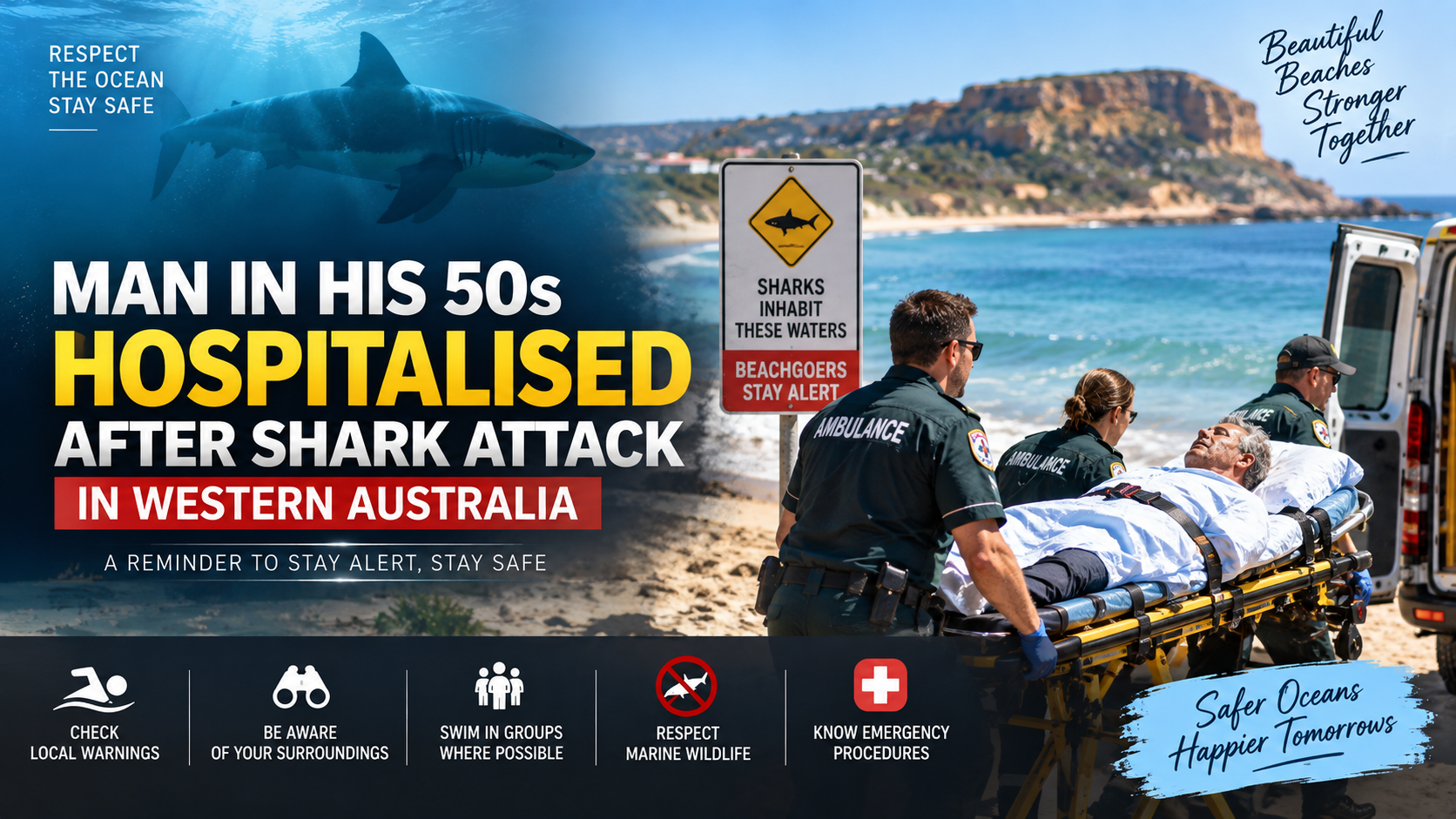
A man in his 50s has been hospitalised following a shark attack in Western Australia, bringing renewed attention to the risks faced by people using the state’s coastal waters.
Shark encounters remain relatively uncommon, but Western Australia has some of the world’s most recognised beaches and attracts swimmers, surfers, divers, fishermen and other ocean users throughout the year. The combination of a large coastline, marine wildlife and popular recreational areas means that questions about shark awareness and beach safety regularly come into focus after serious incidents.
For anyone who spends time in the ocean, an attack can be a frightening reminder that natural environments come with risks that cannot always be completely eliminated.
The incident involving the man highlights several important issues, including how people should respond when sharks are present, why emergency preparation matters, and how beachgoers can reduce their exposure to avoidable risks.
Because details surrounding individual shark incidents can change as authorities investigate, the focus of this article is on the reported hospitalisation and the broader lessons it provides for coastal safety.
What Happened in Western Australia?
A man in his 50s was hospitalised after a shark attack in Western Australia.
The incident has drawn attention because shark attacks can have serious consequences even when emergency assistance arrives quickly. Injuries resulting from an encounter with a large marine animal can require urgent medical treatment, and the circumstances of each incident can vary considerably.
Information such as the exact location, species of shark involved, extent of injuries and circumstances leading up to the encounter may be subject to official investigation and confirmation.
What remains important for the wider public is understanding that a shark sighting or attack should always be treated seriously.
Beach conditions can change rapidly, and the presence of marine wildlife is not always obvious to people entering the water.
Why Shark Attacks Attract So Much Attention
Shark attacks generate significant public interest because they involve a combination of fear, unpredictability and the ocean’s natural environment.
People can spend years swimming, surfing or fishing without seeing a shark at close range. This can create a perception that the risk is practically nonexistent.
However, marine environments are shared spaces.
Sharks are naturally present in many coastal areas, particularly those where suitable food sources and marine ecosystems exist.
An attack can therefore serve as a reminder that entering the ocean always involves some level of interaction with wildlife.
The challenge is balancing awareness with perspective.
Most people should not be afraid of the ocean, but they should respect its conditions and understand sensible safety measures.
Western Australia’s Long Coastline
Western Australia has an enormous coastline stretching across diverse marine environments.
Its beaches are popular with locals and tourists, while offshore areas attract boating, fishing, surfing, diving and other activities.
This makes the state particularly associated with ocean recreation.
At the same time, its coastal ecosystems support many species of marine life.
Sharks are a natural part of these ecosystems.
The presence of sharks does not automatically mean that a particular beach is unsafe. Instead, it reinforces the importance of paying attention to local warnings, conditions and official advice before entering the water.
What Makes a Shark Encounter Dangerous?
A shark encounter does not always result in an attack.
Sharks may pass through areas used by people without interacting with them.
The risk becomes more concerning when an animal approaches a person closely or behaves aggressively.
Certain environmental conditions can also influence where sharks are found.
Factors such as available prey, water temperature, visibility and local marine activity can affect animal behaviour.
This is why beach users should avoid assuming that a location is always completely risk-free simply because there have been no recent incidents.
The Importance of Beach Awareness
One of the most effective precautions is simply staying aware.
Before entering the water, beachgoers can check local safety information and any current warnings.
People should also pay attention to signs, flags, lifeguards and official notifications.
Technology has also made it easier for authorities to communicate information about unusual marine activity.
When a shark warning is issued, leaving the water promptly is one of the most important steps people can take.
Ignoring a warning because the water appears calm can create unnecessary risk.
Why Swimming in Groups Can Be Important
People often receive advice to avoid swimming alone in areas where shark activity is a concern.
There is a practical reason for this.
Being with other people means there are more individuals who can observe changing conditions and seek assistance if something goes wrong.
Group swimming does not eliminate the possibility of a shark encounter, but it can improve general safety and emergency response.
Parents should also pay particular attention to children near the water.
Young swimmers may not notice warning signs or understand the significance of unusual marine activity.
Avoiding Unnecessary Risk
Beach safety is not about creating fear.
It is about making sensible choices.
People can reduce avoidable exposure by following local guidance and reconsidering activities when conditions are uncertain.
For example, someone who notices a warning or unusual marine activity does not need to prove that the risk is real by entering the water anyway.
Choosing not to swim on a particular day is a small inconvenience compared with the potential consequences of a serious encounter.
What to Do If a Shark Is Spotted
If a shark is spotted near swimmers or surfers, people should remain calm and leave the water as quickly and safely as possible.
Sudden panic can make a difficult situation more dangerous.
Swimmers should follow instructions from lifeguards or authorities.
People who are still on shore should avoid entering the water to investigate.
A sighting should also be reported through the appropriate local channel where advised.
The goal is to create distance rather than attract attention or attempt to interact with the animal.
Why Emergency Response Matters
The reported hospitalisation in Western Australia also highlights the importance of emergency medical response.
After a serious injury, the first few minutes can be critical.
Beach safety therefore involves more than avoiding hazards.
It also involves having systems capable of responding when something goes wrong.
Lifeguards, emergency responders and medical professionals all play important roles in coastal safety.
Members of the public can help by knowing how to contact emergency services, following instructions and avoiding actions that could put additional people in danger.
First Aid and Severe Bleeding
Shark attacks can result in severe injuries and significant blood loss.
Basic first-aid knowledge can therefore be valuable for people who regularly participate in water-based activities.
If someone suffers a serious injury, emergency medical help should be requested immediately.
Where appropriate and within the limits of the responder’s training, controlling severe bleeding can be a priority while waiting for professional assistance.
People should follow recognised first-aid guidance and avoid attempting procedures beyond their level of training.
The key principle is simple: call for emergency help quickly and provide appropriate assistance without placing yourself in danger.
Why People Should Not Blame the Animal
After a shark attack, public conversations can quickly turn toward eliminating sharks or removing marine wildlife from an area.
However, sharks are part of the marine ecosystem.
An attack is tragic for the person involved, but the presence of sharks in the ocean is not itself an abnormal event.
Understanding this distinction can help create a more balanced conversation about coastal safety.
The objective should be reducing risk while respecting the natural environment.
Social Media and Shark Attack Reports
News of shark attacks can spread extremely quickly through social media.
Videos, photographs and unverified claims may circulate before authorities have confirmed the facts.
This can create confusion about the location, severity of injuries or type of shark involved.
People should be cautious when sharing information after an incident.
Official statements from relevant authorities and emergency organisations are generally more reliable than anonymous social media posts.
This is particularly important when an incident is still being investigated.
Why Accurate Information Matters
Shark attacks naturally generate emotional reactions.
People may respond with fear, anger or speculation.
Accurate information helps prevent those emotions from being amplified by rumours.
Details such as the exact circumstances of the incident, the person’s condition and the response of authorities should ideally come from confirmed sources.
For readers following developing stories, it is better to wait for verified updates than to treat every social media claim as fact.
What Surfers and Divers Should Remember
People who spend more time in the ocean may have different risks from occasional swimmers.
Surfers, divers, snorkellers and fishermen can spend longer periods in the water and may travel farther from shore.
They should therefore pay close attention to local conditions and warnings.
Divers in particular should understand that visibility can vary significantly underwater.
The presence of marine life is part of the environment, and being aware of surroundings is essential.
Surf communities often share local knowledge about conditions, wildlife activity and safety practices.
Listening to experienced local advice can be valuable.
The Role of Technology in Beach Safety
Modern beach safety increasingly involves technology.
Authorities can use different monitoring and communication systems to alert the public to potential hazards.
Mobile notifications, digital signage, beach information systems and other tools can help people receive warnings quickly.
However, technology should complement human judgment rather than replace it.
A warning system may not detect every shark, and conditions can change between official observations.
People still need to pay attention to their surroundings.
What Families Can Learn From the Incident
For families, the reported attack is a reminder to establish clear water-safety habits.
Parents can teach children to:
- Follow beach signs
- Listen to lifeguards
- Never ignore water warnings
- Stay close to supervised areas
- Avoid entering the ocean when conditions are unsafe
- Tell an adult immediately if they notice something unusual
These habits are useful not only for shark awareness but also for general beach safety.
Currents, waves, sudden weather changes and other hazards can also create serious risks.
The Psychological Impact of a Shark Attack
Physical injuries are only part of the story.
A serious shark encounter can also have psychological consequences.
People who survive an attack may experience fear, anxiety or hesitation about returning to the ocean.
Family members and witnesses can also be affected.
Recovery can therefore involve more than medical treatment.
Emotional support and rehabilitation may become important parts of the longer-term recovery process.
The psychological impact will vary from person to person, but serious traumatic events can have effects that continue long after physical injuries begin to heal.
Respecting the Ocean
Perhaps the biggest lesson from incidents like this is the importance of respecting the ocean.
The sea can look calm from the shore.
Yet conditions below the surface can be completely different.
Marine animals move through these waters according to natural patterns that people cannot always predict.
That does not mean people should avoid beaches.
It means beachgoers should enter the water with awareness rather than assuming that familiar surroundings automatically mean complete safety.
What Beachgoers Should Remember
A few straightforward habits can improve safety.
Check local conditions before entering the water.
Follow official warnings.
Pay attention to lifeguards.
Avoid swimming in areas where authorities have advised against it.
Leave the water when instructed.
Do not approach marine wildlife.
Do not assume that a quiet beach is automatically a risk-free beach.
And always know how to contact emergency services.
These actions may seem simple, but they are part of responsible coastal recreation.
The Broader Conversation Around Shark Safety
Every serious shark attack creates a difficult balance between public safety and environmental responsibility.
Communities naturally want to protect swimmers, surfers and other beach users.
At the same time, marine ecosystems cannot be understood solely through the lens of human recreation.
Effective shark-safety strategies therefore require informed decision-making.
Understanding patterns of marine wildlife, improving public communication and ensuring fast emergency response can all contribute to safer coastal environments.
The reported incident in Western Australia is another reminder that this conversation remains important.
Conclusion
The hospitalisation of a man in his 50s following a shark attack in Western Australia has once again focused attention on the risks associated with ocean recreation.
Shark encounters remain unusual events, but their consequences can be serious. For people who regularly swim, surf, dive or fish, awareness and preparation are therefore essential.
Beachgoers should pay attention to official warnings, follow lifeguard instructions and make sensible choices when marine activity is reported.
The incident also highlights the importance of emergency response, first-aid knowledge and reliable public information.
Most importantly, people should remember that the ocean is a natural environment shared with wildlife.
Respecting that environment does not mean avoiding it. It means understanding its risks and taking reasonable steps to reduce them.
For families and individuals planning time on Western Australia’s beaches, awareness can make the difference between an enjoyable day by the water and an avoidable emergency.
As more information about the incident becomes available through official channels, the wider lesson remains clear: enjoy the coast, respect the ocean and never ignore a safety warning.
Frequently Asked Questions
What happened in the Western Australia shark attack?
A man in his 50s was hospitalised following a shark attack in Western Australia. Further incident-specific details should be confirmed through official updates.
Are shark attacks common in Western Australia?
Shark encounters can occur in Western Australia’s coastal waters, but individual attacks are uncommon events. People should follow local warnings and beach-safety advice.
What should I do if a shark is spotted near a beach?
Follow instructions from lifeguards and local authorities and leave the water calmly and promptly when advised.
Is swimming in a group safer?
Swimming with others can improve general awareness and make it easier to seek help in an emergency, although it does not eliminate the risk of encountering marine wildlife.
Should people avoid Western Australia’s beaches after a shark attack?
Not necessarily. People should follow current official safety guidance for the specific beach or area rather than making decisions based solely on a single incident.
Why is official information important after a shark attack?
Developing incidents can generate rumours and misinformation. Official sources provide more reliable updates about the location, circumstances and response.
Can shark attacks affect survivors emotionally?
Yes. A serious encounter can be traumatic, and some survivors may experience fear or anxiety after the incident in addition to physical injuries.