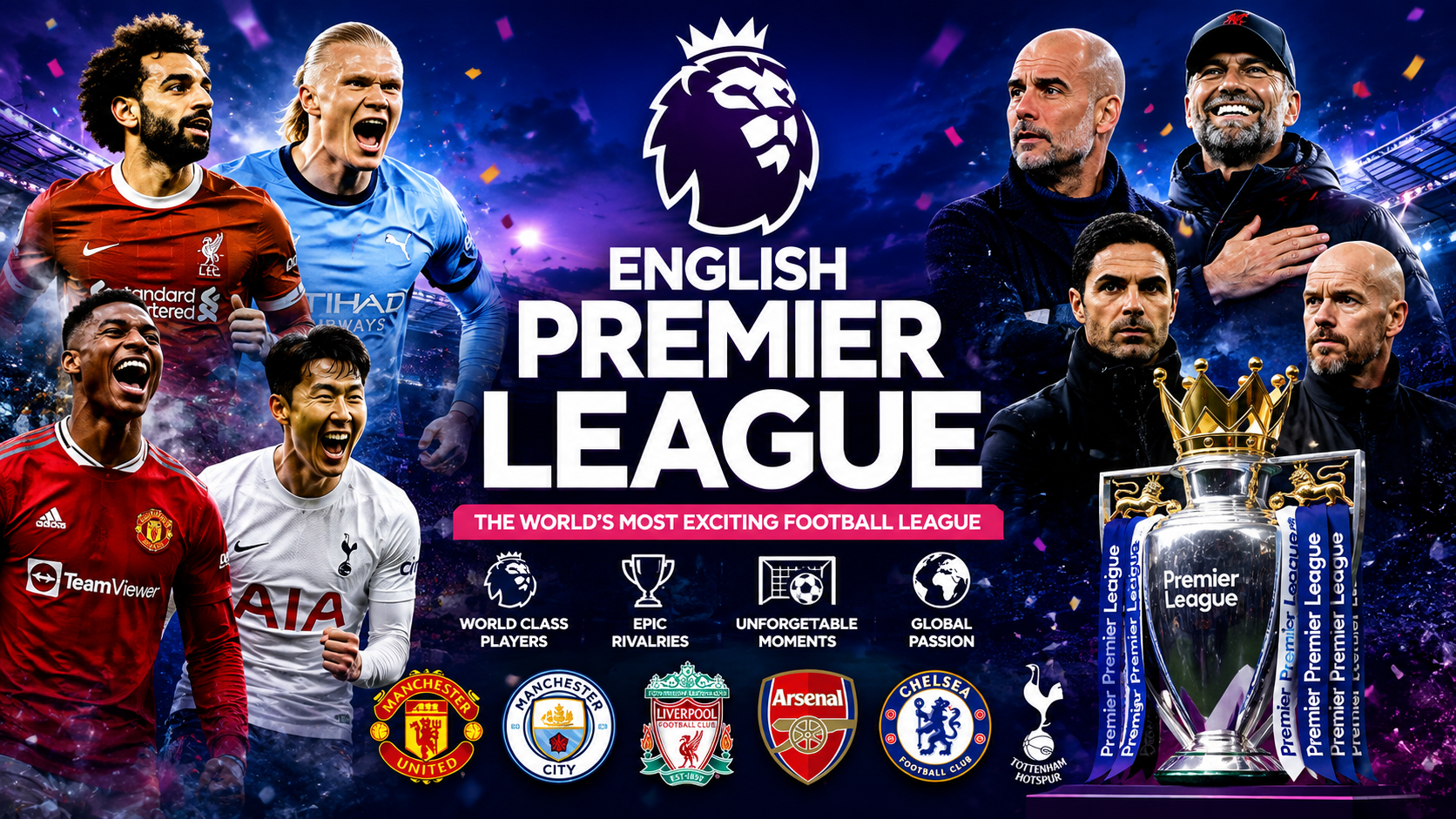
The English Premier League, commonly known as the Premier League or EPL, is one of the most watched and competitive football leagues in the world. Since its formation in 1992, the competition has transformed English football and developed into a global sporting phenomenon.
The Premier League combines some of the biggest football clubs, world-class players, famous managers, historic rivalries and passionate supporters in one competition. Matches are followed not only across England but also by millions of fans around the world.
One of the league’s biggest attractions is its unpredictability. While some clubs regularly compete for the title, every season can produce unexpected results, dramatic comebacks, surprising performances and intense battles at both ends of the table.
From the title race and European qualification to the fight against relegation, there is usually something important happening throughout the season.
What Is the English Premier League?
The English Premier League is the highest level of the English football league system.
It features 20 clubs competing against one another during a league season. Each team plays the other teams twice, once at home and once away, resulting in a total of 38 league matches for each club.
Teams receive three points for a win, one point for a draw and no points for a defeat.
At the end of the season, the team with the highest number of points is crowned Premier League champion.
The teams finishing at the bottom of the table face relegation to the EFL Championship, while successful Championship clubs can earn promotion to the Premier League.
History of the Premier League
The Premier League was established in 1992 following a major restructuring of English football.
Before the Premier League era, the top division was known as the Football League First Division.
The creation of the Premier League introduced a new commercial structure and provided clubs with greater opportunities to develop television and sponsorship revenues.
Over the decades, the competition grew dramatically.
International broadcasting helped turn Premier League matches into a global entertainment product, while clubs increasingly attracted footballers and managers from different countries.
The league gradually became more international in both its playing style and its audience.
How the Premier League Works
The Premier League operates using a straightforward points-based league system.
Each club plays 38 matches during a season.
The points system is:
- Win: 3 points
- Draw: 1 point
- Loss: 0 points
Teams are ranked according to their points total.
If teams have the same number of points, ranking can be determined using the competition’s applicable tie-breaking criteria.
The team at the top of the table after the final round of matches wins the Premier League title.
The bottom clubs face relegation, creating an additional layer of competition throughout the season.
The Premier League Title Race
The title race is one of the biggest attractions of the English Premier League.
Clubs compete throughout the season to collect as many points as possible, and the championship can sometimes remain undecided until the final matches.
A strong start can provide an advantage, but a season contains many matches, injuries, suspensions and difficult fixtures.
Teams need consistency to remain in contention.
The title race can involve traditional giants as well as clubs that have developed into major forces through strong recruitment, management and long-term planning.
Famous Premier League Clubs
Several clubs have played major roles in the history of the competition.
Manchester United
Manchester United have been one of the most successful clubs in English football history.
Their Premier League era has been strongly associated with major domestic success, iconic players and the long managerial reign of Sir Alex Ferguson.
The club’s global fanbase makes it one of the most recognised football brands in the world.
Manchester City
Manchester City have become a dominant force in modern English football.
The club’s transformation into a title contender has been associated with major investment, outstanding players and tactical development.
Under Pep Guardiola, Manchester City have become particularly known for possession-based football, positional movement and tactical control.
Liverpool
Liverpool are one of England’s most historically significant football clubs.
Their rivalry with Manchester United is one of English football’s most famous competitions.
Liverpool have also enjoyed major Premier League success, particularly during the era managed by Jürgen Klopp.
The club’s passionate supporters and historic identity have helped make it one of the world’s best-known football teams.
Arsenal
Arsenal are another major English club with a long footballing history.
Their Premier League story includes the famous unbeaten league season of 2003–04, when Arsène Wenger’s team completed the campaign without losing a match.
Arsenal’s rivalry with Tottenham Hotspur also contributes to the intensity of London football.
Chelsea
Chelsea have enjoyed significant domestic and European success during the modern era.
The club became particularly competitive in the Premier League during the 2000s and has continued to attract high-profile players and managers.
Their rivalry with other London clubs adds another dimension to the league.
Tottenham Hotspur
Tottenham Hotspur are one of England’s most recognisable clubs.
Based in North London, Tottenham share a major rivalry with Arsenal.
The North London Derby is one of the most anticipated fixtures in the Premier League calendar.
Premier League Rivalries
Rivalries are a major part of the competition’s identity.
The Manchester Derby between Manchester United and Manchester City divides the city and has become one of the most significant fixtures in English football.
The Merseyside Derby between Liverpool and Everton is another historic rivalry.
The North London Derby between Arsenal and Tottenham Hotspur is known for its passionate atmosphere.
Liverpool and Manchester United also have a long-standing rivalry that extends beyond individual matches.
These games often attract enormous international audiences because of their history, intensity and significance.
Legendary Premier League Players
The Premier League has featured some of the greatest footballers of different generations.
Players such as Thierry Henry, Alan Shearer, Wayne Rooney, Frank Lampard, Steven Gerrard, Ryan Giggs and Eric Cantona became closely associated with the competition.
More recent generations have included players such as Kevin De Bruyne, Mohamed Salah, Harry Kane and Erling Haaland.
These players have contributed goals, assists, records and memorable performances that have helped define different periods of the league.
The Importance of Managers
Managers have a major influence on Premier League clubs.
A manager is responsible for tactical planning, team selection, training, player development and match strategy.
The Premier League has attracted many famous managers from England and around the world.
Sir Alex Ferguson established one of the most successful managerial eras in English football.
Arsène Wenger influenced English football through his tactical approach, training methods and emphasis on technical football.
José Mourinho brought a highly competitive tactical philosophy to Chelsea and other Premier League clubs.
Pep Guardiola has influenced modern English football with his possession-based tactical system.
Jürgen Klopp also left a significant mark through his energetic style and high-intensity football.
Promotion and Relegation
One of the features that makes English football different from many closed sporting leagues is promotion and relegation.
The bottom three Premier League clubs are relegated to the Championship at the end of the season.
Meanwhile, Championship clubs compete for promotion to the Premier League.
Promotion can dramatically change a club’s financial situation because Premier League participation provides access to significantly greater broadcasting and commercial revenues.
For relegated clubs, returning to the Premier League can become an important long-term objective.
The Battle Against Relegation
While the title race receives enormous attention, the relegation battle can be equally dramatic.
Clubs near the bottom of the table fight to collect enough points to remain in the Premier League.
A single victory late in the season can make a major difference.
Relegation can affect club finances, player recruitment and long-term planning.
For supporters, surviving another season in the Premier League can feel like winning a trophy.
Premier League Transfers
Transfer activity is another major part of the Premier League.
Clubs regularly sign players from England and other footballing nations.
Transfer windows allow teams to strengthen their squads, replace departing players and build for future seasons.
Large transfer fees often attract global attention, but successful recruitment is not always about spending the most money.
Scouting, player development and tactical suitability can be equally important.
Some clubs have developed strong reputations for identifying young players before they become global stars.
Youth Development
Premier League clubs also invest heavily in youth development.
Academies provide young footballers with professional coaching and opportunities to develop their technical and tactical abilities.
Some of the league’s most famous players have progressed through club academy systems.
Youth development can provide clubs with talented first-team players while also creating valuable transfer opportunities.
Premier League Football Style
The English Premier League is known for its intensity and physical demands.
Matches can involve rapid transitions, pressing, counter-attacking football and strong physical competition.
However, tactical styles vary significantly between teams.
Some clubs prioritise possession and controlled buildup.
Others focus on quick counter-attacks.
Some teams use aggressive pressing to regain possession high up the pitch.
The variety of approaches makes the competition tactically interesting.
Technology in the Premier League
Technology has become increasingly important in modern football.
The Premier League uses systems such as Video Assistant Referee technology and goal-line technology to support match officials.
These technologies can help officials make decisions in situations involving goals, penalties, red cards and other major incidents.
Technology has also changed the way fans discuss matches, as controversial decisions can be analysed from multiple camera angles.
The Global Popularity of the Premier League
The Premier League has become a global sporting brand.
Matches are broadcast in countries across the world, and clubs have supporters on almost every continent.
International fans follow individual clubs, players and rivalries.
Social media has also made it easier for supporters to interact with clubs and other fans.
Premier League clubs regularly produce content for international audiences, including interviews, behind-the-scenes footage, match highlights and social media updates.
Why the Premier League Is So Popular
Several factors contribute to the league’s worldwide popularity.
First is the quality of the football.
Second is the history of the clubs.
Third is the competitive nature of the league.
Fourth is the presence of internationally recognised players.
Finally, the league has built a strong global broadcasting and commercial network.
The combination of these factors has made the Premier League one of the most valuable and influential football competitions in the world.
The Business of the Premier League
Modern Premier League football is also a major commercial industry.
Clubs generate revenue through broadcasting rights, sponsorships, ticket sales, merchandise, hospitality and commercial partnerships.
Successful clubs can build global brands that extend far beyond matchday revenue.
However, financial management remains important because clubs must operate within applicable competition and financial regulations.
Investment in players, infrastructure, coaching and youth development all forms part of modern football strategy.
What Makes Premier League Matchdays Special?
For supporters, attending a Premier League match is about more than watching 90 minutes of football.
The experience includes travelling to the stadium, meeting fellow supporters, singing club songs, seeing players enter the pitch and experiencing the atmosphere created by thousands of fans.
Historic stadiums such as Old Trafford, Anfield, Stamford Bridge, Emirates Stadium and other Premier League grounds have become important parts of football culture.
The atmosphere can change dramatically depending on the importance of the match.
The Future of the English Premier League
The Premier League continues to evolve.
Football technology, global broadcasting, player recruitment, commercial partnerships and tactical innovation will continue to influence the competition.
Young players are also becoming increasingly important as clubs look for sustainable ways to build competitive squads.
The league’s global audience is likely to remain a major part of its identity.
At the same time, maintaining competitive balance, financial sustainability and the connection between clubs and supporters will remain important challenges.
Conclusion
The English Premier League is much more than a football competition.
It is a combination of sporting history, intense rivalries, world-class players, tactical innovation, passionate supporters and global entertainment.
From Manchester and Liverpool to London and beyond, clubs compete for trophies while supporters follow every result with extraordinary passion.
The title race provides one of the biggest stories of each season, but the Premier League offers much more than the championship. European qualification, promotion, relegation, individual player performances and local rivalries all contribute to the drama.
Its combination of tradition and modern football has helped the English Premier League become one of the most recognised sports competitions worldwide.
For football fans, that is ultimately what makes the Premier League so compelling: every season brings new stories, new stars, unexpected results and unforgettable moments.
Frequently Asked Questions
What is the English Premier League?
The English Premier League is the highest division of professional football in England. It consists of 20 clubs competing in a league season.
How many matches does each Premier League team play?
Each club plays 38 league matches during a season, facing every other team twice.
How does the Premier League points system work?
A team receives three points for a win, one point for a draw and zero points for a defeat.
Which teams are relegated from the Premier League?
The three teams finishing at the bottom of the league table are relegated to the Championship, subject to the competition’s applicable rules.
What is the Premier League title?
The Premier League title is awarded to the club that finishes at the top of the league table after the complete season.
Why is the English Premier League so popular?
Its popularity comes from the quality of football, famous clubs, historic rivalries, international players, passionate supporters and global broadcasting.
Who are some famous Premier League players?
The competition has featured many famous players, including Thierry Henry, Alan Shearer, Wayne Rooney, Ryan Giggs, Frank Lampard, Steven Gerrard, Mohamed Salah, Kevin De Bruyne and others.
What are some famous Premier League rivalries?
Major rivalries include Manchester United vs Manchester City, Liverpool vs Everton, Arsenal vs Tottenham Hotspur and Liverpool vs Manchester United.
This website is proudly managed by Shunya Digit.