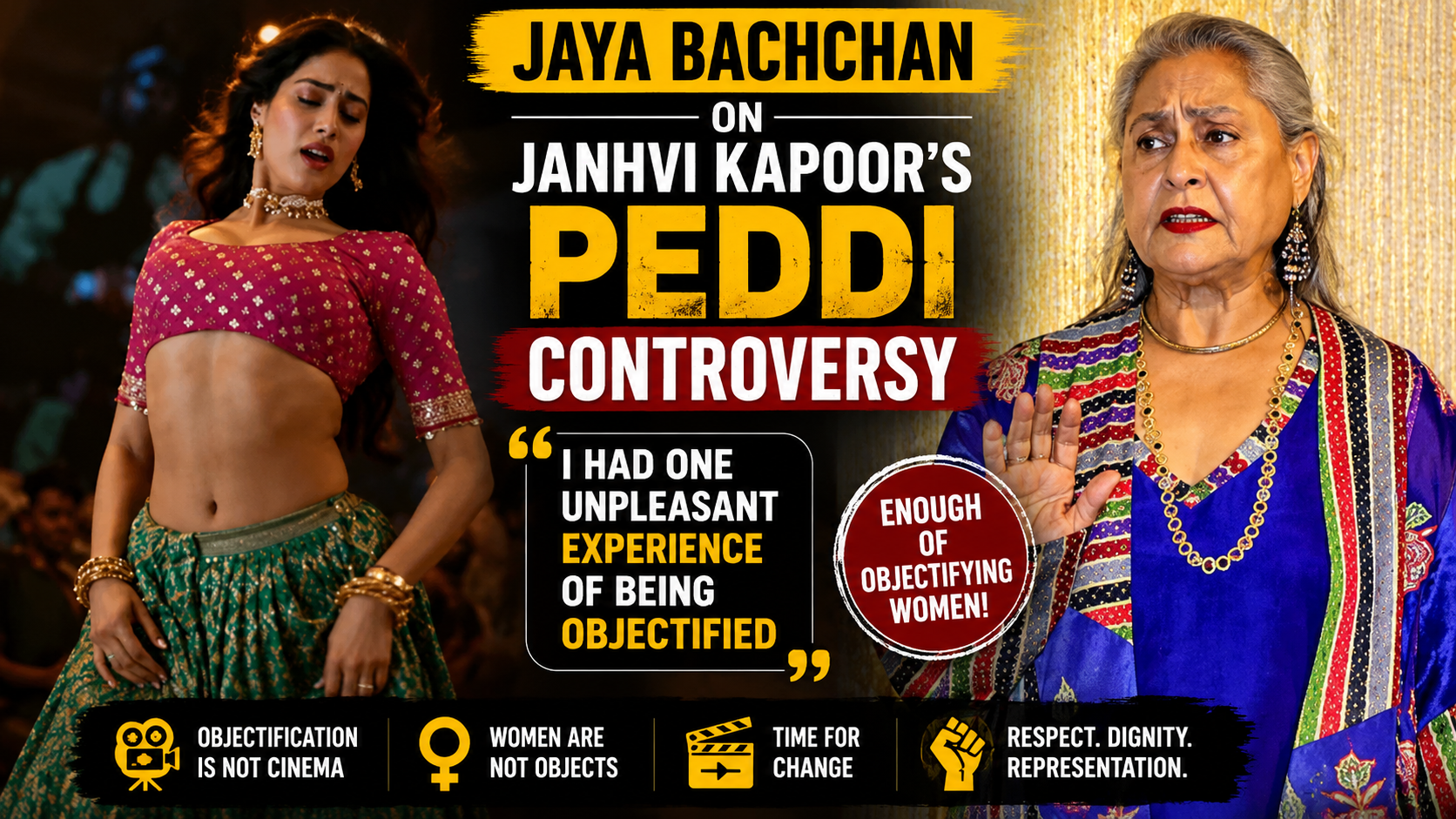
The debate around the portrayal of women in Indian cinema has once again taken center stage, and veteran actor-politician Jaya Bachchan has now added her voice to the discussion. Amid the ongoing controversy surrounding Janhvi Kapoor’s role in Peddi, Bachchan has strongly criticized the objectification of women on screen and shared a personal experience from her own film career.
The remarks come at a time when Peddi, starring Ram Charan and Janhvi Kapoor, continues to face backlash over scenes that many viewers believe reduce the female lead to a visual object rather than a fully developed character. While audiences and industry insiders have expressed concerns about the film’s depiction of women, Jaya Bachchan’s comments have given the debate a powerful new dimension.
Speaking candidly about her experiences in the film industry, Bachchan recalled a time when she felt uncomfortable with the way a director wanted to portray her on screen. Her response then—and her reaction now—highlight an issue that has remained relevant in cinema for decades.
The Controversy Surrounding Peddi
The latest controversy erupted shortly after the release of Peddi, one of the most talked-about films of the year.
While the film generated excitement due to its star cast and large-scale production, several scenes involving Janhvi Kapoor’s character, Achiyamma, quickly became the focus of criticism.
Many viewers argued that the camera repeatedly focused on specific parts of the actress’s body, including her waist, navel, and cleavage, rather than emphasizing her character’s personality, emotions, or role in the storyline.
Social media users accused the filmmakers of relying on outdated cinematic techniques that objectify women for visual appeal.
The criticism intensified when clips from the film began circulating online, prompting debates about representation, consent, and the persistent presence of the male gaze in mainstream cinema.
Jaya Bachchan Speaks Out
During an interview, Jaya Bachchan expressed disappointment over the continued objectification of women in films.
The veteran actor stated that such practices should be challenged immediately rather than accepted as a normal part of filmmaking.
According to Bachchan:
“Nobody ever dared to cross the line with me. I had only one unpleasant experience of being objectified by the director. I never worked with him again.”
Her statement quickly gained attention because of her long-standing reputation as one of Indian cinema’s most respected performers.
By sharing her own experience, Bachchan highlighted how actors can push back against situations that make them uncomfortable.
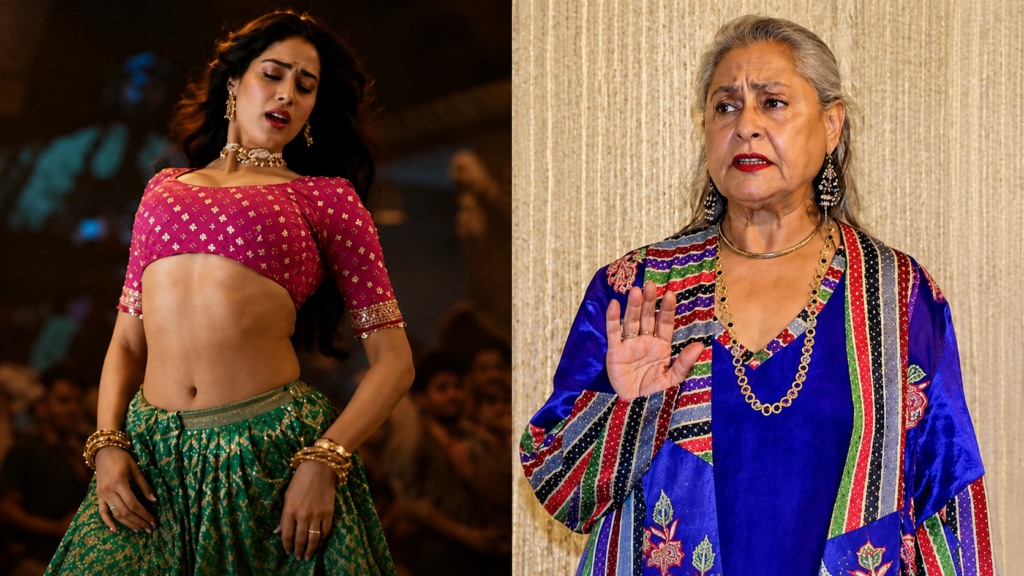
The Story Behind Jaya Bachchan’s Experience
The actor reportedly referred to an incident that occurred during the filming of Shor, directed by veteran filmmaker Manoj Kumar.
In the film, Bachchan played the role of a streetwalker.
According to reports, there was a disagreement regarding her costume.
The filmmaker allegedly wanted her to wear a ghagra-choli throughout the film without additional coverage.
However, Bachchan insisted on wearing a dupatta to cover her upper body, believing it was more appropriate for her comfort level.
The disagreement reportedly led to tension between the actor and director.
Years later, Bachchan still remembers the incident as the only time she felt objectified during her career.
More importantly, she chose not to work with that director again.
Why Her Comments Matter Today
Jaya Bachchan’s remarks resonate because they come from someone who has witnessed multiple generations of Indian cinema.
Having worked in films since the late 1960s, she has experienced the industry’s evolution firsthand.
While filmmaking styles, technology, and storytelling methods have changed significantly, debates around the portrayal of women continue to persist.
Many believe her comments highlight a larger issue:
Can cinema showcase beauty and sensuality without reducing women to physical objects?
The question has become increasingly important as audiences become more aware of representation and gender dynamics in media.
The Scene That Sparked the Biggest Backlash
One of the most criticized moments in Peddi involves a scene between Ram Charan’s and Janhvi Kapoor’s characters.
In the sequence, Ram Charan’s character kisses Achiyamma without her consent.
He later attempts to justify his actions by claiming it is his way of expressing love.
The scene has drawn criticism from audiences who argue that it romanticizes problematic behavior and sends the wrong message about consent.
Critics have pointed out that such portrayals can normalize actions that would be considered unacceptable in real-life relationships.
As discussions around consent become more prominent in society, many viewers expect filmmakers to handle such themes more responsibly.
Kareena Kapoor Khan Also Joins the Discussion
Jaya Bachchan is not the only Bollywood personality who has commented on the issue.
Actor Kareena Kapoor Khan recently shared her thoughts on sensuality and the portrayal of women in cinema.
According to Kareena, true sensuality does not depend on revealing clothing or objectification.
She cited examples from classic Bollywood films, including performances by:
- Kajol in Suraj Hua Maddham
- Sridevi in Chandni
- Sharmila Tagore in Aradhana
Kareena argued that these actresses created unforgettable screen presence without relying on excessive exposure or objectifying camera angles.
Her comments echoed the belief that women can be portrayed as attractive and powerful without reducing them to visual spectacles.
Director Issues an Apology
As criticism against Peddi intensified, director Buchi Babu Sana eventually responded.
The filmmaker apologized to viewers and promised to remove scenes that had caused concern.
He also acknowledged the criticism and stated that he would be more mindful in future projects.
However, reports suggest that some of the controversial scenes remain in theatrical versions of the film despite the apology.
This has led to additional criticism, with audiences questioning whether the promised changes have actually been implemented.
Changing Audience Expectations
The strong reaction to Peddi reflects a significant shift in audience expectations.
Modern viewers are increasingly vocal about issues such as:
- Consent
- Gender representation
- Character depth
- Respectful storytelling
- Ethical filmmaking
Social media has amplified these conversations, allowing audiences to hold filmmakers accountable in ways that were not possible in previous decades.
Many viewers now expect female characters to have agency, purpose, and meaningful story arcs rather than existing solely to support male protagonists.
Can Cinema Celebrate Sensuality Without Objectification?
At the center of the debate lies a broader cultural question.
There is a difference between portraying sensuality and objectifying a character.
Sensuality can be expressed through:
- Performance
- Dialogue
- Emotion
- Confidence
- Storytelling
Objectification, on the other hand, occurs when a character is reduced to their physical appearance.
Many critics argue that great cinema has always been capable of presenting beauty and romance without relying on exploitative visuals.
Examples from classic Indian cinema continue to be cited as proof that strong female characters can be both glamorous and respected.
Conclusion
Jaya Bachchan’s comments on the Peddi controversy have added a significant voice to an important conversation about women’s representation in cinema. By sharing her own experience of refusing to accept objectification, she has reminded audiences and filmmakers alike that respect and dignity should never be compromised for entertainment.
As the debate surrounding Janhvi Kapoor’s portrayal continues, it is becoming increasingly clear that modern audiences expect more from filmmakers. They want compelling female characters, meaningful storytelling, and portrayals that celebrate women rather than reduce them to visual objects.
Whether Peddi becomes a turning point in this discussion remains to be seen, but the conversation it has sparked is unlikely to disappear anytime soon.