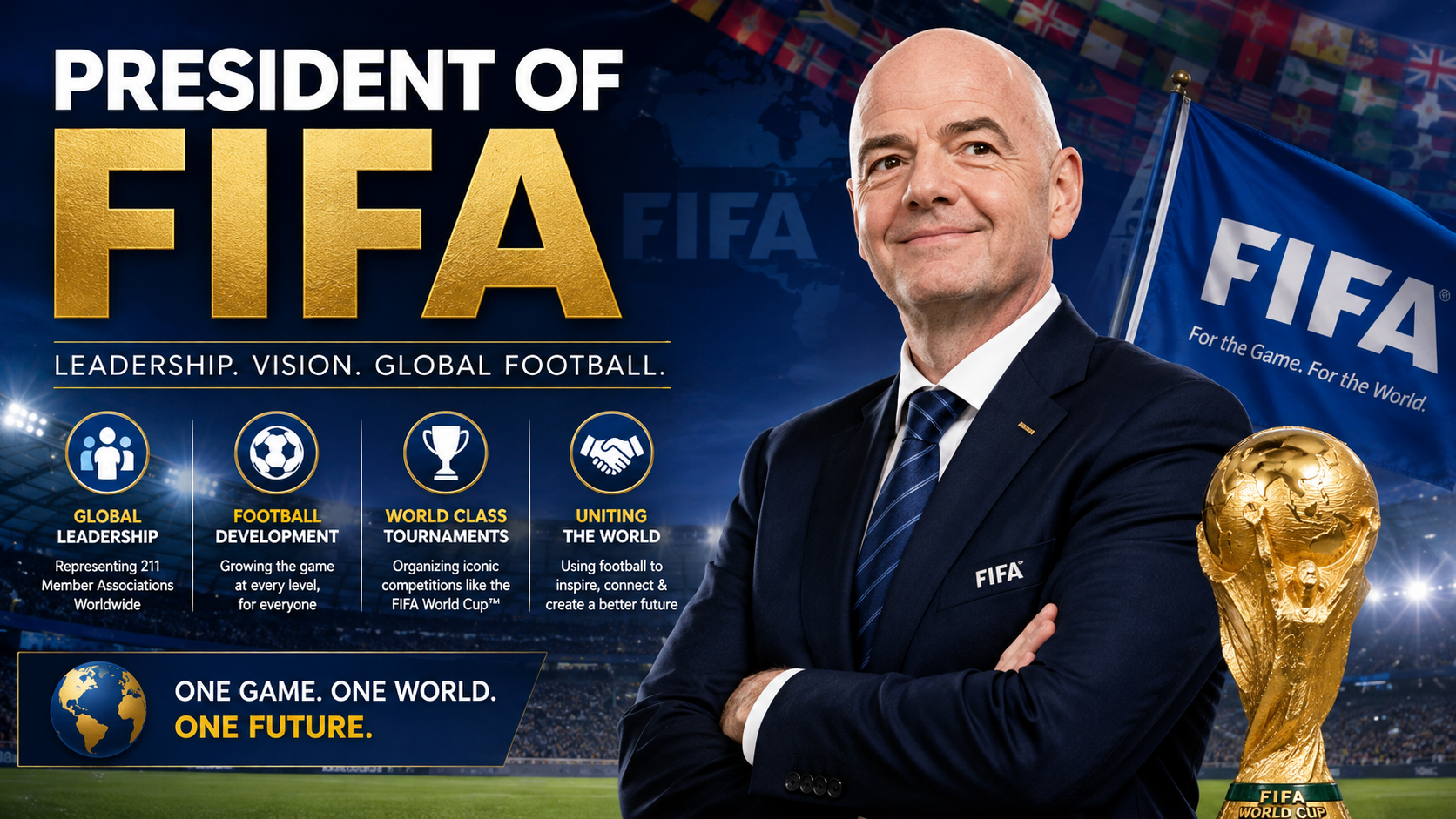
The President of FIFA is one of the most influential figures in the world of sports. As the head of the Fédération Internationale de Football Association (FIFA), the president oversees the organization responsible for governing international football, organizing the FIFA World Cup, and promoting the growth of the sport across more than 200 member associations. With football being the world’s most popular sport, the decisions made by the FIFA president can shape the future of competitions, player development, refereeing, technology, and global football policies.
FIFA represents billions of football fans worldwide and works with continental confederations, national football associations, clubs, players, sponsors, and governments. The organization’s leadership plays a crucial role in ensuring that football continues to grow while maintaining fairness, transparency, and the integrity of the game.
This guide explains the role of the President of FIFA, the responsibilities associated with the position, the history of FIFA leadership, and how the organization influences football around the globe.
What Is FIFA?
FIFA stands for the Fédération Internationale de Football Association, the international governing body for association football.
Founded in 1904, FIFA is headquartered in Zurich, Switzerland, and currently has 211 member associations.
The organization oversees:
- FIFA World Cup
- FIFA Women’s World Cup
- FIFA Club World Cup
- Youth World Cups
- Beach Soccer World Cup
- Futsal World Cup
- International football regulations
FIFA works closely with continental confederations to develop football worldwide.
Who Is the President of FIFA?
The President of FIFA serves as the organization’s highest elected official.
The president represents FIFA internationally and provides leadership for the organization’s strategic direction, governance, and development initiatives.
The position is elected by FIFA’s member associations during the FIFA Congress.
Responsibilities of the FIFA President
The President of FIFA performs numerous important duties.
These include:
- Representing FIFA globally
- Leading executive decision-making
- Promoting football development
- Supporting member associations
- Overseeing major tournaments
- Working with governments and confederations
- Strengthening women’s football
- Encouraging youth development
- Supporting fair play initiatives
- Promoting financial sustainability
The role combines sports administration with international diplomacy.
How Is the FIFA President Elected?
The FIFA President is elected during the FIFA Congress.
Each FIFA member association receives one vote regardless of the country’s football strength.
Candidates must receive support from member associations before standing for election.
Voting is conducted according to FIFA’s statutes.
History of FIFA Leadership
Since FIFA’s founding in 1904, several presidents have guided the organization through different periods of football history.
Over the decades, FIFA has overseen:
- Expansion of international tournaments
- Growth of women’s football
- Introduction of new technologies
- Increased global participation
- Commercial development
- Modern governance reforms
Each administration has contributed differently to football’s evolution.
FIFA World Cup
One of the President’s most visible responsibilities involves overseeing preparations for the FIFA World Cup.
This includes:
- Tournament planning
- Host nation coordination
- Infrastructure support
- Broadcasting agreements
- Commercial partnerships
- Competition regulations
The World Cup remains the largest football tournament in the world.
Developing Football Worldwide
FIFA invests heavily in football development.
Programs support:
- Grassroots football
- Youth academies
- Coaching education
- Referee training
- Women’s football
- Infrastructure projects
The FIFA President often promotes these initiatives during international visits.
Women’s Football
Women’s football has experienced tremendous growth.
FIFA continues supporting:
- Women’s World Cup
- Youth competitions
- Professional leagues
- Coaching opportunities
- Grassroots participation
Increasing participation remains one of FIFA’s major objectives.
Football Technology
Modern football increasingly relies on technology.
FIFA has introduced innovations including:
- Video Assistant Referee (VAR)
- Goal-line technology
- Semi-automated offside technology
- Digital match systems
These technologies aim to improve fairness and accuracy during matches.
FIFA Member Associations
FIFA consists of 211 national football associations.
These associations represent countries and territories across every continent.
The President works with member associations to:
- Support development
- Improve governance
- Organize competitions
- Expand football participation
Global cooperation is central to FIFA’s mission.
Continental Confederations
FIFA collaborates with six continental confederations:
- AFC (Asia)
- CAF (Africa)
- Concacaf (North, Central America & Caribbean)
- CONMEBOL (South America)
- OFC (Oceania)
- UEFA (Europe)
These organizations manage football within their respective regions while working alongside FIFA.
Promoting Fair Play
Fair competition remains one of FIFA’s primary objectives.
Initiatives include:
- Anti-discrimination campaigns
- Respect programs
- Match integrity
- Anti-doping efforts
- Youth education
The President frequently represents FIFA during global campaigns promoting sportsmanship.
Challenges Facing FIFA
The organization faces numerous ongoing challenges.
These include:
- Tournament expansion
- Calendar management
- Financial sustainability
- Governance improvements
- Technology adoption
- Environmental sustainability
- Global football development
Leadership requires balancing the interests of players, clubs, associations, and supporters.
Economic Impact of FIFA
Major FIFA tournaments generate significant economic activity.
Host nations often experience:
- Tourism growth
- Infrastructure investment
- Employment opportunities
- International exposure
- Business development
The President works with organizing committees to coordinate these large-scale events.
Youth Development
Young players represent football’s future.
FIFA supports:
- Youth World Cups
- Coaching programs
- Talent identification
- School football
- Community initiatives
Grassroots development remains essential for long-term success.
Global Popularity of Football
Football continues to unite billions of people worldwide.
Its popularity comes from:
- Simple rules
- Global accessibility
- Rich history
- Passionate fan culture
- International competitions
FIFA plays an important role in maintaining this global appeal.
The Future of FIFA
Football continues evolving rapidly.
Future priorities may include:
- Greater digital innovation
- Enhanced fan engagement
- Sustainable tournament planning
- Continued women’s football growth
- Expanded youth participation
- Improved governance
Strong leadership will remain essential as the sport grows.
Why the FIFA President Matters
The President of FIFA influences decisions affecting players, clubs, referees, sponsors, broadcasters, and supporters around the world.
The position extends beyond tournament management to include promoting football as a tool for education, inclusion, and international cooperation.
Because football reaches nearly every country, FIFA leadership has a significant global impact.
Final Thoughts
The President of FIFA holds one of the most important leadership positions in international sport. From overseeing the FIFA World Cup and supporting football development to encouraging innovation and strengthening governance, the role shapes the future of the world’s most popular game.
As football continues expanding across every continent, FIFA’s leadership will remain central to promoting fair competition, supporting member associations, and inspiring future generations of players and fans. Understanding the responsibilities of the FIFA President provides valuable insight into how international football is organized and why FIFA remains one of the most influential sporting organizations in the world.
Stay connected with Inetfreak for the latest updates on football, FIFA tournaments, sports technology, international competitions, and global sports news.
Frequently Asked Questions (FAQs)
Who is the President of FIFA?
The FIFA President is the elected head of the Fédération Internationale de Football Association and leads the organization’s global football governance.
What does the FIFA President do?
The President oversees FIFA’s strategic direction, represents the organization internationally, supports football development, and helps guide major competitions such as the FIFA World Cup.
How is the FIFA President elected?
The President is elected by FIFA’s member associations during the FIFA Congress, with each association having one vote.
What is FIFA responsible for?
FIFA governs international football, organizes global tournaments, establishes regulations, and supports football development through its member associations.
Where is FIFA headquartered?
FIFA’s headquarters are located in Zurich, Switzerland.
This website is proudly managed by Shunya Digit.