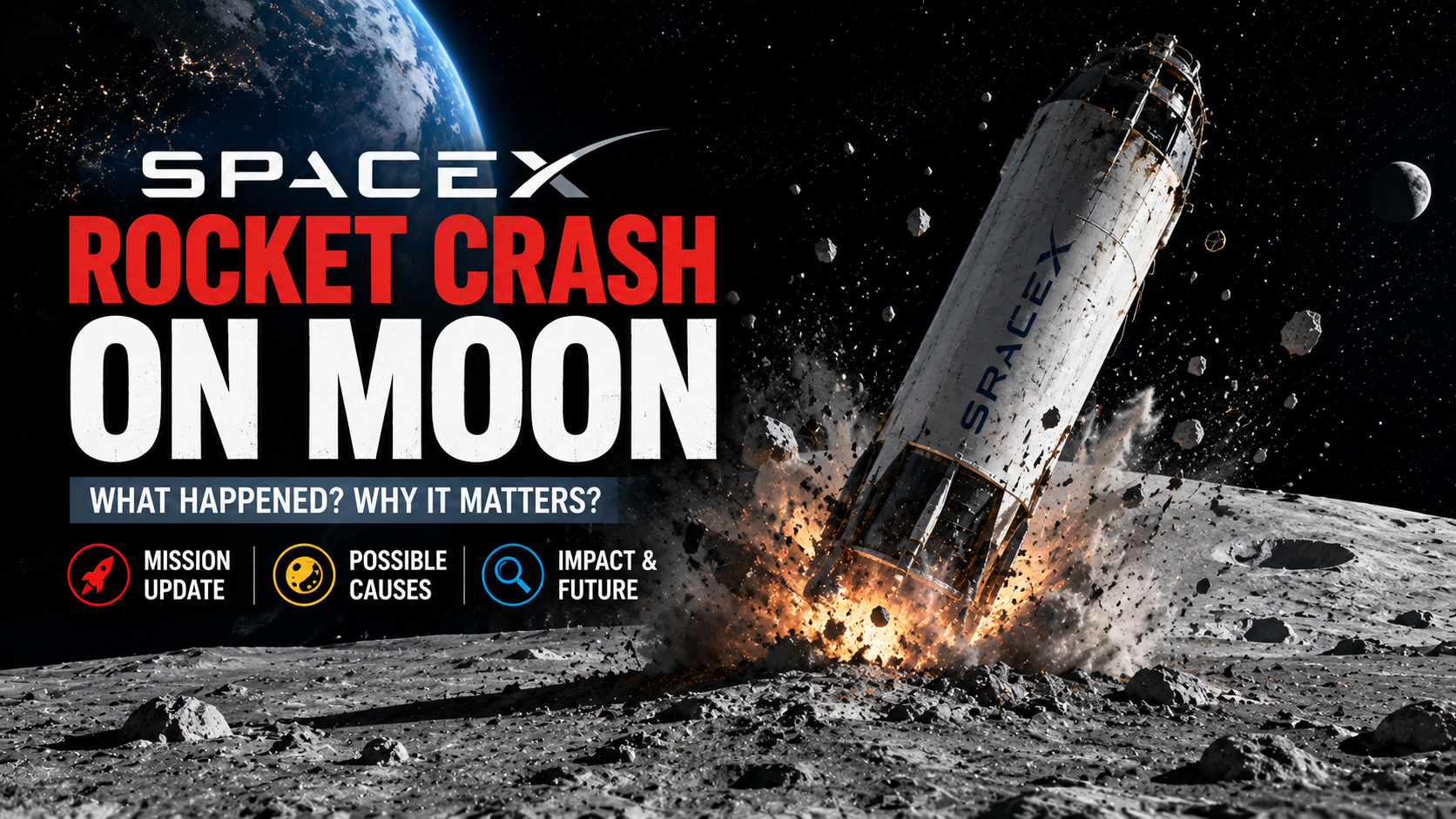
The phrase SpaceX Rocket Crash Moon has generated significant interest among space enthusiasts and technology followers. Reports involving rockets impacting the Moon often create widespread discussion, particularly when SpaceX is mentioned. However, understanding these events requires separating confirmed facts from speculation and examining how modern space missions operate.
The Moon has become an increasingly important destination for scientific exploration. Governments and private space companies are investing billions of dollars in lunar missions designed to study the Moon, test new technologies, and prepare for future human exploration. During this process, spacecraft, rocket stages, and lunar landers occasionally experience mission failures or controlled impacts that become major news stories.
This article explores what people mean when they search for SpaceX Rocket Crash Moon, how lunar missions work, why spacecraft sometimes impact the Moon, and what these events mean for the future of space exploration.
Why Is “SpaceX Rocket Crash Moon” Trending?
Interest in the topic often increases whenever news reports mention:
Rocket debris.
Lunar impacts.
Failed moon landings.
SpaceX missions.
NASA partnerships.
Deep-space launches.
Many readers want to understand whether the event involved a mission failure, a planned impact, or an unrelated piece of space hardware.
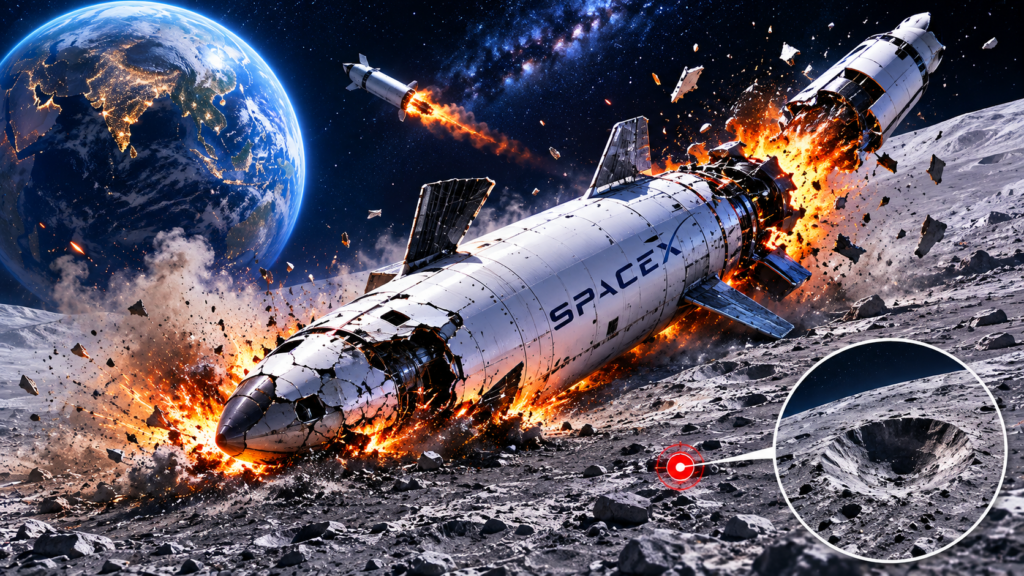
How Space Missions Reach the Moon
Reaching the Moon requires several carefully planned stages.
These include:
Rocket launch.
Earth orbit.
Trans-lunar injection.
Cruise phase.
Lunar orbit.
Landing or flyby.
Each phase involves extremely precise calculations.
Even minor technical issues can affect mission outcomes.
What Happens to Rocket Stages?
After launching spacecraft into space, rockets separate into multiple stages.
Depending on the mission, spent stages may:
Re-enter Earth’s atmosphere.
Remain in Earth orbit.
Travel into deep space.
Perform controlled disposal maneuvers.
Occasionally, inactive rocket stages may eventually collide with celestial bodies if their trajectories evolve over time.
Planned Lunar Impacts
Not every Moon impact is considered a failure.
Scientists have intentionally crashed spacecraft into the lunar surface to:
Study impact craters.
Analyze lunar dust.
Measure underground materials.
Support scientific experiments.
Collect seismic data.
These controlled impacts have contributed valuable scientific knowledge.
SpaceX and Lunar Exploration
SpaceX plays a major role in modern space exploration.
The company develops advanced launch systems used for:
Satellite deployment.
Cargo missions.
Crewed spaceflight.
NASA partnerships.
Lunar exploration support.
Future Mars missions.
SpaceX continues working with NASA and commercial partners on projects involving the Artemis program and future lunar missions.
Why Spacecraft Sometimes Crash
Space missions are among the most complex engineering projects ever attempted.
Potential challenges include:
Engine malfunctions.
Communication problems.
Navigation errors.
Software issues.
Fuel limitations.
Mechanical failures.
Extreme environmental conditions.
Even highly successful space agencies occasionally experience mission setbacks.
The Importance of the Moon
The Moon has become a major focus for international exploration.
Scientists study the Moon to better understand:
Planetary formation.
Early solar system history.
Surface geology.
Water ice deposits.
Future human habitats.
The Moon also serves as a stepping stone for deeper space exploration.
How Scientists Track Space Objects
Space agencies monitor thousands of objects using:
Ground-based telescopes.
Radar systems.
Satellite tracking.
Computer simulations.
Optical observations.
These technologies help predict spacecraft trajectories and orbital behavior.
Lessons from Mission Failures
Every unsuccessful mission provides valuable engineering data.
Engineers analyze:
Flight telemetry.
Navigation systems.
Software performance.
Hardware reliability.
Communication records.
These lessons improve future spacecraft.
NASA and Commercial Partnerships
Modern space exploration increasingly relies on cooperation between government agencies and private companies.
Partnerships support:
Technology development.
Launch services.
Scientific research.
Lunar transportation.
Astronaut missions.
Commercial innovation has accelerated space exploration significantly.
The Artemis Program
NASA’s Artemis program aims to return astronauts to the Moon while preparing for future missions to Mars.
Key objectives include:
Human lunar landings.
Lunar science.
Surface exploration.
International cooperation.
Long-term lunar infrastructure.
Commercial launch providers play an important role in supporting these missions.
Challenges of Lunar Exploration
Operating on the Moon presents unique difficulties.
Engineers must consider:
Extreme temperatures.
Vacuum conditions.
Radiation exposure.
Communication delays.
Landing precision.
Dust management.
Every successful mission requires years of planning.
Advances in Rocket Technology
Modern launch vehicles continue becoming more capable.
Recent innovations include:
Reusable rockets.
Advanced propulsion.
Autonomous landing systems.
Improved navigation.
AI-assisted mission planning.
These technologies reduce launch costs while increasing mission reliability.
The Future of Moon Missions
Over the next decade, lunar exploration is expected to expand dramatically.
Planned activities include:
Scientific research.
Robotic exploration.
Commercial payload delivery.
Astronaut missions.
Technology demonstrations.
International cooperation.
Private companies will continue playing an increasingly important role.
Why Accurate Information Matters
Space-related news often spreads quickly online.
Early reports may contain incomplete or inaccurate information.
Readers should rely on verified updates from:
NASA.
SpaceX.
National space agencies.
Official mission teams.
Trusted scientific organizations.
Accurate reporting helps distinguish confirmed facts from speculation.
Public Interest in Space Exploration
Space exploration continues inspiring millions of people worldwide.
New missions encourage interest in:
Science.
Engineering.
Astronomy.
Technology.
Education.
Innovation.
Events involving the Moon frequently become global news because of their scientific significance.
Final Thoughts
The growing interest in SpaceX Rocket Crash Moon reflects the public’s fascination with space exploration and lunar missions. While spacecraft impacts may sound dramatic, they can result from planned scientific objectives, the natural evolution of inactive rocket stages, or unexpected technical challenges. Each mission—whether completely successful or not—adds valuable knowledge that helps engineers improve future exploration efforts.
As NASA, SpaceX, and international partners continue preparing for a new era of lunar exploration, the Moon will remain at the center of scientific discovery and technological innovation. Understanding how these missions work allows us to appreciate both the complexity and the remarkable achievements of modern spaceflight.
Stay connected with Inetfreak for the latest updates on SpaceX, NASA, space exploration, rocket launches, astronomy, AI technology, and global science news.
Frequently Asked Questions (FAQs)
What does “SpaceX Rocket Crash Moon” mean?
It generally refers to reports about a spacecraft, rocket stage, or lunar mission associated with SpaceX or other organizations impacting the Moon. The specific circumstances depend on the event being discussed.
Are all Moon impacts accidental?
No. Some spacecraft are intentionally directed to impact the Moon for scientific research after completing their primary missions.
Why do spacecraft sometimes fail during lunar missions?
Lunar missions involve complex engineering challenges, including navigation, propulsion, communications, and landing precision. Technical issues can sometimes affect mission success.
Is SpaceX involved in Moon exploration?
Yes. SpaceX supports multiple lunar initiatives through launch services, NASA partnerships, and the development of spacecraft intended for future Moon missions.
Why is lunar exploration important?
The Moon helps scientists study planetary history, test new technologies, search for valuable resources, and prepare for future human missions to Mars and beyond.
This website is proudly managed by Shunya Digit.