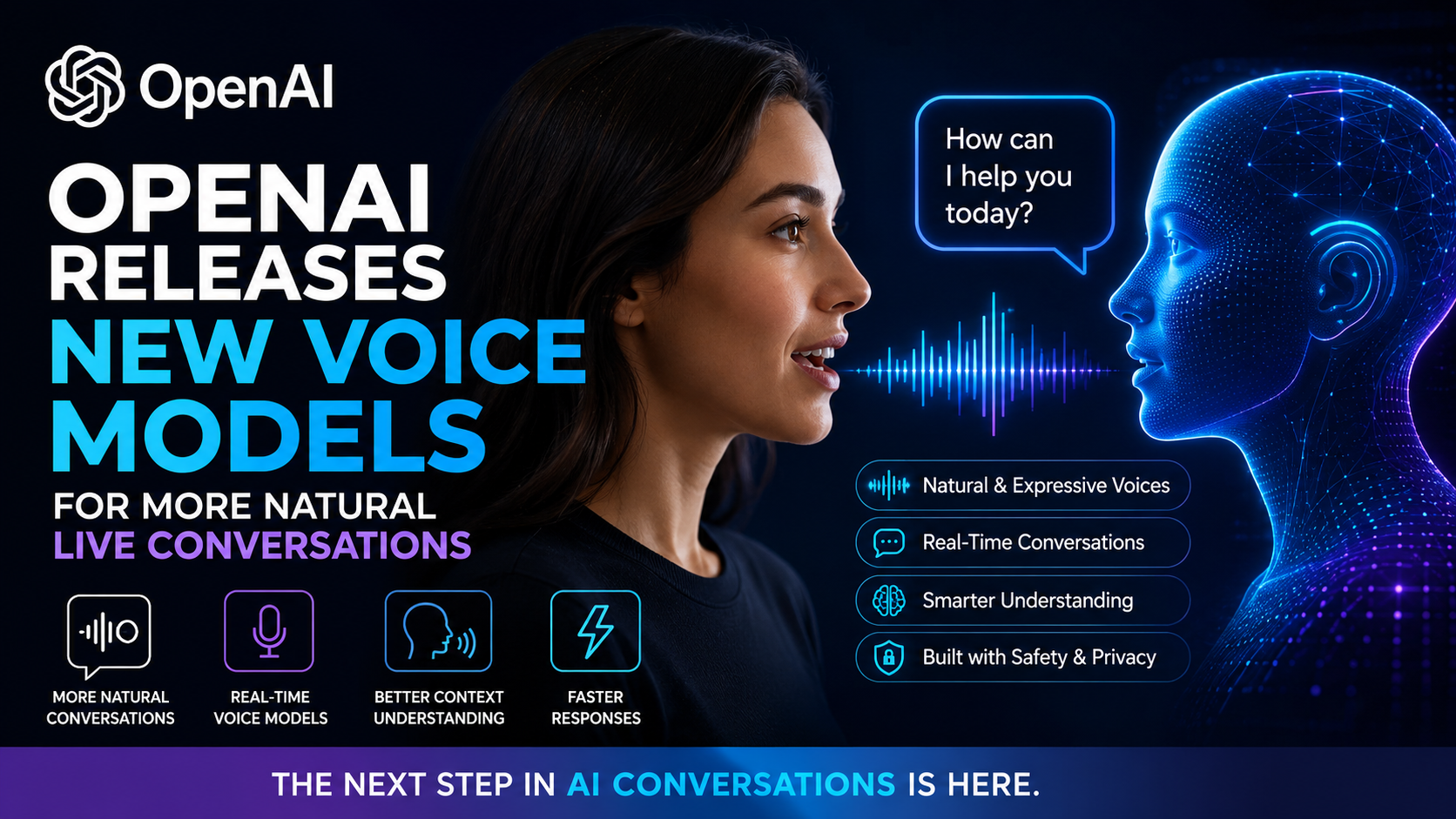
Artificial Intelligence is rapidly transforming the way humans communicate with technology. From text-based chatbots to AI-powered virtual assistants, the next major frontier is voice AI—systems capable of understanding, responding, and conversing with humans in real time.
OpenAI has now taken another significant step toward that future by introducing new voice models designed to make live conversations with AI feel more natural, expressive, and human-like. The announcement reflects the company’s broader vision of enabling developers to build voice agents that can interact seamlessly with users across customer support, education, healthcare, entertainment, and countless other industries.
Unlike traditional speech recognition systems that simply convert spoken words into text, these new models are built to understand tone, pacing, emotion, interruptions, and conversational context, resulting in smoother and more engaging interactions.
In this article, we explore everything you need to know about OpenAI’s latest voice models, how they work, their key features, potential applications, benefits, challenges, and what they mean for the future of AI-powered conversations.
What Are OpenAI’s New Voice Models?
OpenAI’s latest voice models are advanced AI systems designed to support real-time spoken conversations between humans and machines. These models integrate speech recognition, natural language understanding, and speech generation into a more unified experience.
Instead of treating conversation as separate steps—listening, transcribing, generating text, and then converting it back into speech—the new models are optimized for fluid interaction, helping reduce delays and making conversations feel more natural.
Developers can use these models to create AI applications that understand spoken language, respond conversationally, and generate expressive speech in real time.
Why Voice AI Matters
Voice is one of the most natural forms of human communication. While typing remains effective, speaking is often faster, more intuitive, and more accessible.
Voice AI has become increasingly important because it enables:
- Hands-free interaction
- Faster communication
- Better accessibility
- More natural user experiences
- Improved customer engagement
As AI becomes more capable, voice interactions are expected to become a primary way people communicate with digital assistants.
Key Features of OpenAI’s New Voice Models
OpenAI’s latest models introduce several improvements aimed at making AI conversations more realistic and useful.
1. More Natural Conversations
One of the biggest improvements is conversational flow.
Instead of waiting for users to completely finish speaking before responding, the models are designed to handle interactions more smoothly, making conversations feel closer to human dialogue.
This creates a more engaging experience during live interactions.
2. Improved Speech Recognition
The new models are better at understanding spoken language across different speaking styles.
They can process:
- Fast speech
- Slow speech
- Different accents
- Background noise
- Natural pauses
This makes them more reliable in real-world environments.
3. Expressive Voice Generation
AI-generated voices have improved significantly in recent years.
OpenAI’s new models focus on creating speech that sounds more expressive by incorporating:
- Natural pacing
- Better intonation
- More realistic rhythm
- Appropriate emphasis
The result is speech that feels less robotic and easier to listen to.
4. Faster Response Times
Latency plays a major role in voice interactions.
If an AI takes too long to respond, conversations feel unnatural.
The new models are optimized to reduce delays, helping maintain conversational momentum during live exchanges.
5. Better Context Awareness
One challenge for voice assistants has always been maintaining context.
OpenAI’s models can better understand ongoing conversations by remembering previous exchanges and using them to generate more relevant responses.
This allows for longer, more coherent discussions.
How Do These Voice Models Work?
Modern voice AI combines several technologies:
Automatic Speech Recognition (ASR)
Converts spoken language into text.
Large Language Models (LLMs)
Interpret user intent and generate appropriate responses.
Text-to-Speech (TTS)
Transforms AI-generated text back into spoken language.
OpenAI’s newer approach aims to streamline these components to produce faster and more natural conversations.
Real-World Applications
The possibilities for advanced voice AI are extensive.
Customer Support
Businesses can deploy AI voice agents capable of:
- Answering questions
- Resolving common issues
- Scheduling appointments
- Processing requests
This can improve response times while allowing human agents to focus on more complex tasks.
Education
Voice AI can serve as an interactive tutor by:
- Explaining concepts
- Answering questions
- Practicing language skills
- Providing personalized learning experiences
Students can engage in conversational learning rather than relying solely on text.
Healthcare
Healthcare organizations may use voice AI to assist with:
- Appointment scheduling
- Medication reminders
- Patient education
- Symptom guidance
Such systems can help improve accessibility while supporting healthcare professionals.
Accessibility
Voice technology is particularly valuable for individuals with disabilities.
Advanced AI voices can make digital services more accessible for users who have difficulty typing or reading.
Smart Home Integration
Voice assistants continue to play an important role in connected homes.
Users can control:
- Lights
- Thermostats
- Security systems
- Entertainment devices
More natural conversations improve the overall smart home experience.
Benefits for Developers
OpenAI’s latest voice models provide developers with new tools for building conversational applications.
Potential advantages include:
- Faster implementation
- Improved voice quality
- Better conversation flow
- Reduced latency
- Enhanced multilingual capabilities
These improvements allow developers to create more engaging user experiences.
Enterprise Opportunities
Businesses across industries are exploring voice AI.
Potential use cases include:
- Banking
- Insurance
- Retail
- Hospitality
- Logistics
- Telecommunications
AI voice agents can assist customers around the clock while handling repetitive inquiries efficiently.
Multilingual Communication
Modern AI increasingly supports multiple languages.
Voice models capable of understanding and generating speech across languages can help organizations communicate with global audiences more effectively.
This has significant implications for international businesses and education platforms.
The Future of AI Assistants
The evolution of voice models points toward AI assistants that feel more conversational and capable.
Future systems may be able to:
- Maintain long-term conversational context
- Adapt speaking styles to user preferences
- Handle complex multi-step tasks
- Collaborate across devices
- Provide richer multimodal experiences
As hardware and AI models continue advancing, voice interactions are expected to become even more seamless.
Privacy and Security Considerations
As voice AI becomes more widespread, privacy remains an important consideration.
Organizations using voice AI should implement appropriate safeguards to protect user data and comply with relevant regulations.
Users should also understand how voice recordings and transcripts are handled within the applications they use.
Challenges of Voice AI
Despite rapid progress, voice AI still faces several challenges.
These include:
- Background noise
- Strong regional accents
- Domain-specific terminology
- Emotional nuance
- Low-bandwidth environments
Continued research aims to improve performance across these scenarios.
Voice AI vs Traditional Voice Assistants
Earlier voice assistants primarily focused on executing commands such as setting alarms or checking the weather.
New conversational models go much further by enabling:
- Dynamic dialogue
- Context retention
- Complex reasoning
- Interactive problem-solving
This represents a major shift from command-based systems to conversational AI.
Industries Poised to Benefit
Several sectors are likely to see significant adoption of advanced voice models:
Customer Service
AI agents handling routine inquiries.
Education
Interactive tutoring and language learning.
Healthcare
Patient engagement and administrative support.
Retail
Shopping assistance and personalized recommendations.
Travel
Booking support and itinerary management.
Automotive
Hands-free in-car assistance.
How This Fits Into OpenAI’s Broader Vision
The release of new voice models aligns with OpenAI’s broader mission of making AI more useful and accessible.
By improving conversational capabilities, OpenAI aims to help developers create applications that are more intuitive and better suited to real-world interactions.
Voice is expected to play an increasingly important role alongside text, images, and other forms of AI-powered communication.
What It Means for Users
For everyday users, improved voice AI could lead to:
- Faster customer support
- Better virtual assistants
- More natural conversations
- Enhanced accessibility
- Smarter educational tools
These improvements may make interacting with AI feel increasingly similar to speaking with another person.
Final Thoughts
OpenAI’s new voice models represent an important milestone in the evolution of conversational AI. By focusing on more natural dialogue, expressive speech, lower latency, and improved context awareness, these models have the potential to reshape how people interact with digital services across industries.
From customer support and education to healthcare and smart devices, the ability to engage in fluid spoken conversations with AI opens new possibilities for developers and businesses alike. While challenges such as privacy, security, and performance in complex environments remain important considerations, the pace of innovation suggests that voice AI will continue becoming more capable and more widely adopted.
As artificial intelligence evolves beyond text-based interactions, voice is poised to become one of the most intuitive ways humans communicate with machines. OpenAI’s latest announcement marks another significant step toward that future.
Stay connected with Inetfreak for the latest AI news, OpenAI updates, technology trends, cybersecurity insights, gadget launches, software innovations, and everything shaping the future of digital technology.
Frequently Asked Questions (FAQs)
What are OpenAI’s new voice models?
They are AI models designed to support more natural, real-time spoken conversations with improved speech recognition, expressive voice generation, and conversational context.
Who can use these models?
Developers can integrate them into applications for customer support, education, healthcare, accessibility, productivity, and other conversational AI experiences.
What are the benefits of advanced voice AI?
Benefits include more natural conversations, faster responses, improved accessibility, better user engagement, and broader real-world applications.
Can these models support multiple languages?
Support depends on the specific model and implementation, but OpenAI continues expanding multilingual capabilities across its AI offerings.
Why are these voice models significant?
They represent an important advancement toward AI systems capable of handling real-time conversations in a more human-like and efficient manner.
This website is proudly managed and maintained by Shunya Digit.