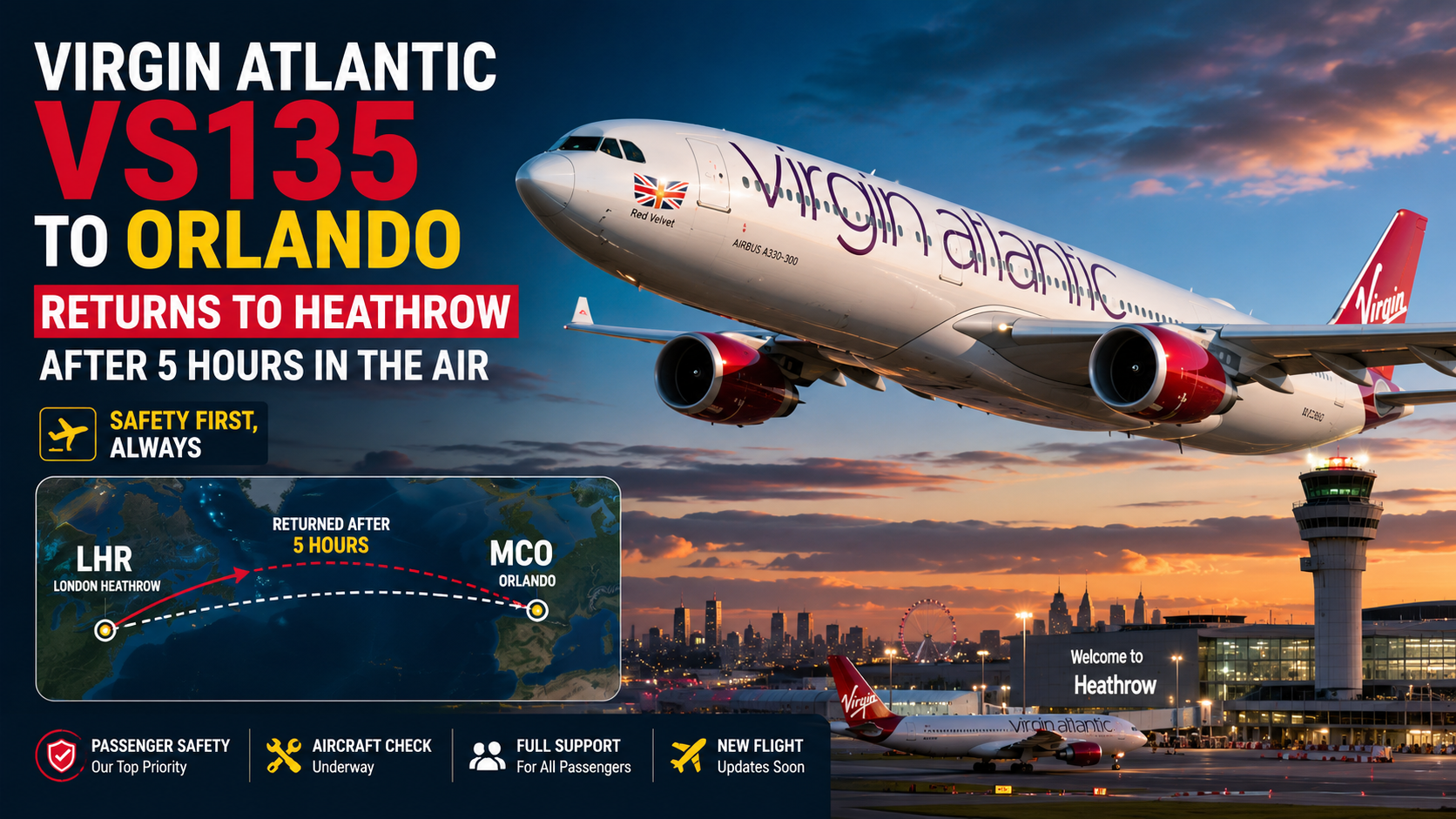
Virgin Atlantic VS135 has become one of the most talked-about flights in recent aviation news after unexpectedly returning to London Heathrow Airport (LHR) while en route to Orlando International Airport (MCO). Air travel is one of the safest forms of transportation in the world, but even the most carefully planned flights can occasionally face unexpected situations that require changes to their journey. This particular incident caught the attention of travelers and aviation enthusiasts worldwide when Virgin Atlantic Flight VS135 turned around and returned to Heathrow after spending nearly five hours in the air. The unusual mid-flight return sparked widespread discussion across social media and flight-tracking platforms, leaving many people wondering what prompted the aircraft to reverse course instead of continuing to its destination.
The unusual flight path quickly became a talking point across social media, with flight tracking websites showing the aircraft making a lengthy journey over the Atlantic before reversing course back to the United Kingdom. Passengers, aviation experts, and frequent travelers immediately began asking why an aircraft would fly for several hours only to return to its departure airport instead of diverting to another destination.
Although airline operations are carefully managed and such events are uncommon, they are not unprecedented. Modern aviation prioritizes passenger safety above all else, and airlines have detailed procedures for handling unexpected technical issues, medical emergencies, weather disruptions, and operational concerns.
This article explains what happened, why aircraft sometimes return to their departure airport, how pilots make these decisions, and what passengers can expect in situations like this.
What Is Virgin Atlantic Flight VS135?
Virgin Atlantic VS135 is a scheduled long-haul service connecting London Heathrow with Orlando, Florida, one of the airline’s busiest leisure routes.
The service is particularly popular among:
- Families visiting Walt Disney World Resort
- Universal Orlando visitors
- Holiday travelers
- Business passengers
- Cruise passengers connecting through Florida
Because Orlando remains one of the most popular destinations for UK travelers, flights on this route often operate with high passenger loads, especially during holiday seasons.
What Happened to Virgin Atlantic VS135?
According to publicly available flight tracking information, Virgin Atlantic Flight VS135 departed London Heathrow as scheduled before beginning its westbound journey across the Atlantic Ocean.
After approximately five hours of flight, however, the aircraft reversed course and headed back toward Heathrow rather than continuing to Orlando.
The aircraft landed safely back in London, where airline teams and engineering staff were able to inspect the aircraft.
At the time of reporting, the airline’s official updates should be consulted for the most accurate information regarding the specific reason for the return.
Why Would an Aircraft Return After Several Hours?
Many passengers assume that if a problem develops over the Atlantic, the nearest airport would automatically become the preferred landing location.
In reality, airline operations are far more complex.
Pilots evaluate numerous factors before deciding where to land.
These include:
- Aircraft condition
- Fuel remaining
- Weather
- Airport facilities
- Maintenance availability
- Passenger safety
- Crew duty limitations
- Emergency response capabilities
Returning to the departure airport may sometimes be the safest and most practical decision.
Possible Reasons for Returning
Airlines generally do not speculate publicly until engineers complete inspections.
However, aircraft may return for several operational reasons.
Technical Precaution
Modern aircraft contain thousands of sensors.
If one system reports an unexpected indication, pilots may choose to return even if the aircraft remains fully controllable.
This reflects aviation’s emphasis on preventive safety rather than reacting after a problem worsens.
Maintenance Availability
Major airline hubs such as Heathrow have extensive engineering support.
Returning allows airline technicians with specialized equipment and spare parts to inspect the aircraft more efficiently.
Operational Considerations
Long-haul flights require careful planning.
Continuing across the Atlantic with an unresolved technical indication may not always be appropriate.
Returning early can minimize additional operational complications.
Passenger Comfort
Although returning is inconvenient, it may ultimately reduce delays if repairs can be completed at the airline’s primary maintenance base.
Aviation Safety Always Comes First
One of the most important points for passengers to understand is that modern aviation places safety ahead of schedules.
Pilots receive extensive simulator training covering countless emergency scenarios.
Airlines encourage flight crews to make conservative decisions whenever uncertainty exists.
Even relatively minor technical indications may justify returning if further investigation is needed.
Modern Aircraft Are Extremely Reliable
Incidents like this sometimes generate concern online, but they should also highlight how carefully aircraft are monitored.
Modern commercial aircraft continuously report system information throughout the flight.
Pilots receive alerts regarding:
- Hydraulic systems
- Electrical systems
- Fuel management
- Flight controls
- Engines
- Pressurization
- Navigation equipment
Many alerts are precautionary rather than indicating immediate danger.
Why Not Continue to Orlando?
Passengers often wonder why an aircraft would turn around after already flying several hours.
The answer depends on operational risk assessment.
If engineers are better equipped at Heathrow and the aircraft remains capable of returning safely, that option may provide the best overall outcome.
Every situation is unique.
There is no universal rule requiring aircraft to continue or divert.
Could the Aircraft Have Diverted Elsewhere?
Depending on the aircraft’s location, alternative airports might include facilities in:
- Ireland
- Iceland
- Canada
- Greenland
- Other Atlantic diversion airports
However, diversion decisions depend on numerous operational considerations rather than simple geographic distance.
What Happens After Landing?
Once the aircraft returns, several processes begin immediately.
Engineering Inspection
Maintenance teams inspect the aircraft to identify the issue.
Diagnostic systems help engineers locate potential faults.
Passenger Assistance
Airlines typically assist passengers by:
- Providing updated travel information
- Arranging replacement flights where possible
- Offering accommodation when necessary
- Providing meals or refreshments depending on circumstances and applicable regulations
Crew Planning
Flight and cabin crews must also comply with regulated duty time limits before operating another flight.
Passenger Rights
Passengers affected by significant delays or cancellations may have rights depending on the applicable regulations and the circumstances behind the disruption.
Eligibility can vary based on factors such as:
- Cause of the disruption
- Departure airport
- Destination
- Airline
- Length of delay
Passengers should consult the airline directly or review relevant passenger rights guidance for their specific situation.
The Role of Flight Tracking Websites
Services such as FlightRadar24 and FlightAware allow aviation enthusiasts to monitor flights worldwide.
When unusual flight paths appear, they often generate considerable online discussion.
While these platforms provide excellent tracking information, they generally do not explain the operational reasons behind airline decisions.
Official airline statements remain the most reliable source of information.
How Pilots Make These Decisions
Commercial airline pilots work closely with:
- Airline operations centers
- Maintenance control
- Dispatch teams
- Air traffic control
Together they evaluate available information before deciding whether to continue, divert, or return.
These decisions are based on established safety procedures rather than convenience.
ETOPS and Long-Haul Flights
Flights crossing oceans operate under regulations known as ETOPS (Extended-range Twin-engine Operational Performance Standards).
These rules govern how twin-engine aircraft operate over remote areas while ensuring suitable diversion airports remain available.
ETOPS planning is one reason long-haul flights involve careful operational monitoring throughout the journey.
Social Media Reactions
As soon as VS135 reversed course, screenshots from flight tracking platforms spread rapidly across social media.
Many users speculated about possible causes.
However, it is important to distinguish verified information from online speculation.
Until official findings are available, conclusions should be avoided.
Virgin Atlantic’s Safety Record
Virgin Atlantic has built a strong reputation for safety and operational professionalism.
Like all major international airlines, it operates under strict regulatory oversight and follows comprehensive maintenance programs.
When crews choose to return an aircraft, the decision reflects the industry’s commitment to prioritizing passenger safety.
Lessons for Travelers
Incidents like this remind travelers that unexpected disruptions are occasionally part of air travel.
Helpful preparation includes:
- Purchasing comprehensive travel insurance
- Carrying essential medications in hand luggage
- Keeping chargers and important documents easily accessible
- Allowing flexibility when planning connections
- Monitoring airline updates
Good preparation reduces stress during unexpected delays.
Why Aviation Remains One of the Safest Ways to Travel
Despite occasional diversions or returns, commercial aviation maintains one of the highest safety standards of any transportation system.
Every unusual event is investigated carefully.
Lessons learned contribute to:
- Improved maintenance
- Enhanced pilot training
- Better aircraft design
- Updated operational procedures
This continuous improvement helps make flying remarkably safe.
Final Thoughts
The return of Virgin Atlantic Flight VS135 to London Heathrow after approximately five hours in the air understandably attracted significant attention from travelers and aviation enthusiasts. While an aircraft turning back after such a long journey may appear unusual, these decisions are made with one overriding priority: passenger and crew safety.
Commercial aviation relies on rigorous procedures, highly trained flight crews, sophisticated aircraft monitoring systems, and extensive operational support to manage unexpected situations effectively. Returning to the departure airport is sometimes the safest and most practical option, particularly when comprehensive maintenance facilities and airline engineering teams are readily available.
Although incidents like this may temporarily disrupt travel plans, they also demonstrate how modern aviation prioritizes caution over convenience. As further official information becomes available, passengers should rely on updates issued directly by Virgin Atlantic and relevant aviation authorities.
Stay connected with Inetfreak for the latest aviation news, airline updates, technology developments, transportation insights, and breaking stories from around the world.
Frequently Asked Questions (FAQs)
What happened to Virgin Atlantic VS135?
Virgin Atlantic Flight VS135 departed London Heathrow for Orlando before returning to Heathrow after approximately five hours in the air. The aircraft landed safely.
Why would a flight return after several hours?
Aircraft may return due to technical indications, operational considerations, maintenance availability, or other safety-related reasons determined by the flight crew and airline operations.
Was passenger safety at risk?
There is no indication that passengers were placed in immediate danger. Returning to the departure airport is often a precautionary decision made to maintain the highest safety standards.
Why didn’t the aircraft divert elsewhere?
Diversion decisions depend on multiple operational factors, including maintenance facilities, airport capabilities, aircraft status, weather, and overall safety considerations.
Where can passengers find official updates?
Passengers should check Virgin Atlantic’s official website, customer service channels, or direct communications from the airline for the latest information regarding their specific flight.