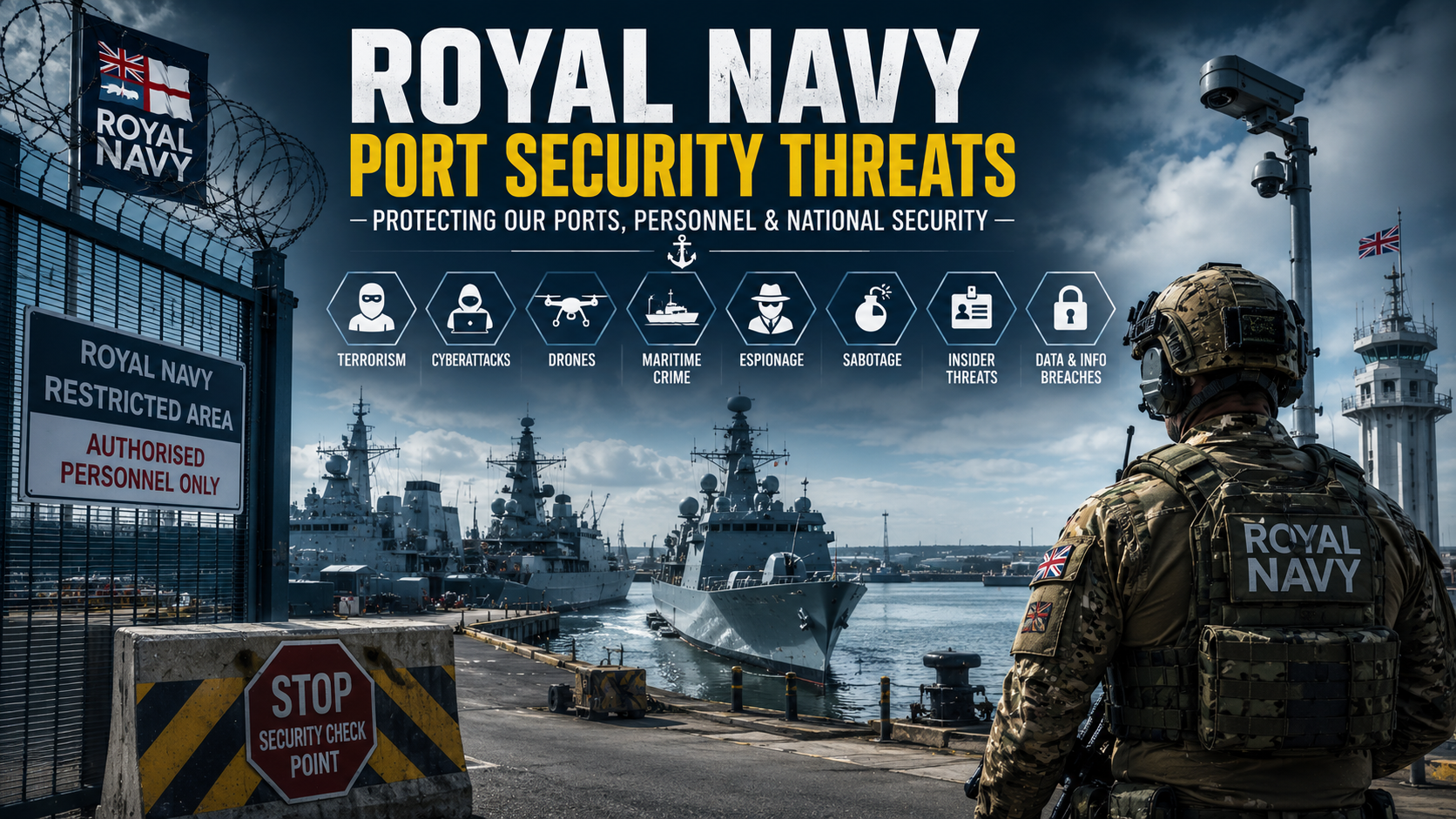
Naval ports are among the most strategically important locations in a country’s maritime security network. For the Royal Navy, ports and naval bases are essential for maintaining ships, supporting personnel, storing equipment, managing logistics and preparing vessels for operations. However, the concentration of people, technology, infrastructure and military assets also makes these locations potential targets for a wide range of security threats.
Royal Navy port security threats are not limited to traditional physical attacks. Modern naval facilities must consider terrorism, cyberattacks, espionage, sabotage, unmanned systems, organised crime, insider threats and disruption to critical infrastructure. At the same time, ports operate within complex environments where military facilities may be located close to commercial shipping, civilian communities and major transport networks.
Understanding these threats is therefore an important part of modern maritime security. Effective port protection requires multiple layers of security, trained personnel, technology, intelligence, emergency preparedness and strong coordination between military and civilian organisations.
This article explores the major security threats facing Royal Navy ports and explains why an integrated approach is increasingly important.
Why Royal Navy Ports Are Strategically Important
A naval port is much more than a place where ships are parked.
It can support activities such as:
- Ship maintenance and repair
- Crew changes and personnel management
- Fuel and energy supply
- Storage and movement of equipment
- Communications and information systems
- Training and operational preparation
- Engineering and technical support
- Transportation and logistics
- Emergency response and recovery
Because these activities are interconnected, disruption to one part of a naval port can potentially affect other operations.
Naval facilities can also contain highly valuable infrastructure and sensitive information. This makes them attractive targets for hostile actors seeking intelligence, disruption or political impact.
Consequently, port security must address both the physical environment and the digital systems that support naval operations.
1. Terrorism and Deliberate Physical Attacks
Terrorism remains an important consideration for security planners at major maritime facilities.
Naval bases can be attractive targets because of their strategic importance and their connection with national defence. A successful attack could potentially cause physical damage, interrupt operations, create casualties and generate significant public concern.
Security planning therefore has to consider risks involving unauthorised access, suspicious vehicles or packages, attacks against personnel and attempts to disrupt port activity.
Physical security measures can include controlled access, security patrols, surveillance systems, identification procedures, perimeter protection and emergency response planning.
The objective is not simply to prevent an incident but also to ensure that security teams can detect, assess and respond to suspicious activity quickly.
2. Cybersecurity Threats
One of the biggest changes in modern port security is the increasing dependence on digital technology.
Naval facilities rely on computer networks, communications systems, access-control technology, logistics platforms and industrial systems. A cyberattack could potentially disrupt services without requiring an attacker to physically enter the facility.
Cyber threats can include:
- Phishing and social engineering
- Malware
- Ransomware
- Credential theft
- Network intrusion
- Data theft
- Disruption of digital services
The consequences can extend beyond individual computers. Modern infrastructure is interconnected, meaning that weaknesses in one system may create risks elsewhere.
Cybersecurity therefore needs to be treated as an integral part of port security rather than as a separate IT issue.
Regular security assessments, employee awareness training, access controls, network monitoring, incident response plans and system resilience are important components of a strong cybersecurity strategy.
3. Drone and Unmanned System Threats
The rapid growth of commercially available drones has created another challenge for security authorities.
Small unmanned aircraft can be inexpensive, easily accessible and difficult to detect in certain circumstances. From a security perspective, unauthorised drones could be used for surveillance, photography, disruption or potentially hostile activity.
For naval facilities, the concern is particularly significant because drones can potentially provide aerial visibility of areas that are otherwise difficult to observe from outside a perimeter.
Counter-drone security is therefore becoming an increasingly important area of maritime security planning.
A suitable approach can involve detection, identification, assessment and appropriate response procedures. The exact response depends on the legal, operational and security environment of the facility.
4. Espionage and Intelligence Gathering
Naval ports can contain information that is valuable to hostile states and other intelligence-gathering organisations.
Espionage does not necessarily involve dramatic physical infiltration. Intelligence collection can take many forms, including observation, information gathering, cyber activity, social engineering and attempts to exploit individuals with access to sensitive environments.
Even apparently routine information can become valuable when combined with information from other sources.
Security awareness is therefore important for everyone working within or around a naval facility. Personnel should understand the risks associated with sharing sensitive information, interacting with unknown individuals and discussing operational activities through unsecured channels.
The human element remains a critical part of intelligence security.
5. Insider Threats
One of the more complicated Royal Navy port security threats is the insider threat.
Unlike an external attacker, an insider may already possess legitimate access to buildings, systems or information. This can make malicious activity more difficult to identify.
Insider threats may involve:
- Theft of information
- Unauthorised disclosure
- Deliberate sabotage
- Abuse of system privileges
- Facilitation of external attacks
- Criminal activity
However, insider risk management should not simply focus on identifying suspicious individuals. Effective security also involves appropriate access controls, monitoring, reporting procedures, staff training and a strong organisational security culture.
The principle of least privilege can help ensure that personnel have access only to the information and systems necessary for their responsibilities.
6. Sabotage and Infrastructure Disruption
Naval ports depend on critical infrastructure to function.
Electricity, communications, water, fuel systems, transport networks, maintenance facilities and other services can all be important to port operations.
An attempt to deliberately damage or disrupt infrastructure could potentially affect the ability of a facility to perform its normal functions.
This makes resilience an essential component of port security.
Security planners need to consider not only how to prevent sabotage but also how quickly essential services could be restored after an incident. Backup systems, contingency plans, emergency exercises and effective maintenance can contribute to resilience.
7. Maritime Crime and Unauthorised Activity
Naval ports operate within wider maritime environments. Nearby waters may contain commercial vessels, fishing boats, recreational craft and other maritime traffic.
This creates the possibility of unauthorised approaches or suspicious activity near restricted areas.
Maritime security teams therefore need situational awareness across both the port and its surrounding environment.
Monitoring vessel activity, maintaining clearly defined restricted areas and coordinating with relevant maritime authorities can help improve awareness and reduce security risks.
8. Smuggling and Organised Crime
Ports are naturally associated with the movement of people, goods and equipment. This can create opportunities for criminal networks.
Smuggling may involve prohibited goods, illegal substances, weapons or other controlled materials.
While naval facilities have additional security controls compared with ordinary commercial ports, their connection to wider transportation networks means that security authorities must remain aware of criminal activity in the surrounding maritime and logistics environment.
Effective security can involve cooperation between military authorities, law enforcement agencies, customs organisations and other relevant bodies.
9. Social Engineering and Human Vulnerabilities
Technology alone cannot provide complete protection for a naval port.
Attackers may attempt to manipulate people rather than directly attacking technical systems.
Social engineering can involve deceptive emails, phone calls, impersonation or attempts to persuade personnel to reveal information or bypass security procedures.
For example, an individual may attempt to appear as a contractor, employee or delivery worker in order to gain information or access.
Security awareness training can help personnel recognise unusual requests and understand when an activity should be reported.
A strong security culture ensures that employees understand that reporting suspicious behaviour is a security responsibility rather than an inconvenience.
10. Supply Chain Security
Modern naval operations depend on extensive supply chains.
Equipment, components, software, maintenance services and other resources may come from multiple suppliers and contractors.
This creates another layer of security risk.
A compromised component, unreliable supplier or vulnerable digital service could potentially introduce risks into an otherwise secure environment.
Supply chain security therefore requires appropriate supplier assessment, procurement controls, cybersecurity requirements and ongoing risk management.
The goal is to understand not only the security of a naval facility but also the security of the wider ecosystem supporting it.
11. Information Security and Operational Secrecy
Information itself can be a critical asset.
Details relating to naval activities, personnel, infrastructure, schedules and logistics may have security implications if improperly disclosed.
The growth of social media has added another dimension to this challenge. Information that appears harmless individually can potentially reveal more when combined with other publicly available material.
Personnel awareness is therefore essential.
Clear policies regarding photography, social media use, information sharing and handling of sensitive material can help reduce accidental disclosure.
12. Emergency Preparedness and Incident Response
Even with strong preventative measures, no security system can guarantee that an incident will never occur.
Emergency preparedness is therefore a crucial part of port security.
A naval facility needs appropriate plans for responding to different categories of emergencies, including security incidents, fires, infrastructure failures, cyber incidents and other disruptions.
Exercises and drills can help personnel understand their responsibilities before an actual emergency occurs.
An effective response framework should also support communication and coordination between different teams and external emergency services where appropriate.
13. The Importance of Layered Security
No single security measure can address every Royal Navy port security threat.
Modern port protection is better understood as a layered system.
Different layers can include:
- Perimeter security
- Access control
- Personnel security
- Surveillance and monitoring
- Cybersecurity
- Intelligence and threat assessment
- Maritime domain awareness
- Emergency response
- Infrastructure resilience
- Security training
If one layer fails, other layers should help detect or contain the problem.
This approach is particularly important because modern threats can overlap. A single incident might involve physical security, cyber activity, social engineering and information gathering at the same time.
The Role of Security Training
People remain one of the most important elements of effective security.
Security personnel need appropriate training in areas such as observation, access control, emergency response, communication and incident reporting.
Other employees also have an important role. Staff working in administration, engineering, logistics, IT, maintenance and other functions may encounter security-related situations during normal working activities.
Regular awareness programmes can help create a culture in which security becomes everyone’s responsibility.
Training should also evolve as threats change. Security procedures that were effective several years ago may need to be reviewed as technology and threat methods develop.
Future Challenges for Royal Navy Port Security
The security environment surrounding naval facilities is likely to become increasingly complex.
Artificial intelligence, autonomous systems, advanced cyber threats, commercially available surveillance technology and increasingly interconnected infrastructure could create new opportunities for both security and hostile activity.
At the same time, geopolitical tensions can influence the security environment surrounding strategically important maritime facilities.
Future port security will therefore require a combination of technology, human expertise, intelligence, resilience and continuous training.
The emphasis should not simply be on responding to individual threats. Security organisations need to build systems capable of adapting when new threats emerge.
Conclusion
Royal Navy port security threats are increasingly diverse. Terrorism and physical attacks remain important concerns, but modern naval facilities must also consider cyberattacks, drones, espionage, insider threats, sabotage, organised crime, information security and supply chain vulnerabilities.
The complexity of naval ports means that security cannot depend on one technology, one team or one procedure. Effective protection requires a layered approach that combines physical security, cybersecurity, intelligence, trained personnel, surveillance, emergency preparedness and infrastructure resilience.
Perhaps most importantly, security is not a one-time activity. Threats evolve, technology changes and new vulnerabilities emerge. Continuous assessment, training and improvement are therefore essential to maintaining secure and resilient naval facilities.
For the Royal Navy and the wider maritime security community, understanding these changing threats is an important step towards protecting people, infrastructure, information and critical maritime operations.
Frequently Asked Questions
What are the main Royal Navy port security threats?
Major threats can include terrorism, cyberattacks, espionage, drones, sabotage, insider threats, organised crime, unauthorised maritime activity and information security breaches.
Why is cybersecurity important for naval ports?
Naval facilities increasingly depend on digital systems for communications, logistics, access control and infrastructure management. Cybersecurity helps protect these systems from disruption, unauthorised access and data compromise.
Can drones pose a threat to naval ports?
Yes. Unauthorised drones can create security concerns because they may be capable of observing restricted areas or disrupting operations. This has increased the importance of drone detection and counter-drone security planning.
What is an insider threat?
An insider threat occurs when someone with legitimate access to a facility, system or information misuses that access, intentionally or unintentionally, creating a security risk.
Why is security training important at naval ports?
Security personnel and other employees may be the first people to notice unusual activity. Training helps them recognise potential risks, follow procedures and report incidents appropriately.
How can naval ports improve security?
A layered security strategy combining physical protection, cybersecurity, surveillance, access management, intelligence, personnel awareness, emergency preparedness and infrastructure resilience can strengthen overall port security.
This website is proudly managed by Shunya Digit.