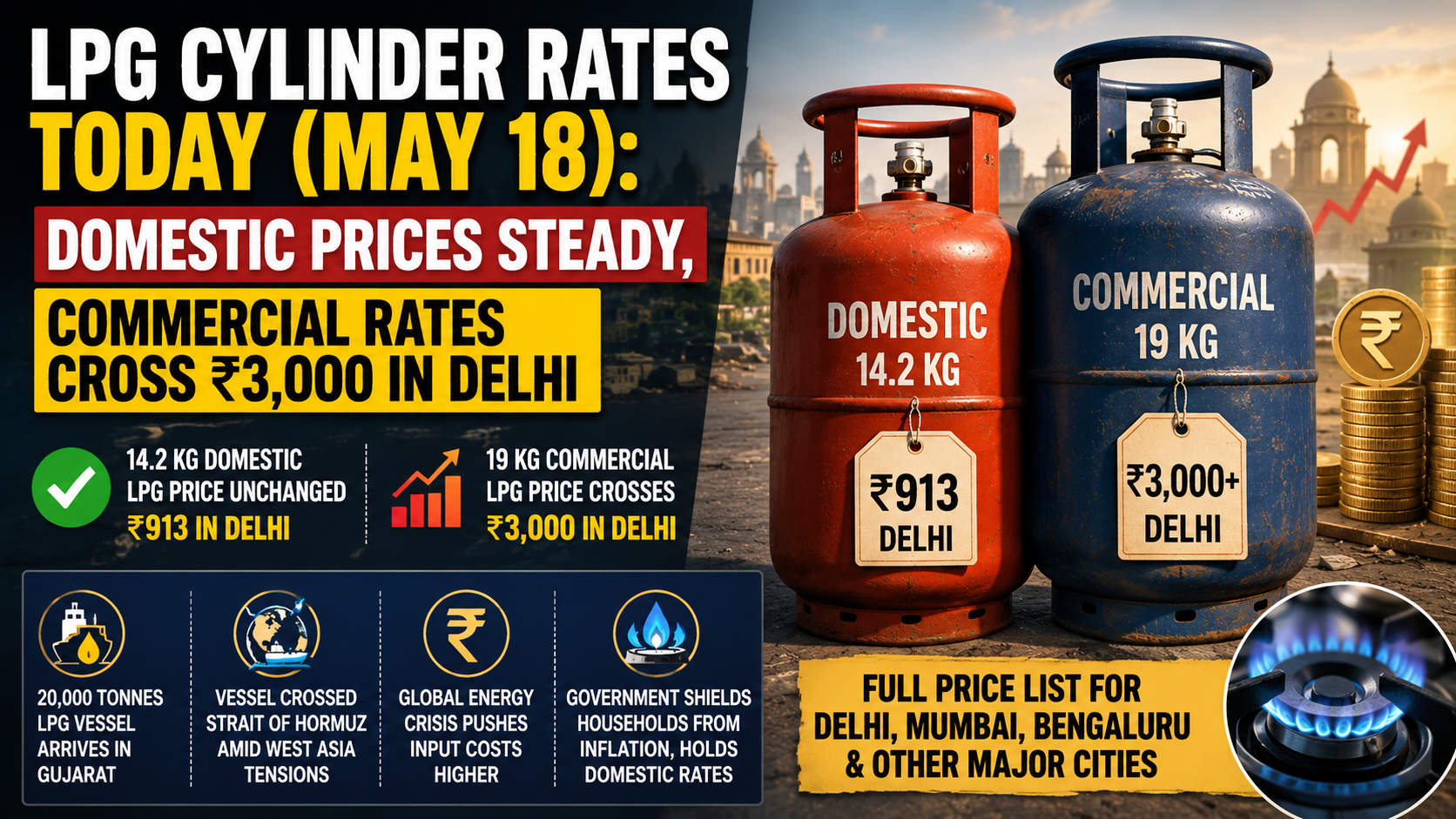
Even as rising geopolitical tensions in West Asia continue to shake global energy markets, Indian households have received some relief on the cooking gas front. According to the latest LPG price revision issued on May 18, 2026, domestic LPG cylinder prices have remained unchanged across major cities, shielding consumers from immediate inflationary pressure.
The price of a standard 14.2-kg domestic LPG cylinder continues to stand at ₹913 in Delhi, while rates in Mumbai, Bengaluru, Chennai, Kolkata, and other cities remain broadly stable.
However, the story is completely different for businesses and commercial users. Commercial LPG cylinders continue to witness elevated pricing, with the cost of a 19-kg commercial cylinder crossing ₹3,000 in Delhi, reflecting mounting pressure from global energy disruptions and higher import costs.
The development comes amid escalating tensions in West Asia, disruptions near the Strait of Hormuz, and rising global fuel costs that are affecting energy markets worldwide.
Here’s everything you need to know about today’s LPG cylinder rates, why prices remain unchanged for households, and what the West Asia crisis means for India’s fuel economy.
LPG Cylinder Rates Today – May 18
Domestic LPG Prices Stay Stable
Indian households received a much-needed breather as the government maintained unchanged LPG prices despite mounting global fuel pressure.
Domestic LPG Price in Delhi
- 14.2-kg Domestic LPG Cylinder: ₹913
Oil marketing companies (OMCs) have chosen to maintain stability in household cooking gas prices to protect consumers from inflation.
The unchanged rate follows a steep ₹60 increase implemented earlier in March, after which prices have remained stable.
Commercial LPG Cylinder Prices Remain High
Businesses Continue to Feel the Heat
While domestic consumers have been protected, hotels, restaurants, cafes, food businesses, and commercial kitchens continue facing rising costs.
Commercial LPG Price in Delhi
- 19-kg Commercial LPG Cylinder: ₹3,000+
This sharp rise comes after multiple price revisions over the past few months.
Commercial LPG rates remain under pressure due to:
- Rising crude oil prices
- Increased import costs
- Global supply disruptions
- Shipping uncertainty in West Asia
The widening gap between domestic and commercial cylinder pricing highlights the government’s strategy of cushioning households while allowing market-linked pricing for commercial sectors.
LPG Cylinder Prices in Major Cities Today
Domestic LPG Cylinder Rates (14.2 kg)
| City | Price |
|---|---|
| Delhi | ₹913 |
| Mumbai | Around prevailing OMC rate |
| Bengaluru | Stable |
| Kolkata | Stable |
| Chennai | Stable |
(Prices may vary slightly based on local taxes and distributor charges.)
Commercial LPG Cylinder Rates (19 kg)
Commercial cylinder prices remain significantly higher across metro cities due to elevated energy costs.
Businesses dependent on LPG continue experiencing pricing pressure.
Why Domestic LPG Prices Have Not Increased
Government Shields Consumers
According to market analysts, the Centre’s decision to avoid raising household LPG prices is a deliberate inflation-control measure.
India is currently facing pressure from:
- Rising crude oil prices
- Global shipping disruptions
- Inflation risks
- Imported energy costs
Increasing cooking gas prices could significantly burden households.
As a result, policymakers appear focused on protecting middle-class and lower-income consumers from immediate cost escalation.
Experts believe this pricing pause serves as a buffer against broader inflationary pressure.
West Asia Conflict and LPG Prices
Why the Global Crisis Matters
The ongoing geopolitical crisis in West Asia continues affecting global fuel markets.
The conflict, which intensified after military action involving Iran, Israel, and the United States, has disrupted global energy routes and pushed oil prices upward.
This matters because India depends heavily on imported energy.
Key concerns include:
- Rising crude oil prices
- Higher LPG import costs
- Shipping disruptions
- Increased insurance and logistics expenses
As fuel prices rise globally, maintaining affordable LPG becomes increasingly expensive for state-run oil companies.
Strait of Hormuz Crisis Explained
One of the World’s Most Important Energy Routes
A major reason for global energy anxiety is instability around the Strait of Hormuz.
The narrow waterway handles nearly:
20% of global energy supplies
including:
- Crude oil
- Liquefied Petroleum Gas (LPG)
- Energy shipments to Asia and Europe
Any disruption in this route directly affects global fuel pricing.
LPG Vessel Reaches Gujarat Amid Crisis
India Continues Securing Fuel Supplies
In an important development, officials confirmed that a vessel carrying:
20,000 metric tonnes of LPG
successfully arrived at Deendayal Port Authority in Kandla, Gujarat.
The ship:
MV SYMI
- Started its journey from Qatar
- Crossed the Strait of Hormuz on May 13
- Reached Gujarat amid heightened tensions
Officials said the vessel’s successful arrival provides temporary relief regarding India’s LPG supply continuity.
India’s LPG Supply Chain Remains Active
Despite geopolitical instability, India continues maintaining energy imports.
Reports indicate:
Since early March:
- 12 LPG tankers
- 1 crude oil tanker
have crossed the Strait of Hormuz under Indian operations.
This reflects India’s effort to prevent supply shortages even during international disruptions.
However, the rising transportation and procurement cost remains a challenge.
PM Modi’s Appeal to Citizens
Reduce Dependence on Imports
Prime Minister Narendra Modi recently urged citizens to adopt measures that reduce India’s import burden amid global uncertainty.
His appeal reportedly included:
- Prioritising work from home
- Reducing fuel consumption
- Avoiding foreign travel temporarily
- Supporting Swadeshi products
- Cutting edible oil use
- Adopting natural farming practices
- Reducing unnecessary gold purchases
The broader message focuses on reducing dependence on imports and protecting India’s foreign exchange reserves.
Why LPG Prices Matter for Inflation
Cooking Gas Directly Impacts Household Budgets
LPG pricing is closely linked with inflation because cooking gas is an essential household commodity.
Higher LPG prices affect:
- Family monthly budgets
- Food preparation costs
- Household expenses
- Small businesses
- Restaurants and catering operations
This is one reason governments tend to move cautiously while revising domestic LPG prices.
Why Commercial LPG Is More Expensive
Market-Linked Pricing
Commercial LPG follows a more market-driven pricing structure compared to subsidised or politically sensitive domestic cylinders.
This means prices react more directly to:
- Global crude oil movement
- Shipping costs
- International demand
- Supply disruptions
Businesses often bear the brunt of energy inflation earlier than households.
Impact on Restaurants and Small Businesses
Rising Costs for Food Businesses
The surge in commercial LPG prices is creating concern among:
- Restaurants
- Hotels
- Caterers
- Tea stalls
- Cloud kitchens
- Street food businesses
Higher LPG prices may eventually lead to:
- Increased menu costs
- Reduced profit margins
- Inflation in food services
Consumers may indirectly feel the effect through rising food prices.
What Analysts Are Saying
Household Relief May Continue for Now
Energy analysts believe the government may continue holding domestic LPG prices stable for the near term.
However, much depends on:
- Crude oil prices
- Iran conflict developments
- Shipping safety near Hormuz
- Currency exchange rates
If global energy prices rise sharply for an extended period, pricing pressure could intensify.
Key Highlights
- Domestic LPG prices remain unchanged on May 18
- Delhi domestic LPG cylinder costs ₹913
- Commercial LPG cylinder crosses ₹3,000 in Delhi
- West Asia conflict continues impacting fuel markets
- 20,000-tonne LPG vessel reached Gujarat successfully
- Strait of Hormuz disruptions raising global energy concerns
- Government appears focused on protecting households from inflation
Expert Analysis
Energy market experts believe India is currently balancing:
Consumer Relief vs Import Costs
While oil marketing companies face higher costs due to global uncertainty, policymakers appear determined to avoid immediate inflation shocks for households.
Experts note:
- Domestic LPG prices may remain stable temporarily
- Commercial pricing could continue fluctuating
- West Asia developments remain crucial
If tensions escalate further, global fuel prices could become even more volatile.
FAQ SECTION
What is the domestic LPG price in Delhi today?
As of May 18, the price of a 14.2-kg domestic LPG cylinder in Delhi is ₹913.
Why are domestic LPG prices unchanged?
The government is reportedly holding prices stable to shield households from inflation and global energy shocks.
What is the commercial LPG cylinder price today?
The 19-kg commercial LPG cylinder price has crossed ₹3,000 in Delhi.
How does the West Asia conflict affect LPG prices?
The conflict affects crude oil and LPG supply routes, increasing fuel and shipping costs globally.
What is the Strait of Hormuz and why is it important?
The Strait of Hormuz is a key global energy shipping route through which nearly 20% of global fuel supplies pass.
CONCLUSION
While geopolitical tensions in West Asia continue rattling energy markets worldwide, Indian households have temporarily escaped another LPG price hike. With domestic cooking gas prices holding steady at ₹913 in Delhi, the government appears focused on shielding consumers from inflationary pressure despite rising global costs.
However, commercial LPG prices crossing ₹3,000 signal the growing financial strain businesses are already facing. As global energy markets remain volatile and tensions around the Strait of Hormuz continue, LPG pricing in India is likely to remain under close watch in the coming months.
For now, households can breathe a small sigh of relief — but global developments will ultimately determine what comes next.
Stay updated with the latest business, technology, finance, and trending news only on Inetfreak.com.