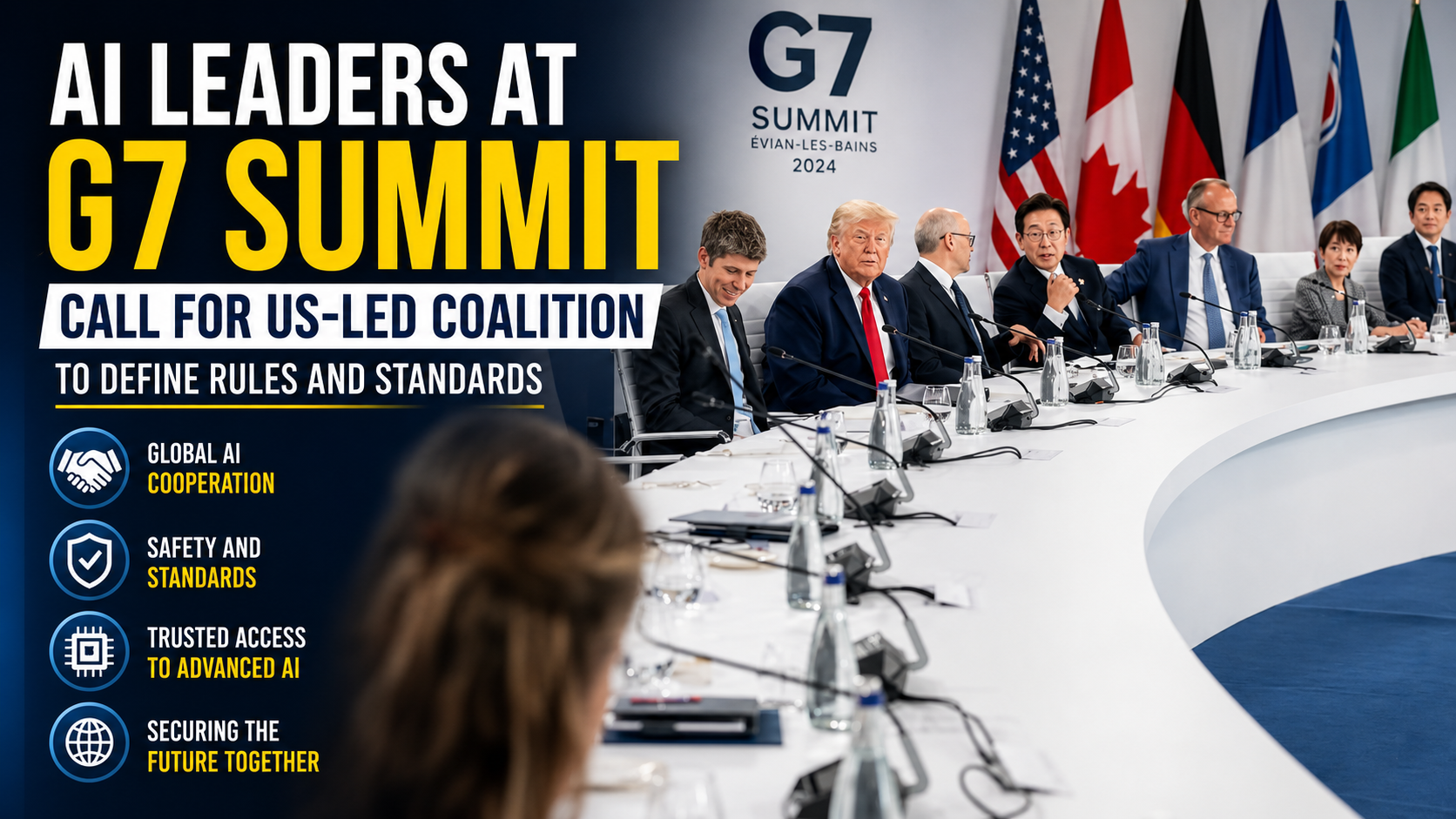
Artificial intelligence is rapidly transforming industries, economies, and societies around the world. As AI systems become increasingly powerful, questions about governance, safety, and international cooperation are becoming more urgent. At the recent G7 Summit in Évian-les-Bains, France, some of the biggest names in artificial intelligence—including OpenAI CEO Sam Altman, Anthropic CEO Dario Amodei, and Google DeepMind chief Demis Hassabis—called for the creation of a US-led coalition to establish global standards and rules for AI.
The discussions took place during a closed-door lunch attended by tech executives and leaders of G7 countries, including US President Donald Trump. The meeting highlighted growing concerns over the future of AI and the need for international collaboration to manage its risks while unlocking its potential.
Sam Altman Calls for Global AI Governance
OpenAI CEO Sam Altman emphasized that the debate over whether artificial intelligence is useful is already settled. According to him, even more powerful AI systems are on the horizon, capable of transforming scientific research, productivity, and the global economy.
Altman stressed the importance of establishing internationally accepted standards for AI testing and risk analysis. He proposed creating an international forum that would provide expert and impartial assessments of AI capabilities and dangers while serving as a platform for cooperation among nations.
Importantly, Altman clarified that AI companies should not be responsible for creating regulations.
“Do not cede your responsibilities to AI labs like mine. We develop the technology, and the citizens of the free world make the rules,” Altman reportedly said.
His comments underline a growing consensus among AI leaders that governments—not corporations—must define how advanced AI systems are governed.
Why a US-Led Coalition Is Being Proposed
The United States currently dominates the frontier AI industry through companies such as OpenAI, Anthropic, Google DeepMind, and others.
Because of America’s leadership position, several tech executives believe the US is best placed to coordinate international AI standards.
Anthropic CEO Dario Amodei and DeepMind chief Demis Hassabis reportedly advocated for a coalition led by the US that would focus on:
- AI safety standards
- Structured access to advanced models
- Regulation of critical AI chips and hardware
- Cybersecurity risks
- Biosecurity threats
- International intelligence cooperation
Canadian Prime Minister Mark Carney also reportedly supported the idea, suggesting that the United States could take a leading role in building such an alliance.
Other world leaders present at the summit acknowledged that Washington is currently best positioned to coordinate efforts around AI governance.
Concerns Over Powerful AI Models
The discussions come at a time when AI capabilities are advancing rapidly.
One major topic of concern is Anthropic’s highly advanced AI model, Claude Mythos, which reportedly possesses sophisticated cybersecurity capabilities.
Experts fear that AI models with advanced reasoning and cyber abilities could potentially be misused if they fall into the wrong hands.
Risks include:
- Cyberattacks
- Financial disruptions
- Biosecurity threats
- Election interference
- Deepfake misinformation
- Autonomous decision-making without proper safeguards
These concerns have pushed governments and AI companies to seek stronger international frameworks before AI systems become even more powerful.
Anthropic’s Project Glasswing Expands to India
Another major development discussed at the summit involved Anthropic’s cybersecurity initiative known as Project Glasswing.
Earlier this month, Anthropic expanded access to selected organizations in India, including government agencies responsible for protecting sectors such as:
- Banking
- Telecom
- Energy
- Power infrastructure
The project aims to strengthen cybersecurity capabilities and help organizations defend themselves against increasingly sophisticated digital threats.
India’s inclusion highlights the country’s growing importance in global AI and cybersecurity discussions.
Mythos Access and the Trusted Partners Scheme
Leaders at the G7 summit also discussed creating a “trusted partners” program that would provide selected countries access to advanced AI models developed by US companies.
French President Emmanuel Macron reportedly supported broader access to models like Anthropic’s Mythos.
Macron argued that global users would hesitate to rely on American AI systems if access could be abruptly restricted.
His comments come shortly after Anthropic temporarily restricted access to its Fable 5 and Mythos 5 models following export control measures imposed by the US government due to national security concerns.
The restrictions triggered debates across Europe and Asia about AI dependence and technological sovereignty.
Why AI Sovereignty Is Becoming Important
Recent developments have reinforced concerns among governments worldwide regarding overreliance on foreign AI providers.
In Europe, policymakers have begun discussing:
- Domestic AI infrastructure
- Independent AI research
- Reduced dependence on American companies
India has witnessed similar discussions.
Following Anthropic’s restrictions, Indian entrepreneurs, investors, and policymakers renewed calls for:
- Indigenous AI models
- Open-source alternatives
- National AI infrastructure
- Semiconductor manufacturing
- Increased AI investments
Many experts argue that relying entirely on foreign AI models could expose countries to geopolitical and economic vulnerabilities.
G7 Leaders Focus on Economic Impact
Beyond security issues, G7 leaders released a joint statement emphasizing the need to assess AI’s impact on:
Financial Stability
Advanced AI systems may significantly alter financial markets and economic behavior.
Productivity
AI has the potential to dramatically improve productivity across industries.
Labor Markets
Automation could reshape employment patterns and create new economic challenges.
Regulation
Governments must ensure innovation does not outpace safeguards.
To address these concerns, G7 countries plan to involve:
- Financial regulators
- Cybersecurity experts
- Economists
- Technology specialists
Their goal is to better understand the long-term implications of frontier AI systems.
China and AI Competition
Another topic discussed by Anthropic CEO Dario Amodei reportedly involved restricting sensitive AI technologies from reaching China.
According to reports, Amodei emphasized the importance of managing the trade of AI chips and critical components while maintaining cooperation among trusted allies.
The issue reflects growing technological competition between the US and China, with AI becoming one of the most strategically important sectors globally.
Many analysts believe that AI leadership will shape geopolitical power in the coming decades.
A Defining Moment for AI Governance
The discussions at the G7 summit represent a critical turning point.
Unlike previous technological revolutions, AI is advancing at an unprecedented pace.
Industry leaders increasingly agree that international cooperation is essential to ensure:
- AI remains safe
- Innovation continues responsibly
- Risks are minimized
- Democratic governments maintain oversight
Sam Altman’s message that governments—not AI companies—should define the rules reflects a broader recognition that AI governance cannot be left solely to private firms.
Final Thoughts
As artificial intelligence becomes more powerful, the world faces a historic challenge: balancing innovation with responsibility.
The calls by Sam Altman, Dario Amodei, and Demis Hassabis for a US-led coalition signal that the conversation around AI governance is entering a new phase.
With concerns surrounding cybersecurity, biosecurity, economic disruption, and technological sovereignty growing rapidly, global cooperation is becoming increasingly necessary.
Whether a US-led alliance emerges or nations choose separate paths, one thing is clear: the decisions made today will shape the future of artificial intelligence—and perhaps the future of humanity itself.
As AI capabilities continue to evolve, establishing clear rules, international standards, and trusted partnerships may prove to be one of the most important challenges of the digital age.