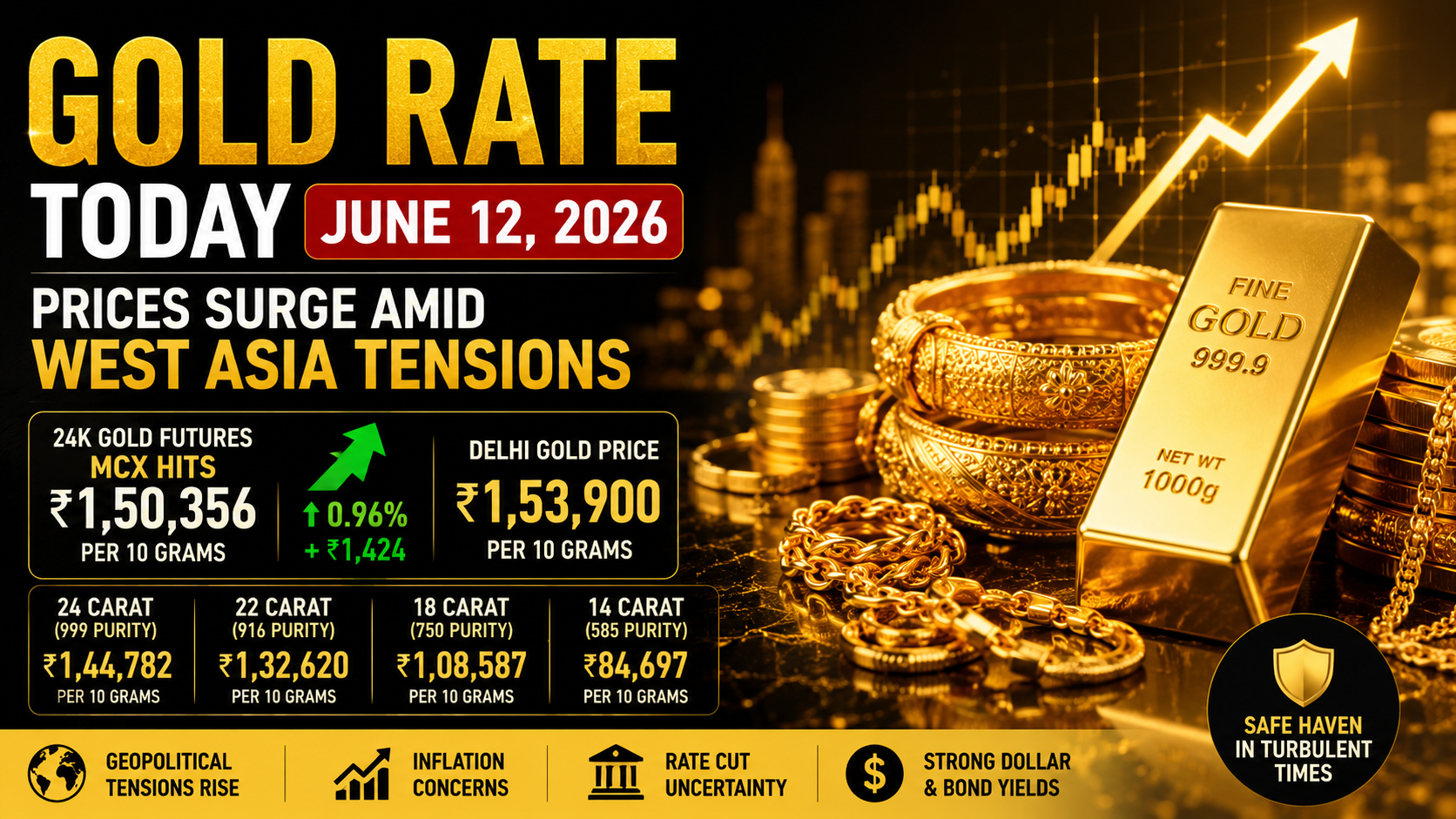
Gold has once again become the center of attention as prices witnessed fresh volatility on June 12, 2026, driven by escalating geopolitical tensions in West Asia and growing uncertainty in global financial markets. The precious metal, often considered a safe-haven asset during times of crisis, saw a sharp rise in domestic futures trading while remaining under pressure in international markets.
With gold prices crossing significant milestones in India and investors closely monitoring global developments, many are wondering whether this rally will continue and whether now is the right time to buy gold.
Gold Prices Rise Sharply in India
At the opening of trade on June 12, 2026, the 24-carat gold futures contract on the Multi Commodity Exchange (MCX) jumped by Rs 1,424, representing a gain of 0.96 percent, reaching Rs 1,50,356 per 10 grams.
The rise reflects increased investor demand for safe assets amid growing geopolitical concerns and economic uncertainty.
In Delhi’s physical bullion market, gold prices were even higher, with 24-carat gold quoted at Rs 1,53,900 per 10 grams, indicating strong local demand and market sentiment.
Data released by the Indian Bullion and Jewellers Association (IBJA) showed:
- 24-carat gold (999 purity): Rs 1,44,782 per 10 grams
- 23-carat gold (995 purity): Rs 1,44,202 per 10 grams
- 22-carat gold (916 purity): Rs 1,32,620 per 10 grams
- 18-carat gold (750 purity): Rs 1,08,587 per 10 grams
- 14-carat gold (585 purity): Rs 84,697 per 10 grams
These figures highlight how gold continues to remain one of the most closely watched investment assets in India.
Gold Rates Across Major Indian Cities
Gold prices vary slightly from city to city due to local taxes, transportation costs, and market demand.
24-Carat Gold Rate (Per 10 Grams)
| City | Price |
|---|---|
| Delhi | Rs 1,45,790 |
| Mumbai | Rs 1,45,640 |
| Kolkata | Rs 1,45,640 |
| Chennai | Rs 1,47,280 |
| Bengaluru | Rs 1,45,640 |
| Hyderabad | Rs 1,45,640 |
| Pune | Rs 1,45,640 |
| Ahmedabad | Rs 1,45,690 |
| Lucknow | Rs 1,45,790 |
| Chandigarh | Rs 1,45,790 |
Among major cities, Chennai recorded the highest 24-carat gold rate at Rs 1,47,280 per 10 grams, reflecting regional market variations.
22-Carat Gold Rate
The price of 22-carat gold, commonly used for jewelry purchases, ranged between Rs 1,33,500 and Rs 1,35,000 per 10 grams across major cities.
18-Carat Gold Rate
For buyers looking at lower-purity gold jewelry, 18-carat gold rates ranged from Rs 1,09,230 to Rs 1,13,100 per 10 grams.
International Gold Market Shows Mixed Signals
While domestic gold prices surged, international markets displayed a different trend.
The COMEX Gold Futures August Contract declined by:
- $17.23 per ounce
- Down 0.42 percent
- Trading at $4,116.07 per ounce
This divergence between Indian and international prices highlights how local demand and currency movements can sometimes outweigh global price trends.
Experts believe that fluctuations in the US dollar and changing expectations regarding interest rates have influenced international gold prices.
Why Are Gold Prices So Volatile?
Gold markets around the world are currently being influenced by a combination of geopolitical and economic factors.
1. Rising Geopolitical Tensions in West Asia
One of the biggest drivers behind the recent rally is the continued uncertainty in West Asia.
Whenever geopolitical conflicts intensify, investors tend to move money away from riskier assets such as equities and into traditional safe-haven investments like gold.
The ongoing instability has increased concerns about:
- Global economic growth
- Energy supply disruptions
- Oil price volatility
- Inflationary pressures
As a result, demand for gold has risen significantly.
2. Inflation Concerns Remain Strong
Inflation continues to be a major concern for investors worldwide.
Although several central banks have worked aggressively to control inflation, elevated energy prices and supply chain challenges continue to create uncertainty.
Gold has historically been viewed as a hedge against inflation because it tends to preserve value when purchasing power declines.
Many investors are increasing their exposure to gold as a precautionary measure.
3. Interest Rate Expectations
According to market analysts, changing expectations surrounding future interest rate cuts are also influencing gold prices.
Generally:
- Lower interest rates support gold prices.
- Higher interest rates can reduce gold’s appeal because gold does not generate interest income.
Investors are closely monitoring signals from major central banks, particularly the US Federal Reserve, regarding future monetary policy decisions.
Any indication of delayed rate cuts can impact gold markets immediately.
4. Strength of the US Dollar
The US dollar remains one of the most important factors affecting gold prices globally.
A stronger dollar often makes gold more expensive for international buyers, which can limit demand.
However, geopolitical uncertainty can sometimes override this effect as investors prioritize safety over valuation concerns.
5. Bond Yield Movements
Government bond yields also play a critical role.
When bond yields rise significantly, some investors shift money from gold into fixed-income investments that offer guaranteed returns.
Conversely, when yields stabilize or decline, gold often becomes more attractive.
Recent fluctuations in bond markets have added another layer of volatility to precious metals trading.
Is Gold Still a Safe Investment?
For centuries, gold has been considered a reliable store of value.
Even today, many financial advisors recommend allocating a portion of an investment portfolio to gold for diversification.
Gold offers several advantages:
Protection Against Inflation
When prices rise across the economy, gold often maintains or increases its value.
Portfolio Diversification
Gold typically behaves differently from stocks and bonds, helping reduce overall investment risk.
Safe-Haven Demand
During economic crises, geopolitical conflicts, or market uncertainty, investors frequently turn to gold.
Liquidity
Gold can be easily bought and sold through multiple channels including:
- Physical gold
- Gold ETFs
- Sovereign Gold Bonds
- Gold mutual funds
- Digital gold platforms
Should You Buy Gold Now?
The answer depends on your investment goals.
If you’re buying gold for:
Long-Term Wealth Preservation
Gold can continue to serve as a strong hedge against uncertainty.
Jewelry Purchases
Buyers may want to compare prices carefully because current levels are near record highs.
Short-Term Trading
Volatility remains elevated, meaning traders should exercise caution and monitor global developments closely.
Financial experts generally recommend avoiding emotional buying during sharp rallies and instead focusing on long-term asset allocation strategies.
What Could Happen Next?
Several events could determine gold’s direction over the coming weeks:
- Developments in West Asia
- US inflation data
- Federal Reserve policy announcements
- Global oil prices
- Currency market fluctuations
- Bond yield movements
If geopolitical tensions continue to escalate, gold could remain supported at elevated levels.
However, any signs of easing tensions or stronger-than-expected economic growth could trigger profit-booking and short-term corrections.
Conclusion
Gold prices on June 12, 2026, reflected the growing uncertainty in global markets. Domestic gold futures surged above Rs 1.50 lakh per 10 grams, while physical market prices in major cities remained near historic highs. The combination of geopolitical tensions, inflation concerns, fluctuating interest rate expectations, and global economic uncertainty continues to drive investor demand for the precious metal.
While short-term volatility is likely to persist, gold remains one of the most trusted safe-haven assets for investors seeking stability during uncertain times. Whether you’re an investor, trader, or jewelry buyer, keeping a close eye on market developments will be essential as gold continues its remarkable journey in 2026.