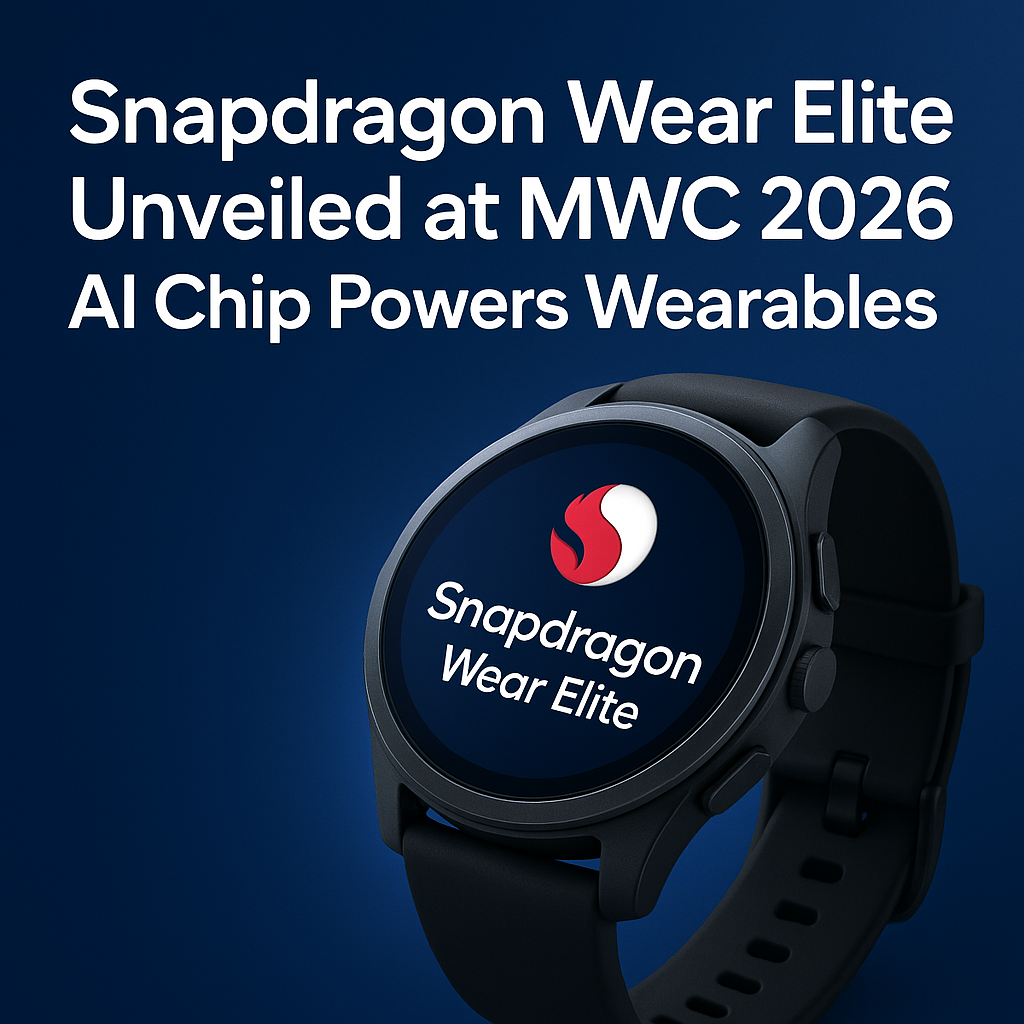
At MWC 2026, Qualcomm pulled the curtain back on a new platform aimed squarely at the next wave of smartwatches and premium wearables: Snapdragon Wear Elite. Positioned as an AI-first wearable chipset, the new silicon focuses on faster on-device intelligence, better battery efficiency, and tighter integration with health sensors and connectivity features that users actually depend on every day. As wearable makers compete on personalization, coaching, and wellness insights, Snapdragon Wear Elite arrives as a timely answer: more machine learning performance at the edge, without turning your wrist into a charging schedule.
Snapdragon Wear Elite at MWC 2026: What Was Announced
Snapdragon Wear Elite was introduced as Qualcomm’s most advanced wearable chip to date, designed to power flagship smartwatches, fitness-centric wearables, and emerging form factors like AI rings and compact health trackers that need higher intelligence in smaller thermal envelopes. While previous generations leaned heavily on incremental CPU/GPU gains, the Snapdragon Wear Elite story is largely about the AI pipeline: faster inference, smarter sensor processing, and a platform that can make decisions locally even when the phone is far away.
In practical terms, that means more features can run continuously on the device—such as adaptive coaching, sleep staging improvements, arrhythmia screening workflows, and contextual assistants—without the constant round-trip to the cloud that drains battery and raises privacy concerns.
Why Qualcomm Is Calling It an “AI Chip” for Wearables
Wearables are uniquely constrained: tiny batteries, limited cooling, and a constant requirement to be “always on.” An AI-centric wearable SoC typically emphasizes:
- Efficient on-device inference: Running machine learning models locally for speed and privacy.
- Sensor fusion: Combining data from heart rate, SpO2, temperature, accelerometer, gyroscope, GPS, and more to make meaningful predictions.
- Low-power states: Keeping intelligence active without keeping the whole chip awake.
- Personalization: Learning individual baselines for stress, recovery, sleep, and activity.
Snapdragon Wear Elite targets these exact priorities, aiming to make advanced health and assistant features feel instantaneous while staying power-efficient.
Key Features and Improvements in Snapdragon Wear Elite
Although device makers will ultimately shape how the platform performs in real-world products, Snapdragon Wear Elite is built to deliver improvements across the areas that matter most: speed, battery, AI capabilities, and connectivity. Below are the major feature themes wearable fans and manufacturers are watching.
On-Device AI Performance for Smarter, Faster Experiences
Snapdragon Wear Elite brings a more capable AI engine designed for always-on intelligence. This matters because a smartwatch isn’t just a mini phone—it’s a sensor hub that should interpret your body signals and daily context in real time. Better on-device AI enables:
- Faster voice processing: More commands handled locally with reduced latency.
- Context-aware suggestions: Timely prompts based on motion patterns, location, and routine.
- Improved health insights: Model-based detection of anomalies and pattern changes.
- Adaptive fitness coaching: Personalized training cues based on recovery and readiness signals.
For consumers, the benefit is a watch that responds immediately and behaves more like a proactive assistant than a reactive gadget.
Battery Efficiency and Always-On Intelligence
Battery life remains the number one pain point in many advanced smartwatches—especially when features like always-on display, continuous heart-rate monitoring, sleep tracking, GPS, and cellular connectivity are used together. Snapdragon Wear Elite emphasizes power optimization through smarter task allocation and low-power processing for background workloads.
In everyday use, this can translate into better endurance for high-demand scenarios:
- Long workouts: Sustained GPS and sensor tracking without rapid drain.
- Overnight sleep tracking: Less compromise between accuracy and battery.
- Always-on display: More feasible for all-day wear, not just short stints.
- Continuous wellness monitoring: Stress, respiration, and recovery estimates that don’t force mid-day charging.
Health Sensor Processing and Next-Gen Wellness Tracking
Modern wearables increasingly depend on specialized signal processing to improve the quality of sensor readings, especially during motion. Snapdragon Wear Elite is designed to support richer sensor stacks and more advanced filtering, enabling clearer data and more reliable insights.
Potential health and wellness upgrades supported by improved processing include:
- More accurate heart-rate tracking during exercise: Better motion artifact reduction.
- Enhanced sleep stage estimation: More consistent classification across nights.
- Temperature trend analysis: Better baseline modeling for personalized insights.
- Cardio and respiratory signals: Improved quality for downstream analytics, depending on sensor hardware.
It’s important to note that many “health features” depend on regulatory approvals, device sensors, and the brand’s software. Snapdragon Wear Elite provides the horsepower and framework; device makers decide what ships.
Connectivity Built for Standalone Wearables
One of the strongest arguments for a more powerful wearable platform is the move toward more independent devices. Consumers want watches that can stream music, handle messages, run navigation, and support contactless payments—even when their phone stays in a bag or at home.
Snapdragon Wear Elite highlights connectivity as a pillar, supporting smoother performance in scenarios like:
- Outdoor runs and rides: Navigation, safety features, and workout tracking.
- Travel: Better roaming experiences and stable connections when paired or standalone.
- Busy workdays: Reliable notifications and calls without constant phone access.
What Snapdragon Wear Elite Means for Smartwatch Brands
The real impact of Snapdragon Wear Elite will be determined by the devices that adopt it. For manufacturers, a new flagship wearable chip can reduce engineering tradeoffs and open up new product tiers. Brands can choose to use the platform to build:
- Premium lifestyle smartwatches: With smooth UI, faster app launches, and richer watch faces.
- Performance fitness watches: With longer tracking, better sensor accuracy, and coaching.
- Hybrid wearables: That blur the lines between medical-grade monitoring and consumer convenience.
- Specialty devices: For kids, seniors, workers, or health programs needing on-device intelligence.
Wear OS and the Software Experience
If Snapdragon Wear Elite is widely adopted in Wear OS devices, users could see noticeable improvements in day-to-day interactions: less lag when navigating tiles, faster wake-up times, smoother animations, and better multitasking when health monitoring is running continuously in the background.
For developers, more capable wearable hardware can also mean room for better apps—particularly those that rely on on-device inference, real-time coaching, or offline features that previously felt too heavy for a watch.
Edge AI and Privacy: Why On-Device Processing Matters
As AI features expand, privacy concerns expand with them. On-device AI can reduce the need to send sensitive biometric or voice data to the cloud for processing. Snapdragon Wear Elite’s AI focus supports a privacy-friendly direction for wearables:
- Fewer cloud round-trips: Lower exposure of personal data in transit.
- Faster responses: Reduced latency for assistant features and health alerts.
- Better offline functionality: Useful in gyms, planes, trails, and areas with weak coverage.
That said, privacy depends on the full stack: device firmware, apps, policies, and how brands handle data storage and sharing.
Competitive Landscape: Where Snapdragon Wear Elite Fits in 2026
MWC 2026 made it clear that wearables are no longer “accessories.” They are becoming primary health and communication devices. Snapdragon Wear Elite enters a crowded and fast-moving space that includes proprietary smartwatch chips, hybrid microcontroller architectures, and multi-chip designs that separate low-power sensor tasks from high-performance UI tasks.
Qualcomm’s advantage has historically been in connectivity expertise, ecosystem partnerships, and scalable platforms that multiple brands can use. With Snapdragon Wear Elite, the company is leaning into on-device AI and sensor intelligence—two areas that increasingly define premium wearables.
Who Benefits Most from This New Wearable Chip
Snapdragon Wear Elite is most relevant to people who want:
- A smoother smartwatch experience: Less lag, more responsive interactions.
- Better battery balance: Advanced features without constant charging.
- Smarter health and fitness insights: More personalized analytics and coaching.
- Standalone capability: More reliable performance away from the phone.
Expected Devices, Release Timing, and What to Watch Next
After a major MWC unveiling, the typical next steps involve reference designs, partner announcements, and the first wave of consumer devices. Exact product timelines depend on each manufacturer’s design cycle, but new flagship wearable chips often show up in premium smartwatch launches over the following months.
When Snapdragon Wear Elite watches and wearables begin rolling out, these are the key indicators to watch in reviews:
- Real battery life: Especially with always-on display, sleep tracking, and GPS.
- Thermals and comfort: Performance is only useful if the watch stays cool and comfortable.
- Health tracking accuracy: Compared to chest straps and established baselines.
- AI feature usefulness: Whether “AI” is practical or mostly marketing.
- App performance: Load times, stability, and offline behavior.
Snapdragon Wear Elite sets the stage for smarter wearables in 2026, but the most important part will be execution: thoughtful software, meaningful features, and efficiency that users can feel on day one.
Conclusion: Snapdragon Wear Elite Signals a Smarter Wearable Era
Snapdragon Wear Elite, unveiled at MWC 2026, highlights where the wearable industry is headed: on-device AI, deeper sensor intelligence, and better power efficiency to support always-on experiences. As smartwatches evolve into continuous health companions and standalone communication devices, the chipset at the center matters more than ever. If Qualcomm’s partners translate this platform into polished products, Snapdragon Wear Elite could become one of the most important wearable chip launches of 2026—enabling devices that are not only faster, but genuinely smarter and more personal.
FAQs
What is Snapdragon Wear Elite?
Snapdragon Wear Elite is Qualcomm’s next-generation wearable chipset unveiled at MWC 2026, designed to power advanced smartwatches and wearables with a focus on on-device AI, efficiency, and improved sensor processing.
How does Snapdragon Wear Elite improve AI features on smartwatches?
It emphasizes faster and more efficient on-device AI inference, enabling features like quicker voice commands, better context awareness, and more advanced health and fitness insights without relying as heavily on cloud processing.
Will Snapdragon Wear Elite improve battery life?
It is designed to improve power efficiency, especially for always-on workloads like health tracking, sleep monitoring, and background intelligence. Actual battery life will depend on the device maker’s battery size, display, sensors, and software tuning.
Which smartwatches will use Snapdragon Wear Elite?
Qualcomm typically works with multiple wearable brands, but specific models depend on partner announcements. Expect Snapdragon Wear Elite to appear first in flagship-tier smartwatches and premium fitness wearables after the MWC 2026 launch window.
Does on-device AI in Snapdragon Wear Elite help with privacy?
Yes, on-device AI can reduce the need to send sensitive data to the cloud, which can improve privacy and speed. However, overall privacy depends on each brand’s software, permissions, and data handling policies.