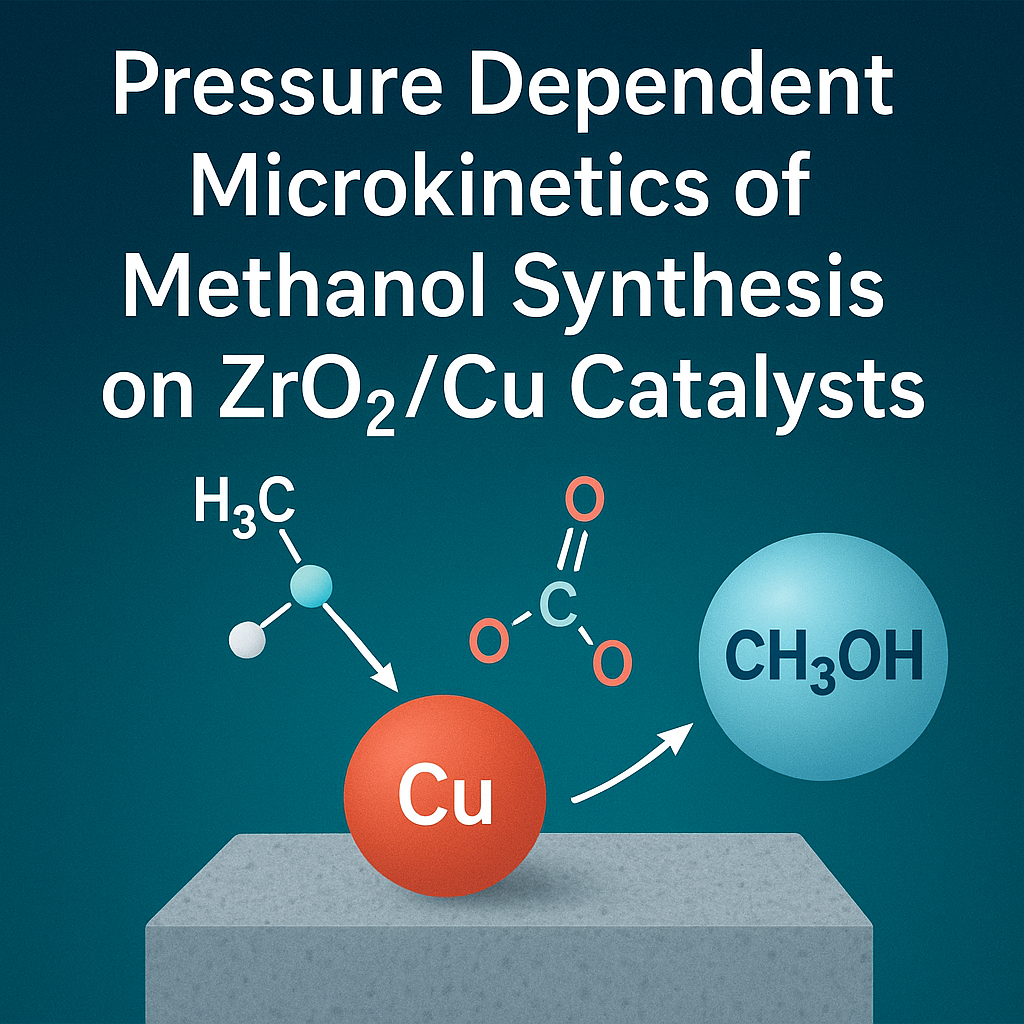
Methanol synthesis from syngas remains one of the most important catalytic processes in the chemical industry, bridging carbon resources and downstream products such as formaldehyde, acetic acid, fuels, and olefins. Among commercial catalyst families, Cu-based systems supported on oxides are central, and ZrO2-promoted or ZrO2-supported Cu catalysts have attracted special attention for their stability, CO2 utilization, and tunable interfacial chemistry. Yet, performance is not determined by composition alone. Pressure strongly reshapes surface coverages, reaction pathways, and rate-controlling steps. Pressure dependent microkinetics of methanol synthesis on ZrO2–Cu catalysts provides a mechanistic map that links operating conditions to turnover frequency, selectivity, and deactivation tendencies.
This article explains how pressure alters the microkinetic landscape for methanol formation on Cu sites and Cu–ZrO2 interfaces, why CO and CO2 routes respond differently, and how these insights guide reactor optimization and catalyst design.
Methanol Synthesis on ZrO2–Cu: Why Microkinetics Matters
Microkinetic modeling describes a catalytic reaction network using elementary steps (adsorption, surface reactions, diffusion, and desorption) governed by rate constants and thermodynamics. Instead of fitting a single overall rate law, a microkinetic framework predicts how the dominant pathway shifts with temperature, pressure, and feed composition. For methanol synthesis, this is especially valuable because:
- Multiple carbon-containing reactants participate (CO, CO2, H2), each with distinct adsorption behavior.
- Water is co-produced and can inhibit key sites, particularly at higher pressure where its partial pressure increases.
- The active ensemble is bifunctional: metallic Cu facilitates hydrogenation steps, while ZrO2 can activate CO2, stabilize intermediates, and modify Cu electronic/structural properties at the interface.
- Surface coverages are pressure-sensitive, and coverage controls apparent activation energies and reaction orders.
Pressure dependent microkinetics therefore serves as a practical tool for understanding why the same catalyst can exhibit different rate laws and selectivities across industrially relevant ranges (typically 30–100 bar), and why lab-scale data at 1–10 bar may not extrapolate cleanly.
Key Reaction Pathways and Surface Intermediates
CO and CO2 Hydrogenation Routes
Methanol can form from both CO and CO2 in syngas feeds. On Cu-based catalysts, two mechanistic families are commonly discussed:
- Formate pathway (CO2-based): CO2 adsorbs and forms surface formate (HCOO*) followed by sequential hydrogenation to methoxy (CH3O*) and methanol (CH3OH).
- CO-based pathway: CO hydrogenation can proceed via formyl-like intermediates (HCO*) or via CO insertion/hydrogenation steps that converge to methoxy and methanol. In many Cu systems, CO is also produced/consumed through the reverse water-gas shift (RWGS), coupling CO2, CO, and H2O in a pressure-sensitive equilibrium.
ZrO2 frequently enhances the CO2 route by providing basic or defective sites (oxygen vacancies, Zr–O pairs) that bind/activate CO2, while Cu provides mobile H* and facilitates hydrogenation at the metal or interface. The Cu–ZrO2 perimeter can stabilize key intermediates such as formate, carbonate/bicarbonate, and methoxy species, altering their relative coverages as pressure changes.
Interfacial Sites: Cu–ZrO2 Perimeter as a Kinetic Lever
Many experimental and theoretical studies attribute high activity to interfacial ensembles where Cu atoms neighbor ZrO2 sites. At these boundaries, CO2 activation can be easier than on extended Cu terraces, while hydrogen spillover from Cu to the oxide (and back) can accelerate hydrogenation steps. Pressure can amplify or suppress the role of these sites by changing:
- Availability of oxygen vacancies and hydroxyl coverage on ZrO2
- Water partial pressure and degree of surface hydroxylation
- Relative coverage of CO* vs CO2-derived species at the interface
How Pressure Changes Surface Coverage and Rate Control
Coverage Effects: From Kinetics to “Surface Crowding”
Increasing total pressure at fixed composition increases the partial pressures of CO, CO2, H2, and products. In microkinetic terms, higher reactant pressures generally increase adsorption rates and raise steady-state coverages. However, the direction of the net rate depends on which species occupy active sites and whether those species are reactive intermediates or spectators/inhibitors.
Typical pressure-dependent coverage trends on ZrO2–Cu catalysts include:
- Higher H* coverage on Cu as H2 pressure rises, often promoting hydrogenation steps until site saturation or competitive adsorption limits further gains.
- Higher CO* coverage at elevated CO partial pressure, which can inhibit CO2 activation and hydrogenation by blocking Cu sites (especially steps requiring vacant metal sites).
- Higher formate and carbonate coverage at higher CO2 pressure on ZrO2 and at the interface. Formate can be productive (as a true intermediate) or inhibiting (if its hydrogenation is slow and it accumulates).
- Higher water coverage (hydroxyls on ZrO2, H2O adsorption/desorption equilibria) which can suppress vacancy sites and reduce CO2 activation, particularly at high pressure where water fugacity rises strongly.
The net effect is often non-linear: methanol formation rate may rise with pressure initially, then show diminishing returns or even inhibition if CO* or H2O-derived species dominate the surface.
Rate-Determining Step Can Shift with Pressure
A key promise of pressure dependent microkinetics is identifying how the rate-determining step (RDS) shifts. On ZrO2–Cu systems, plausible shifts include:
- Low pressure: CO2 activation to formate (or formation of the first C–H bond) may control the rate due to low coverage of activated CO2 species and limited interfacial hydrogen availability.
- Intermediate pressure: Hydrogenation of formate to dioxymethylene-like species or to methoxy may become rate-limiting, especially if formate accumulates as pressure increases.
- High pressure: Product desorption (methanol or water), site blocking by CO*, or suppression of oxygen vacancies by hydroxylation can become dominant constraints, leading to inhibition behavior and altered apparent kinetics.
In microkinetic analysis, these transitions are captured by degree of rate control (DRC) metrics, which quantify which elementary step most influences the net rate under a given condition. Pressure changes DRC profiles by reshaping coverages and driving forces (chemical potentials) for each step.
Pressure Effects on CO2 vs CO Contributions
CO2-Rich Feeds: Formate Dominance and Water Sensitivity
In CO2-rich feeds (including “green methanol” concepts using captured CO2 and renewable H2), the formate pathway often dominates. Pressure increases can boost CO2 adsorption and formate formation, but also increase the water partial pressure, enhancing hydroxylation of ZrO2 and potentially decreasing the population of active oxygen vacancies.
This creates a characteristic pressure sensitivity:
- At moderate pressure, higher CO2 and H2 fugacities favor methanol formation thermodynamically and kinetically.
- At higher pressure, the interface may become more hydroxylated, and formate may become a “resting state,” slowing turnover if its onward hydrogenation is sluggish.
Microkinetic models often reproduce this behavior by including competitive adsorption of H2O and OH* formation steps on ZrO2, along with pressure-dependent activities (fugacities) rather than ideal partial pressures.
CO-Rich Feeds: CO* Inhibition and RWGS Coupling
When CO is abundant, CO* can strongly occupy Cu sites as pressure rises, which may reduce the availability of vacant Cu sites needed for H2 dissociation or for key hydrogenation steps. In addition, the RWGS equilibrium (CO2 + H2 ⇌ CO + H2O) is pressure- and temperature-dependent, and it links CO2 conversion to water formation. High pressure can push methanol synthesis forward thermodynamically, but RWGS may still generate water that inhibits the oxide interface.
In microkinetic terms, CO-rich conditions frequently produce:
- More negative apparent reaction order in CO at higher pressure due to site blocking
- More pronounced water inhibition due to RWGS-derived H2O
- Greater sensitivity to Cu particle morphology (steps/edges vs terraces) because CO binding varies with site type
Apparent Reaction Orders and What They Reveal
Industrial practitioners often interpret catalyst behavior using apparent reaction orders in H2, CO, and CO2. Pressure dependent microkinetics explains why these orders are not constants but emergent properties.
- H2 order: Often positive at low-to-moderate pressure, decreasing toward zero at higher pressure as H* approaches saturation or as other species become limiting.
- CO order: Can shift from mildly positive/near-zero to negative with increasing pressure as CO* blocks Cu sites.
- CO2 order: Frequently positive in regimes where CO2 activation is limiting, but can decline if formate accumulates or if vacancy sites are quenched by hydroxylation.
- H2O inhibition: Becomes more pronounced at high pressure and high conversion. Including explicit H2O adsorption and hydroxyl formation steps is often essential for accurate modeling.
By fitting or validating microkinetic predictions against measured reaction orders across pressures, researchers can discriminate between competing mechanisms (for example, whether formate is a true intermediate or merely a spectator species under given conditions).
Implications for Catalyst Design and Reactor Operation
Design Strategies Informed by Pressure Dependent Microkinetics
- Optimize Cu–ZrO2 interfacial density: Higher perimeter length can increase CO2 activation capacity, but excessive stabilization of formate may cause coverage buildup at high pressure. Balancing interface strength is crucial.
- Tune ZrO2 surface chemistry: Controlling oxygen vacancy formation energy and hydroxyl affinity can reduce high-pressure water inhibition while maintaining CO2 activation.
- Control Cu site distribution: CO adsorption strength varies with Cu facets and defect sites; designing morphologies less susceptible to CO poisoning can improve high-pressure performance.
- Promoters and mixed oxides: Incorporating components that manage water (e.g., modifying acidity/basicity, improving water desorption) can mitigate inhibition at elevated pressure.
Operating Window: Why “Higher Pressure” Isn’t Always Better
While higher pressure generally favors methanol formation thermodynamically (fewer moles of gas products), microkinetics emphasizes practical ceilings. Beyond a certain point, gains can flatten due to:
- Site saturation and strong adsorption of CO* or carbonate/formate species
- Water accumulation and surface hydroxylation of ZrO2
- Mass transfer limitations in catalyst pellets at industrial scale, which can mimic intrinsic inhibition
Thus, optimal pressure is a compromise between equilibrium, intrinsic kinetics, and transport. Microkinetic models, coupled with reactor models, can quantify where increasing pressure yields diminishing returns.
Building a Practical Pressure-Dependent Microkinetic Model
A robust model for methanol synthesis on ZrO2–Cu catalysts typically includes:
- Elementary steps for adsorption/desorption of CO, CO2, H2, CH3OH, and H2O
- H2 dissociation on Cu and hydrogen transfer/spillover steps
- CO2 activation on ZrO2 (including vacancy-mediated adsorption) and interfacial hydrogenation steps
- Formate formation and hydrogenation sequence to methoxy and methanol
- RWGS steps to capture CO/CO2/H2O coupling
- Coverage-dependent energetics or lateral interactions when strong adsorbates (CO*, formate*) accumulate at high pressure
- Non-ideal gas behavior via fugacity coefficients at elevated pressures
Validation should compare predicted trends across pressure: conversion, selectivity, reaction orders, and isotopic labeling signatures when available (e.g., distinguishing carbon origin in methanol from CO vs CO2).
FAQs
1) Why does pressure change the methanol synthesis mechanism on ZrO2–Cu catalysts?
Pressure changes the chemical potentials of reactants and products and strongly alters surface coverages. As coverages shift, different elementary steps become rate-controlling (for example, CO2 activation at low pressure versus formate hydrogenation or water/CO inhibition at high pressure), which looks like a mechanism change in the observed kinetics.
2) Is the formate pathway always the main route for CO2 hydrogenation to methanol?
Formate is often abundant on ZrO2-containing catalysts, but whether it is a true on-path intermediate or a partially inhibiting “resting state” depends on pressure, temperature, and interface properties. Pressure dependent microkinetics helps determine when formate formation is productive versus when its slow conversion limits turnover.
3) How does water affect methanol synthesis at high pressure?
Higher pressure increases water fugacity and surface hydroxyl coverage, especially on ZrO2. This can suppress oxygen vacancies and block interfacial sites needed for CO2 activation or hydrogen transfer, leading to water inhibition and reduced incremental gains from further pressure increases.
4) Why can CO inhibit methanol synthesis more strongly at higher pressure?
CO adsorption on Cu strengthens the competitive occupation of metal sites as its partial pressure rises, reducing the number of vacant Cu sites needed for H2 activation and hydrogenation steps. This often appears as a negative apparent reaction order in CO at elevated pressure.
5) What does “pressure dependent microkinetics” provide that a simple rate law does not?
It predicts how rates, selectivities, coverages, and rate-determining steps change with pressure and composition based on elementary reactions. This makes it possible to extrapolate across operating windows, diagnose inhibition (CO or H2O), and rationally target catalyst modifications (interface density, vacancy stability, water tolerance) for high-pressure performance.