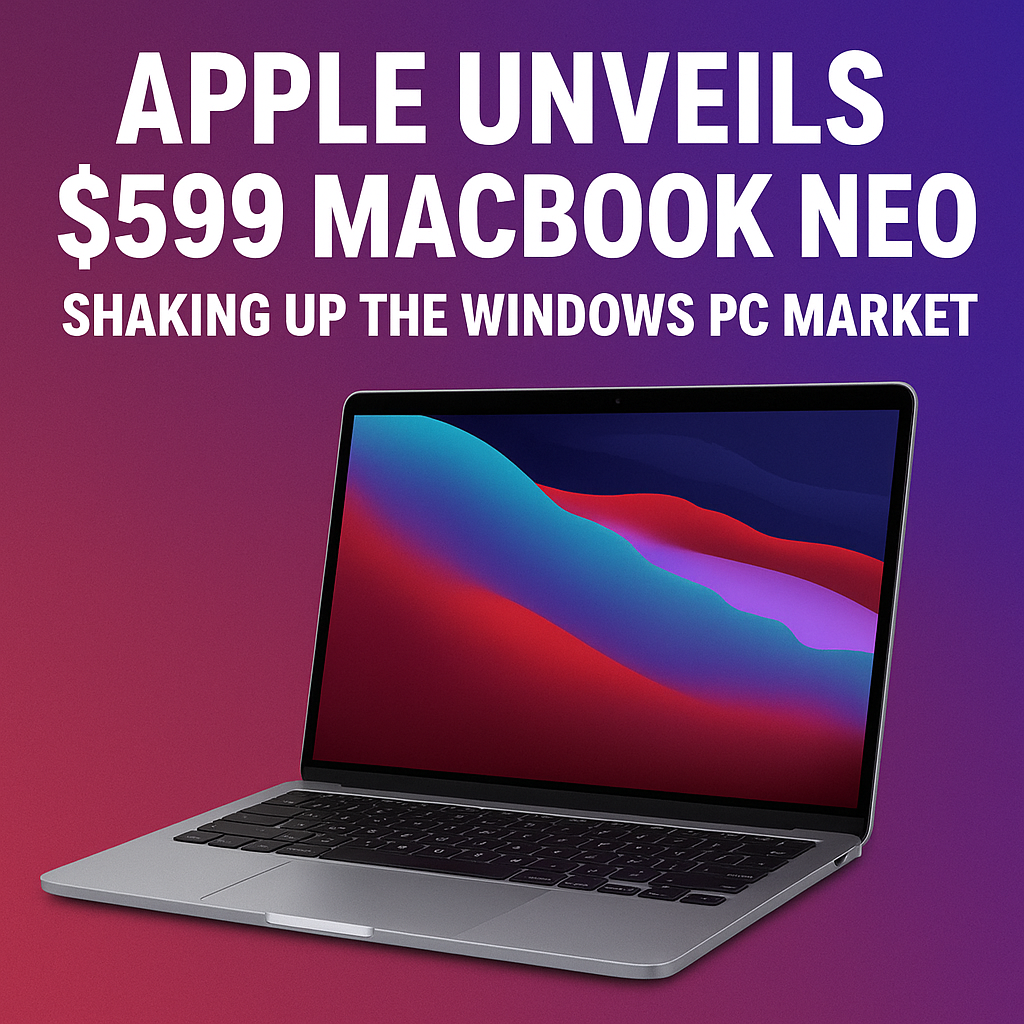
Apple has reportedly pulled the pin on a long-rumored disruption: a $599 MacBook Neo positioned to challenge budget and midrange Windows laptops head-on. If the price and performance claims hold, this new entry-level Mac could alter buying decisions for students, remote workers, small businesses, and anyone who previously assumed macOS was out of reach. The bigger story isn’t just a cheaper Mac—it’s how Apple’s tight integration of hardware, software, and silicon may rewrite expectations in the sub-$700 PC market.
What Is the MacBook Neo and Why the $599 Price Matters
The “MacBook Neo” branding signals a fresh tier in Apple’s lineup: simpler, more accessible, and designed to compete where the highest-volume laptop sales happen. In the Windows world, $499–$799 is the battleground where brands push thin-and-light notebooks with mixed compromises: lower-end processors, smaller batteries, dimmer screens, and plastic builds that don’t always age well.
A $599 MacBook immediately changes the conversation. Historically, Apple’s entry pricing has left many buyers comparing a $999 MacBook against a $599 Windows laptop—an unfair fight for the Mac. Bringing macOS down into the mainstream price band could:
- Increase macOS adoption among first-time laptop buyers
- Pressure Windows OEMs to improve build quality and battery life
- Shift education and small-business procurement toward Apple
- Strengthen Apple’s services ecosystem (iCloud, Apple Music, Apple TV+, Arcade)
How Apple Could Deliver a Budget Mac Without Gutting the Experience
Apple’s advantage in the lower-cost segment comes from its silicon strategy. By designing its own chips, Apple can deliver strong performance per watt, often translating into cooler operation and longer battery life. A $599 MacBook Neo is likely built around a cost-optimized Apple silicon configuration—potentially a slightly older-generation chip or a binned variant—while retaining the core benefits that make Macs feel “premium.”
Apple Silicon Efficiency vs. Budget Windows Laptops
In the Windows laptop market at this price, many models rely on entry-level Intel Core i3/i5 U-series, Intel N-series, or AMD Ryzen 3/5 chips paired with modest cooling and small batteries. Even when benchmarks look acceptable, real-world factors like fan noise, heat, and unplugged performance can undermine the experience.
A MacBook Neo priced at $599 could lean on Apple silicon efficiency to deliver:
- Consistent unplugged performance with less throttling
- All-day battery life expectations, even at a lower price
- Silent or near-silent operation thanks to efficient thermals
- Reliable standby and instant wake behavior
Where Apple Might Make Compromises
To hit $599, Apple would need to trim costs somewhere—without undermining the “Mac feel.” Likely areas for optimization could include:
- Display tiering: A solid Retina-class screen, but possibly lower peak brightness or refresh rate than premium models
- Ports: Fewer Thunderbolt/USB-C ports, or no MagSafe
- Storage and memory: Lower base configurations (e.g., 8GB RAM, 256GB SSD) to meet the headline price
- Materials: More cost-effective chassis design, though Apple may still favor aluminum to preserve durability
- Camera/audio: Competent, but not necessarily the same mic array and speakers as higher-end MacBooks
Even with compromises, Apple typically prioritizes responsiveness, trackpad quality, and software polish—areas where budget Windows laptops often struggle.
MacBook Neo vs. Windows Laptops: The Market Shockwave
If Apple truly enters the $599 tier, Windows PC makers will feel the pressure across retail shelves and online carts. The biggest impact won’t be on premium Windows ultrabooks; it will be on high-volume models from major OEMs competing on thin margins.
Value Comparison: What Buyers Usually Get at $599
Most $599 Windows laptops can be good, but the experience varies dramatically. Buyers often face trade-offs like mediocre displays, short battery life, loud fans, or fragile hinges. The MacBook Neo’s disruption is that it could offer a more consistent baseline, particularly in these categories:
- Trackpad and keyboard consistency: Apple’s trackpads remain a benchmark for precision
- Battery life predictability: macOS and Apple silicon are optimized together
- Build quality: Better rigidity and long-term durability than many budget plastics
- Software longevity: macOS updates tend to be supported for years
Performance: Real-World Tasks That Matter
For most mainstream buyers, “performance” means the laptop doesn’t stutter with everyday workloads. A well-positioned MacBook Neo could be highly competitive in:
- Web browsing with many tabs
- Office work (Docs/Sheets/Slides, Microsoft 365)
- Video calls (FaceTime, Zoom, Teams)
- Photo editing for hobbyists (Photos, Lightroom basics)
- Light video editing for social media clips
- Coding and student developer workflows (Xcode for iOS/macOS, VS Code, Python)
Where some Windows laptops may still win is in gaming at this price, especially with models offering entry-level discrete GPUs or better compatibility with popular titles. But Apple has been improving its gaming story, and for many shoppers in this segment, battery and portability matter more than FPS.
Why the MacBook Neo Could Be a Big Win for Students and Schools
Education is one of the most competitive laptop markets. Schools want low costs, durability, easy management, and long support windows. Apple already has strong mindshare with iPads, but laptops remain a Windows and Chromebook stronghold due to price and manageability.
A $599 MacBook Neo could shift that equation by offering:
- Lower entry cost for macOS-based learning environments
- Better resale value than many budget laptops, helping total cost of ownership
- Integration with iPhone and iPad for students already in the Apple ecosystem
- Accessibility features built into macOS
For college students, the Neo could be especially attractive as a “one laptop for everything” option: reliable battery life for campus days, strong performance for productivity, and access to Apple’s creative apps and tools.
Impact on Small Businesses and Remote Work
Small businesses often buy in the $600–$900 range because they need functional, secure machines without premium pricing. If Apple delivers a MacBook Neo at $599, it could become a default recommendation for teams that live in browsers, spreadsheets, and video calls.
Key business-friendly advantages may include:
- Security and privacy posture built into macOS
- Stable performance for conferencing and multitasking
- Device longevity and strong update cadence
- Easy onboarding for employees who already use iPhones
That said, Windows still dominates many workplaces due to legacy apps and IT tooling. The MacBook Neo won’t erase that overnight, but it could accelerate gradual shifts—especially in startups, agencies, and distributed teams.
The Ecosystem Effect: Apple Services and Device Synergy
One reason Apple can justify aggressive hardware pricing is the long-term value of ecosystem engagement. A MacBook Neo could bring more users into macOS, increasing usage of:
- iCloud+ storage plans
- Apple Music and Apple TV+
- App Store purchases and subscriptions
- Continuity features like AirDrop, Handoff, Universal Clipboard, and iPhone Mirroring
For consumers, this synergy can be genuinely useful: quick file sharing, seamless switching between devices, and tighter integration with iMessage and FaceTime. For competitors, it’s a lock-in advantage that’s difficult to match without controlling both hardware and software.
Potential Concerns: What Buyers Should Watch Before Jumping In
A lower-priced MacBook is exciting, but shoppers should evaluate the details. The headline price may reflect a base configuration that’s perfect for some people and restrictive for others.
RAM and Storage Configuration
If the MacBook Neo starts at 8GB of memory and 256GB storage, it may be excellent for everyday productivity, but buyers planning to keep it for many years should consider whether upgrades are possible or cost-effective. Apple’s configuration upgrades can add up quickly, sometimes narrowing the gap with higher-tier models or strong Windows alternatives.
Ports and Display Features
Budget laptops often cut ports. If the Neo offers only one or two USB-C ports, many users will want a hub for USB-A accessories, HDMI, or SD cards. Similarly, screen brightness and color accuracy matter for creators—so it’s worth checking whether the display is aimed at general users or creative workloads.
Windows Compatibility and Specialized Software
Some buyers simply need Windows-only applications. While virtualization and compatibility layers can help in some cases, they’re not universal solutions. If your work depends on a specific Windows app or enterprise VPN/security tool, confirm macOS support before switching.
What This Means for the Windows PC Market in 2026
The Windows ecosystem is enormous, diverse, and resilient—but it’s also fragmented. Apple’s strategy with a $599 MacBook Neo would be to offer a simpler choice: a laptop that feels premium even at a mainstream price, backed by years of OS updates and a tightly integrated experience.
Windows laptop makers are unlikely to stand still. Expect responses such as:
- More aggressive discounting on popular thin-and-light models
- Improved battery life focus in mainstream configurations
- Better screens and trackpads at lower price points
- Increased marketing around gaming, ports, upgradeability, and Windows flexibility
Ultimately, consumers benefit. A real Apple entry at $599 could raise the baseline for what a budget laptop should deliver.
Conclusion: A Cheaper Mac Could Change Laptop Buying Habits
If Apple’s $599 MacBook Neo becomes widely available, it could be one of the most important laptop launches in years—not because it introduces a radically new category, but because it brings Apple’s strengths to the price bracket where most laptops are sold. For students, remote workers, and everyday buyers, the Neo could offer a more reliable, longer-lasting alternative to typical budget Windows laptops. For the PC industry, it’s a wake-up call: value is no longer only about specs on a sticker—it’s about the full experience over several years of ownership.
FAQs
Is the $599 MacBook Neo real and available everywhere?
Availability depends on Apple’s release strategy and regional pricing. Even if the base price is $599 in the U.S., taxes, tariffs, and currency conversion can change the final cost elsewhere. Check Apple’s official store listings and authorized retailers for confirmed pricing and stock.
Who should buy the MacBook Neo instead of a Windows laptop?
The MacBook Neo is best for users who want reliable battery life, smooth everyday performance, and macOS features—especially students, remote workers, and iPhone owners. If you rely on Windows-only software or want the widest range of gaming options, a Windows laptop may still be the better fit.
Will a $599 MacBook Neo be good for gaming?
It should handle casual and some optimized titles well, but many mainstream Windows games still run best on Windows PCs, especially those designed around DirectX and discrete GPUs. Buyers focused on gaming value may find stronger options among Windows laptops in the same price range.
What compromises might Apple make to reach the $599 price?
Common cost-saving areas could include fewer ports, a simpler display spec, and lower base RAM/storage. The overall experience may still feel premium, but buyers should verify configuration details and consider whether storage or memory upgrades are needed for their workload.
Could the MacBook Neo force Windows laptop prices down?
It could increase competitive pressure, especially in retail channels where shoppers compare laptops by price first. Windows OEMs may respond with discounts, improved baseline features, and better bundled value to keep buyers from switching to macOS.