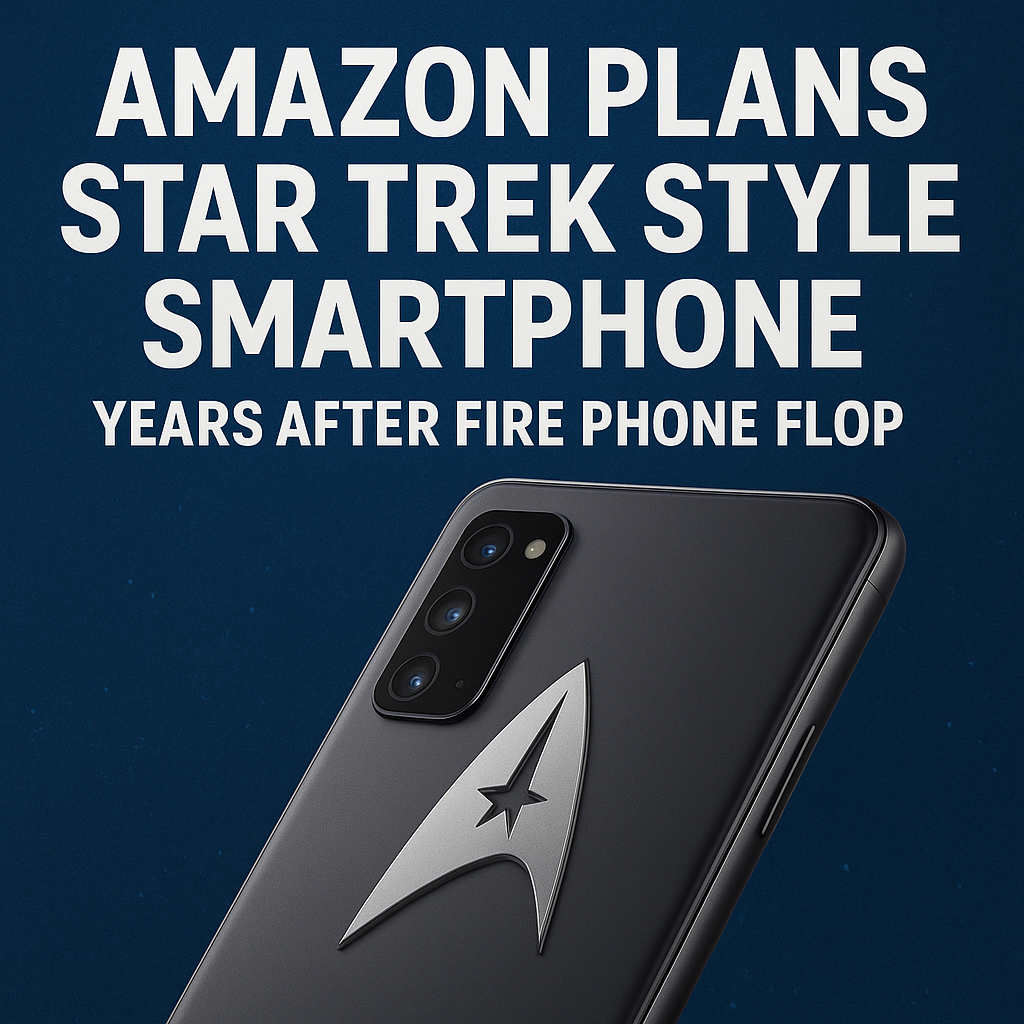
Amazon is reportedly exploring a “Star Trek style” smartphone concept years after the company’s high-profile Fire Phone flop—an idea that signals both ambition and a willingness to revisit a market it once exited with bruises. While details remain speculative, the phrase suggests a device that feels more like a futuristic communicator than a conventional handset: voice-first, deeply contextual, and infused with AI that anticipates what you need before you tap a screen. In an era where generative AI and ambient computing are reshaping consumer expectations, Amazon may believe the timing is finally right to reimagine what a smartphone can be.
Amazon’s Smartphone Comeback: Why Now?
Amazon’s potential return to smartphones comes at a moment when the market is hungry for meaningful innovation beyond incremental camera upgrades and faster chips. The smartphone category is mature, but the user experience is in flux as AI assistants become more capable and as hardware makers search for the next interface shift—voice, gestures, wearables, or even “screenless” interactions.
For Amazon, the opportunity is clear: it already operates one of the largest consumer ecosystems in the world, spanning shopping, entertainment, smart home devices, and cloud services. A new Amazon smartphone could act as a personal hub that connects Prime benefits, Alexa, Ring, Eero, Kindle, and Amazon’s growing AI capabilities into a single always-available device.
The AI Inflection Point
The biggest change since the Fire Phone era is AI. In 2014, the Fire Phone’s differentiator—Dynamic Perspective 3D effects and Firefly object recognition—felt novel but niche. Today, AI can power genuinely useful features: summarizing messages, booking reservations, generating shopping lists, predicting reminders, and orchestrating smart home routines based on context.
Amazon’s Hardware Confidence Has Improved
Amazon’s hardware track record looks stronger than it did a decade ago. Echo speakers, Fire TV, Ring, and other devices have built a large installed base. Even if Amazon’s hardware margins are slim, the company has repeatedly shown it can scale devices that strengthen service usage and customer retention.
What “Star Trek Style Smartphone” Could Mean
When people say “Star Trek style,” they often mean a device that functions like a communicator: quick to access, voice-driven, and seamless. In practical terms, that could translate to a smartphone designed around AI-first interactions—less app switching, more natural conversation with a digital assistant, and smarter automation.
Voice-First and Ambient Intelligence
A Star Trek-inspired phone would likely prioritize voice commands and contextual awareness. Instead of hunting through apps, you might ask the device to “plan my commute,” “send a summary of today’s meetings,” or “reorder what I’m low on,” and the assistant would coordinate across services automatically.
Faster Actions, Fewer Screens
Future-forward phones may reduce the friction of repetitive tasks. Think of a “command deck” interface: quick actions, intelligent suggestions, and on-device widgets that respond to location, time, and habits. The goal would be to make the device feel more like a helpful companion than a portal to endless scrolling.
Potential Form Factors: Not Just Another Slab
“Star Trek style” could also hint at a more distinctive design—possibly a slimmer, more ergonomic build, specialized buttons, or accessories that make it easier to initiate voice interactions. While foldables and flip phones are already changing hardware design, Amazon might pursue a more functional twist: a device optimized for one-handed use, quick capture, and smart home control.
Lessons from the Fire Phone Flop
Any Amazon smartphone plans will be viewed through the lens of the Fire Phone, launched in 2014 and discontinued not long after. The Fire Phone is often cited as a cautionary tale: even companies with deep pockets can fail in smartphones if they misread consumer priorities.
What Went Wrong with Fire Phone?
- Weak value proposition: The 3D interface didn’t solve a common problem, and many users saw it as a gimmick.
- Carrier and pricing challenges: Limited distribution and pricing missteps made adoption harder.
- Ecosystem limitations: Amazon’s app ecosystem lagged behind Apple and Google, and users didn’t want to compromise on core apps.
- Late to a crowded market: The smartphone battlefield was already dominated by iPhone and Android flagships.
What Amazon Would Need to Do Differently
To succeed this time, Amazon would need a sharper focus on daily utility and friction reduction—especially through AI—rather than flashy visual effects. It would also need strong partnerships, broad app access (likely via Android), competitive camera and battery performance, and a clear reason to choose it over established brands.
How Amazon Could Differentiate in 2026 and Beyond
A modern Amazon smartphone wouldn’t win by trying to out-iPhone the iPhone. It would need a unique angle that leverages Amazon’s strengths: retail, logistics, smart home, and cloud-scale AI.
Deep Alexa Integration (and a Smarter Alexa)
Alexa remains one of Amazon’s most recognizable consumer products, but the next era demands an assistant that can handle complex, multi-step tasks. A new phone could become the “best place” to use Alexa: private, personalized, and always with you.
- Conversational search that actually completes tasks rather than just answering questions
- Proactive reminders based on email, calendar, location, and purchase history (with strong privacy controls)
- Seamless handoff between Echo devices at home and the phone on the go
Prime as a Built-In Advantage
Amazon could bundle phone perks with Prime to make the value proposition instantly understandable. For example: extended warranties, cloud storage, device trade-in credits, exclusive deals, or integrated delivery tracking and returns. The key is to make benefits feel tangible every day, not just during sales events.
Smart Home Control That’s Actually Frictionless
Amazon owns major smart home touchpoints through Ring, Echo, and Eero. A Star Trek style smartphone could act as the control center for home security and automation with:
- One-tap arming/disarming and live camera views
- AI-powered alerts that summarize events (“Package delivered at 2:14 PM”)
- Local, secure controls for Wi‑Fi and device management
Shopping and Logistics Features Others Can’t Match
Amazon’s core business could enable features that feel futuristic in a practical way. Imagine scanning a product and instantly getting compatibility checks, price history, replenishment suggestions, or faster warranty support. If Amazon ties AI to its product catalog and fulfillment network, the phone becomes a powerful commerce assistant—not just a browser.
Big Challenges Amazon Still Faces
Even with better timing, building a successful smartphone is hard. The barriers aren’t only technical—they’re psychological and ecosystem-based. Consumers keep phones for years, and switching costs are high.
Competing with Apple and Google Ecosystems
Apple’s iMessage, AirPods integration, and services lock-in remain formidable. Google owns Android and the default app ecosystem. For Amazon, the most viable path would likely be an Android-based device with Google Play access, unless it can offer a compelling alternative that doesn’t feel restrictive.
Privacy and Trust
A voice-first, AI-forward smartphone raises obvious privacy questions. Amazon would need transparent controls, strong on-device processing where possible, clear opt-ins, and easy-to-understand data policies. If the phone feels like a surveillance device rather than a personal communicator, it won’t gain traction.
Carrier Partnerships and Distribution
One Fire Phone lesson is that distribution matters. Amazon could sell unlocked devices directly, but mainstream adoption often requires carrier visibility, financing offers, and in-store presence. Strong partnerships could determine whether the phone becomes a niche experiment or a serious contender.
What This Means for the Smartphone Market
If Amazon re-enters the market with a Star Trek style smartphone, it could accelerate the shift toward AI-first experiences. Competitors would respond with more proactive assistants, deeper service bundles, and new hardware shortcuts for voice and automation. The biggest winner could be consumers—if competition drives assistants to become genuinely helpful rather than merely conversational.
Even if Amazon’s device never becomes a top seller, it could still influence the industry by pushing new interaction models and normalizing the idea that smartphones should do more on your behalf. That was the promise of digital assistants for years. The AI era might finally make it real.
Should Consumers Be Excited or Skeptical?
Both reactions are reasonable. Amazon has the resources and ecosystem to attempt something bold, and the “Star Trek style” framing hints at a more ambitious rethink than a standard Android handset. At the same time, smartphones punish half-measures. If the device lacks a polished camera, reliable battery life, and familiar apps, early adopters may lose patience quickly.
The most convincing version of an Amazon smartphone would combine strong fundamentals with a new layer of AI-driven convenience—one that’s useful daily, not just impressive in demos. If Amazon can deliver that, its smartphone comeback could be more than a curiosity; it could be a real chapter two after the Fire Phone flop.
FAQs
Is Amazon really making a new smartphone?
Amazon has not officially confirmed a new smartphone launch. Reports and industry speculation suggest the company may be exploring a “Star Trek style” concept, but plans can change before any product announcement.
What does “Star Trek style smartphone” actually refer to?
It generally implies a communicator-like device that emphasizes voice-first controls, AI assistance, and quick, contextual interactions—potentially reducing the need to constantly tap through apps and menus.
Why did the Amazon Fire Phone fail?
The Fire Phone struggled due to limited app ecosystem appeal, distribution and pricing challenges, and features that many consumers considered gimmicky rather than essential, all in a highly competitive market.
How could Amazon differentiate from iPhone and Samsung Galaxy?
Amazon could focus on deep AI-powered Alexa integration, Prime-based benefits, superior smart home controls through Ring and Echo, and shopping/logistics features tied to Amazon’s retail ecosystem.
Would an Amazon smartphone run Android?
There’s no confirmed information. For broad adoption, an Android-based approach with access to mainstream apps would be the most consumer-friendly route, but Amazon could also customize the software heavily around Alexa and its services.