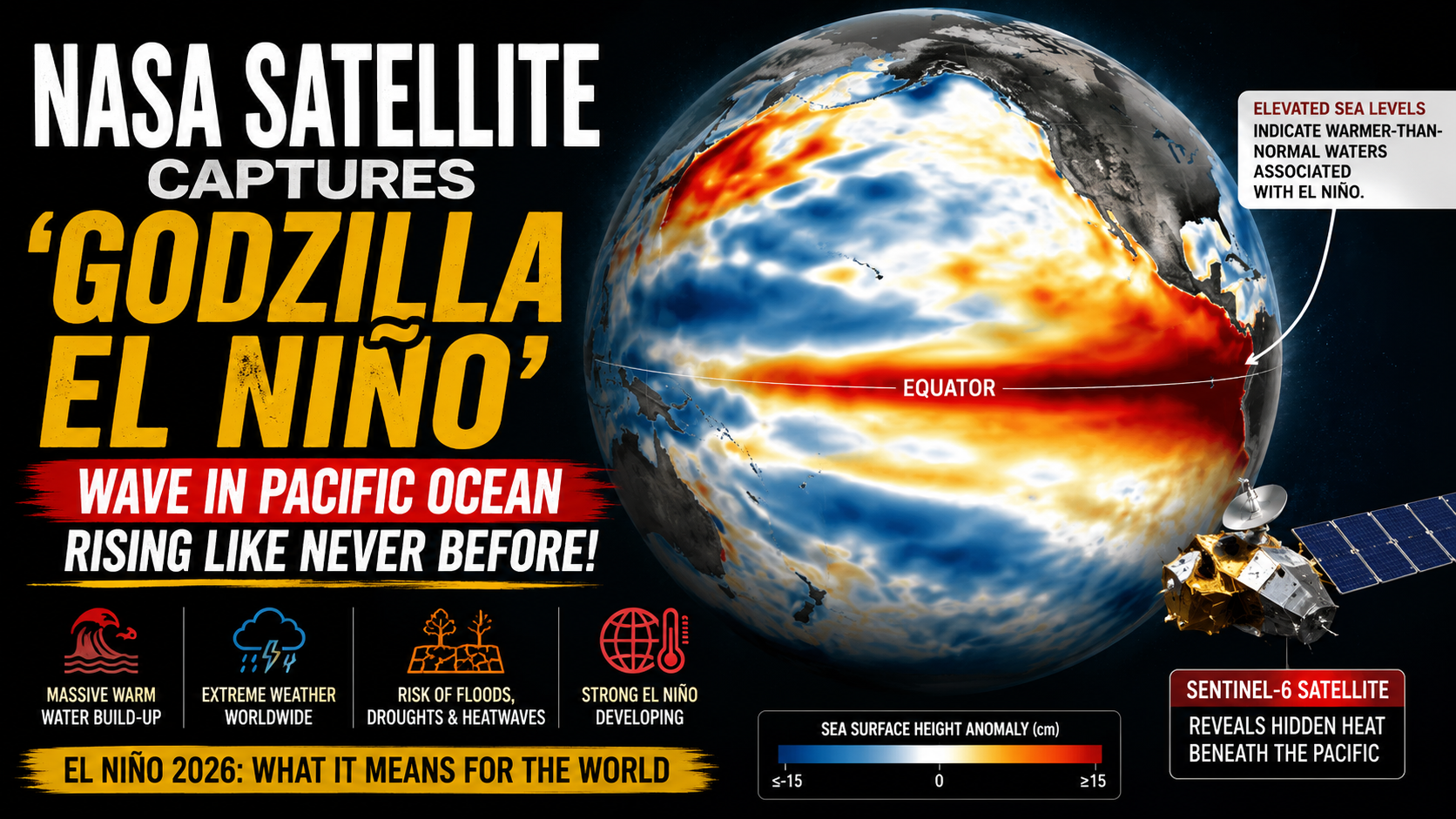
A powerful El Niño event is rapidly developing in the Pacific Ocean, and new satellite observations from NASA have revealed what scientists describe as a massive reservoir of heat hidden beneath the ocean’s surface. The findings have sparked concern among climate experts, who warn that the strengthening phenomenon could become one of the most significant weather events in decades.
Data collected by the Sentinel-6 Michael Freilich satellite show unusually high sea levels stretching across the equatorial Pacific, indicating that enormous amounts of warm water are accumulating below the surface. Researchers say the current conditions bear striking similarities to those observed in 1997, when the infamous “Godzilla El Niño” triggered floods, droughts, crop failures, and extreme temperatures around the world.
As the event intensifies, scientists are closely monitoring its development and assessing what it could mean for global weather patterns, food production, and economies.
What Is El Niño?
El Niño is a naturally occurring climate pattern characterized by unusually warm ocean temperatures in the central and eastern Pacific Ocean. It forms when trade winds weaken, allowing warm water that typically remains near Indonesia and Australia to shift eastward toward the Americas.
This change disrupts atmospheric circulation and alters weather patterns across the globe.
El Niño events can lead to:
- Heavy rainfall and flooding in the Americas.
- Droughts in Australia and Southeast Asia.
- Increased temperatures worldwide.
- Crop losses and food shortages.
- Heatwaves and water shortages in various regions.
While El Niño occurs every few years, some events are far stronger than others. The 1997–98 El Niño remains one of the strongest and most destructive in modern history.
NASA’s Sentinel-6 Satellite Detects Massive Heat Reservoir
Unlike traditional temperature measurements that focus only on the ocean’s surface, NASA’s Sentinel-6 Michael Freilich satellite measures sea surface height.
Warm water expands as it heats up, causing sea levels to rise. These elevated sea levels provide scientists with valuable clues about the amount of heat stored beneath the surface.
Recent observations show large areas of the equatorial Pacific glowing red, indicating significantly higher-than-normal sea levels.
According to researchers at NASA’s Jet Propulsion Laboratory (JPL), this suggests a huge amount of heat is building beneath the ocean surface—a critical ingredient for a powerful El Niño.
Why Scientists Are Comparing It to the 1997 “Godzilla El Niño”
Researchers say the current ocean conditions strongly resemble those observed in June 1997.
The 1997-98 El Niño event became known as the “Godzilla El Niño” because of its extraordinary intensity and devastating impacts worldwide.
That event caused:
- Severe flooding in Peru and California.
- Major droughts across Indonesia and Australia.
- Crop failures in several countries.
- Widespread heatwaves.
- Billions of dollars in economic losses.
- Increased disease outbreaks due to changing weather patterns.
Although the current event has not yet reached that level, scientists say the similarities are concerning.
NOAA Officially Declares El Niño Conditions
The National Oceanic and Atmospheric Administration (NOAA) officially declared El Niño conditions on June 11 after months of above-average ocean temperatures in the Pacific.
This announcement confirmed what many scientists had already suspected—that a major climate shift is underway.
NOAA experts believe the event will continue strengthening over the coming months.
The Role of Kelvin Waves
One of the main drivers behind the developing El Niño is the presence of giant underwater pulses called Kelvin waves.
These enormous waves transport warm water from the western Pacific toward the eastern Pacific.
When trade winds weaken or reverse, warm water that normally accumulates near Indonesia and Australia begins moving eastward.
As this warm water spreads across the Pacific:
- Colder water upwelling near South America becomes suppressed.
- Ocean temperatures rise rapidly.
- Atmospheric circulation patterns change.
- Weather systems around the globe are affected.
Scientists say several additional Kelvin waves are already moving toward the eastern Pacific, suggesting that the event is still intensifying.
Why Sea Surface Height Matters
Traditional sea surface temperature measurements only reveal what is happening near the ocean’s surface.
Sea level measurements provide a deeper understanding.
According to NASA scientists:
“Sea-surface height tells us how much heat is stored below the surface.”
A shallow layer of warm water might have limited effects. However, a deep reservoir of heat can fuel powerful climate events capable of influencing weather worldwide.
The latest Sentinel-6 data indicate that a massive amount of hidden heat is already building beneath the Pacific Ocean.
How El Niño Could Affect India
For India, El Niño is particularly important because it often influences the southwest monsoon.
Historically, strong El Niño events have been associated with:
Weak Monsoon Rainfall
Reduced rainfall can affect agriculture and water availability.
Heatwaves
India could experience prolonged periods of extreme heat.
Crop Losses
Lower rainfall may impact rice, wheat, sugarcane, and other essential crops.
Water Scarcity
Reservoir levels and groundwater supplies could face additional stress.
Rising Food Prices
Poor agricultural output can lead to inflation and higher food costs.
However, experts note that every El Niño behaves differently, and its exact impact on India depends on several factors.
Global Consequences of a Strong El Niño
The effects of El Niño are felt across continents.
North America
Parts of the United States may experience heavy rainfall and flooding.
South America
Peru and Ecuador often face severe flooding and landslides.
Australia
Dry conditions increase the risk of bushfires and drought.
Southeast Asia
Reduced rainfall threatens agriculture and water resources.
Africa
Some regions may experience drought, while others see excessive rainfall.
Europe
Warmer temperatures and unusual weather patterns can occur.
Because weather systems are interconnected, a strong El Niño can influence temperatures and precipitation across the globe.
Climate Change and El Niño
Scientists continue to study how climate change may be affecting El Niño events.
While El Niño itself is a natural phenomenon, rising global temperatures could intensify its impacts.
Warmer oceans contain more energy, potentially leading to:
- Stronger storms.
- More extreme rainfall.
- Increased heatwaves.
- Greater agricultural disruptions.
Many researchers believe that climate change and El Niño together could amplify extreme weather events.
Why Scientists Are Closely Monitoring the Situation
The developing El Niño is still evolving.
Researchers are monitoring:
- Sea surface temperatures.
- Sea level changes.
- Trade wind behavior.
- Kelvin wave activity.
- Atmospheric pressure patterns.
These observations will help determine whether the event becomes comparable to the devastating 1997 “Godzilla El Niño.”
Current satellite data suggest that additional warming is likely in the coming months.
Advances in Satellite Technology Help Predict Climate Events
NASA’s Sentinel-6 Michael Freilich satellite represents one of the most advanced tools available for studying Earth’s oceans.
The satellite provides:
- Highly accurate sea level measurements.
- Real-time climate monitoring.
- Early warning signs for El Niño development.
- Improved forecasting capabilities.
Such technology enables scientists and governments to prepare for extreme weather events before they occur.
Preparing for a Possible Super El Niño
Governments and disaster management agencies worldwide are already assessing potential risks.
Preparation measures may include:
- Strengthening water conservation efforts.
- Improving agricultural planning.
- Enhancing flood management systems.
- Monitoring food supplies.
- Preparing for heatwaves and drought conditions.
Early planning could help reduce the social and economic damage associated with a strong El Niño.
Conclusion
NASA’s Sentinel-6 satellite has provided a remarkable glimpse into the powerful forces building beneath the Pacific Ocean. The enormous reservoir of heat detected by the spacecraft has raised concerns that the world could be heading toward a major El Niño event similar to the devastating “Godzilla El Niño” of 1997.
With additional Kelvin waves approaching and ocean temperatures continuing to rise, scientists believe the phenomenon is still intensifying.
As climate experts monitor developments closely, countries around the world—including India—are preparing for the possibility of significant changes in rainfall, temperatures, agriculture, and extreme weather patterns.
The coming months will reveal whether this developing El Niño becomes one of the most powerful climate events of the 21st century.
This website is proudly managed and maintained by Shunya Digit.