The mysteries of our solar system continue to fascinate scientists and space enthusiasts alike. One long-standing question has puzzled astronomers for years: why does Jupiter have multiple giant moons, while Saturn has only one?
A groundbreaking study published in April 2026 by researchers at Kyoto University in the journal Nature Astronomy finally offers a compelling explanation. The answer lies deep within the early formation of these gas giants—and their magnetic fields.
The Key Difference: Giant Moons of Jupiter vs Saturn
Both Jupiter and Saturn are massive planets with extensive systems of moons. In fact, Saturn has over 280 known moons, far more than Jupiter.
However, when it comes to large moons, the situation is reversed.
Jupiter boasts four massive moons:
- Io
- Europa
- Ganymede
- Callisto
These are collectively known as the Galilean moons and are comparable in size to small planets.
In contrast, Saturn has only one giant moon:
- Titan
This stark difference has long puzzled scientists—until now.
The Magnetic Secret Behind Moon Formation
The new study highlights the role of magnetic fields during the early stages of planetary formation.
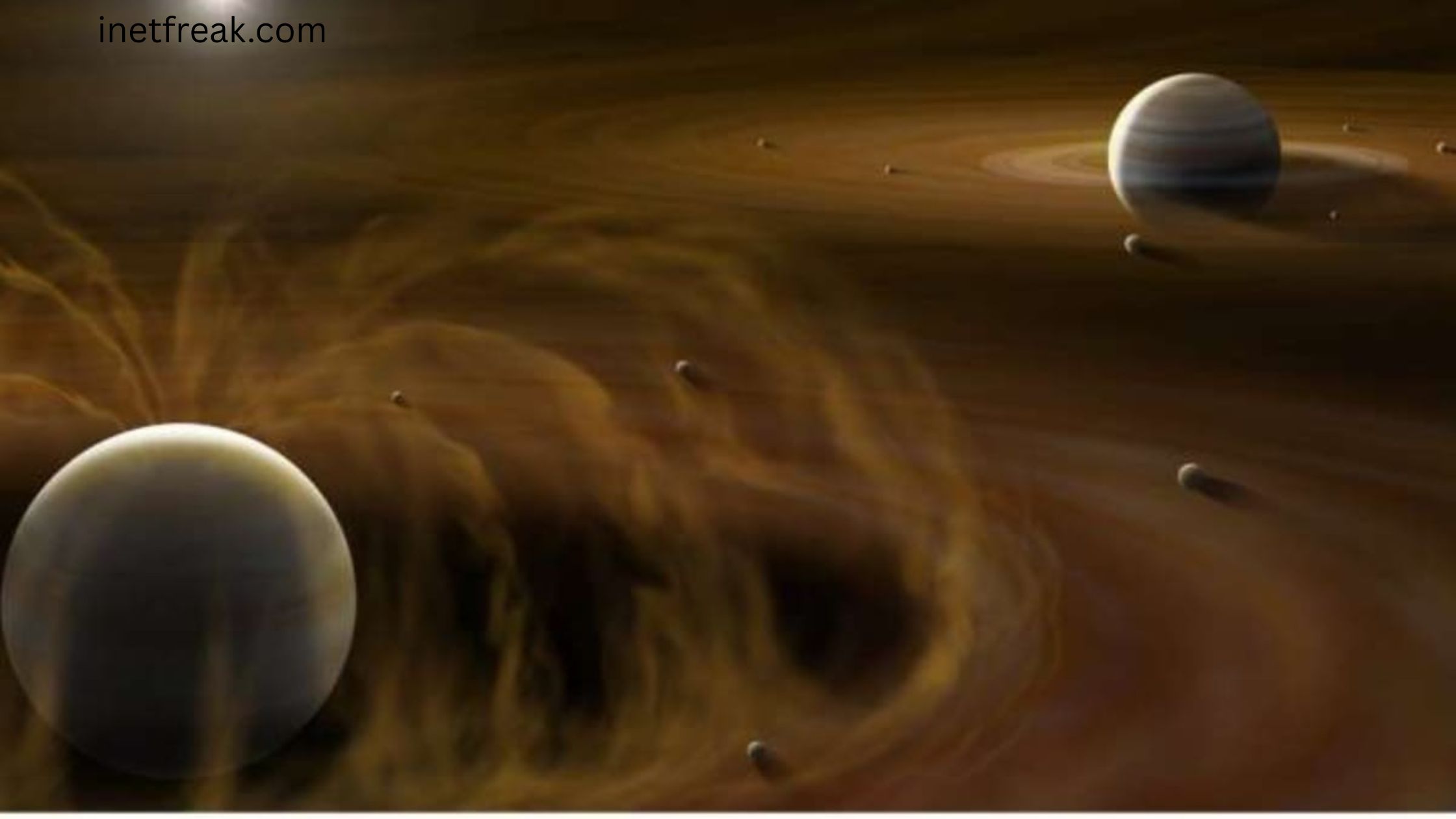
When gas giants like Jupiter and Saturn were forming, they were surrounded by swirling disks of gas and dust called circumplanetary disks. These disks are the birthplaces of moons.
Jupiter’s Strong Magnetic Field
According to the research, Jupiter had a powerful magnetic field in its early days. This field created a gap in its surrounding disk, effectively forming a stable, isolated region.
This region acted like a “moon factory,” allowing multiple large moons to form and remain in stable orbits.
Saturn’s Weaker Magnetic Field
On the other hand, Saturn’s magnetic field was significantly weaker. Because of this, it couldn’t create a similar gap in its disk.
As a result:
- Moon-forming material was less stable
- Moons migrated inward and were lost or merged
- Only one large moon, Titan, managed to survive and grow
Why This Discovery Matters
This study doesn’t just explain the difference between Jupiter and Saturn—it has much broader implications for planetary science.
Understanding Planetary Formation
The findings provide new insights into how planets and their satellites form. Magnetic fields, often overlooked in earlier models, now appear to play a crucial role.
Clues About Exomoons
The research also helps scientists predict the existence of moons beyond our solar system.
Planets larger than Jupiter are likely to have:
- Multiple large moons
- Compact moon systems
While Saturn-sized planets may have:
- Only one or two major moons
This is especially important in the search for exomoons, which are moons orbiting planets in distant star systems.
Our Solar System as a Natural Laboratory
One of the study’s key points is that our solar system serves as a unique testing ground for theories of planetary formation.
According to lead researcher Yuri Fujii, systems like those around Jupiter and Saturn allow scientists to observe and test ideas that would otherwise be impossible to study directly in distant parts of the universe.
A New Perspective on Gas Giants
This discovery reshapes how we understand gas giants and their satellite systems. It shows that even subtle differences—like magnetic field strength—can lead to dramatically different outcomes.
It also explains why Jupiter ended up with a rich system of large moons, while Saturn did not.
Final Thoughts
The question of why Jupiter has more giant moons than Saturn has finally been answered, thanks to cutting-edge research and advanced modeling.
By uncovering the role of magnetic fields in moon formation, scientists have taken a major step forward in understanding the complex processes that shape planetary systems.
As research continues, discoveries like this will not only deepen our knowledge of our own solar system but also guide us in exploring the countless worlds beyond it.