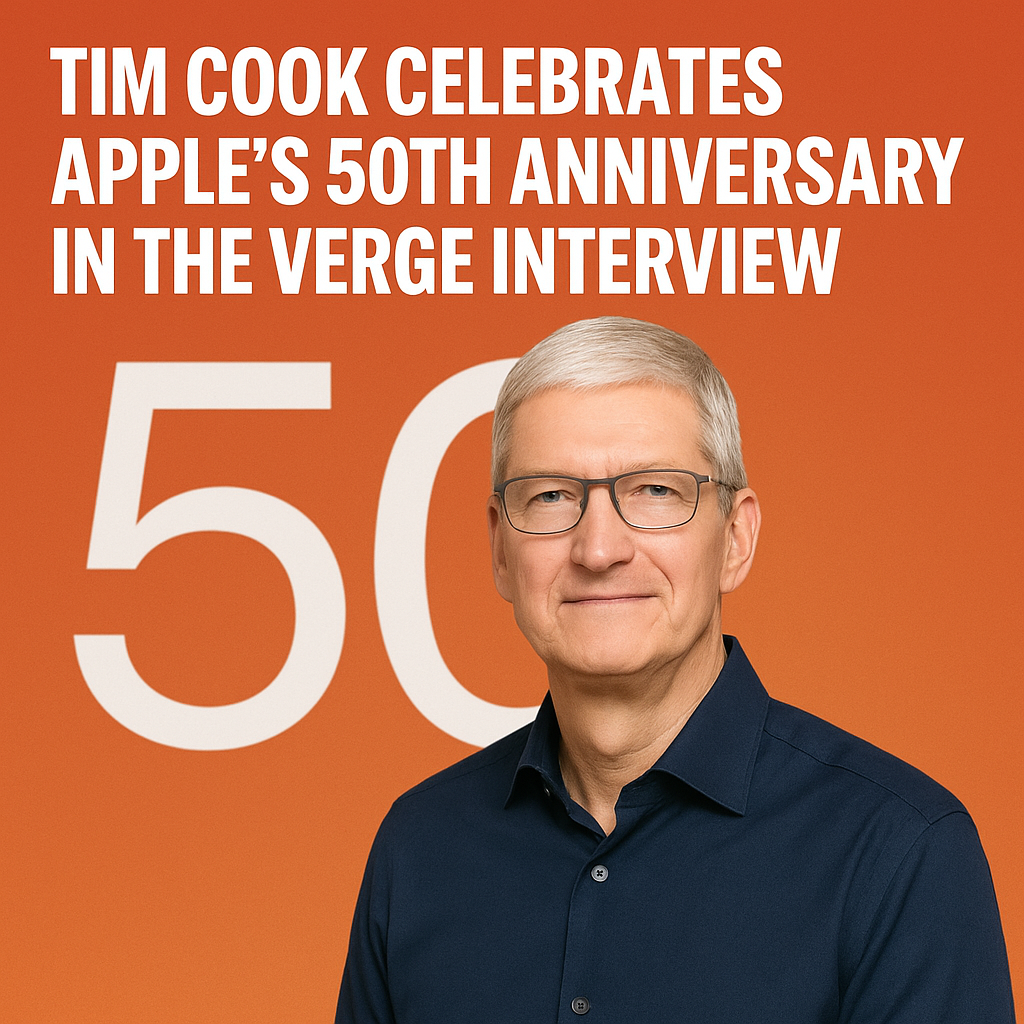
Apple’s 50th anniversary is more than a milestone; it’s a cultural marker for how personal technology moved from hobbyist garages to the center of modern life. In a wide-ranging interview with The Verge, Apple CEO Tim Cook reflected on the company’s legacy, the values that have guided Apple from the Apple I to Apple Intelligence, and the leadership lessons he carries into the next era. The conversation framed Apple’s first half-century as a story of focus, reinvention, and an ongoing commitment to building products that blend hardware, software, and services into experiences people trust.
Why Tim Cook’s The Verge interview matters for Apple’s 50th anniversary
Interviews with Tim Cook are often carefully measured, but anniversaries create space for broader reflection. The Verge conversation, positioned around Apple’s 50th anniversary, highlights how Apple sees itself: a company that wants to lead through product excellence, long-term bets, and a core set of principles rather than short-term trends.
For Apple fans, investors, and industry watchers, Cook’s remarks offer clues about Apple’s strategic posture: how it thinks about innovation now, how it interprets its past, and what it believes will define the next decade of iPhone, Mac, Apple Watch, services, and AI.
Apple at 50: From counterculture startup to global platform
Few technology companies remain relevant for five decades without losing their identity. In the interview, Cook emphasized continuity: Apple’s mission to make technology personal and approachable, and its insistence that the best products come from deep integration and disciplined decision-making.
The themes that defined Apple’s first 50 years
- Product-led storytelling: Apple’s biggest moments are tied to landmark products, not abstract roadmaps.
- Integration as strategy: Apple builds the silicon, the operating systems, and key services to create coherent experiences.
- Design with intent: Hardware and software decisions are shaped by usability, aesthetics, and human factors.
- Privacy as a feature: Apple increasingly differentiates itself by limiting data collection and emphasizing on-device protections.
- Long-term bets: Apple often enters categories late, then refines them through iteration and ecosystem leverage.
Tim Cook’s anniversary message: Values, people, and purpose
Cook’s leadership style differs from Apple’s founder era, and he’s aware of the contrast. In The Verge interview, he used the anniversary as a moment to spotlight the people behind Apple and the values that survive leadership transitions. He also underscored that Apple’s success isn’t solely measured by revenue or market cap, but by whether products improve lives and are built responsibly.
What Cook highlighted about Apple’s culture
Apple’s internal culture is famously secretive, but Cook’s public comments often return to a few recurring ideas:
- Collaboration across disciplines: Engineering, design, operations, and services are expected to move together.
- Operational excellence: Cook’s background in operations shaped Apple’s ability to scale globally without sacrificing margins or quality control.
- Accessibility and inclusion: Apple consistently frames accessibility features as core product work rather than optional add-ons.
- Environmental responsibility: Apple positions its climate efforts as an engineering problem and a supply chain transformation effort.
Innovation at 50: How Apple defines “the next big thing”
The notion that Apple must always be “about to release the next iPhone” is a recurring industry expectation. Cook’s perspective, as conveyed in the interview, is more patient and methodical. Apple tends to view innovation as a combination of breakthroughs, refinement, and ecosystem-level improvements that compound over time.
Incremental vs. breakthrough innovation
Apple’s history shows that its biggest leaps often came from a sequence of smaller steps. The Mac refined graphical computing for a wider audience; the iPod accelerated digital music adoption; the iPhone merged phone, internet device, and media player into one; Apple Silicon redefined Macs’ performance-per-watt curve. Cook’s anniversary reflections reinforce a view that true innovation includes:
- Platform shifts (new architectures, new interaction models, new devices)
- Feature compounding (camera systems, health sensors, continuity tools, security improvements)
- Ecosystem effects (App Store economy, services bundles, cross-device experiences)
Apple and AI: The anniversary lens on Apple Intelligence
No modern Apple conversation is complete without AI. In the context of Apple’s 50th anniversary, Cook’s discussion with The Verge naturally points to Apple’s attempt to define AI on its own terms: privacy-oriented, user-centric, and deeply integrated into the operating system experience rather than delivered as a standalone chatbot.
Apple’s strategy emphasizes practical outcomes: better writing tools, smarter search and summarization, more helpful Siri interactions, and tighter integration with apps people already use. The anniversary framing also reinforces a broader message: Apple wants to adopt transformational technologies in a way that aligns with its philosophy, even if that means moving more deliberately than competitors.
What differentiates Apple’s approach to AI
- On-device processing: More tasks handled locally to reduce data exposure and improve responsiveness.
- Private cloud computing: When server-side help is needed, Apple emphasizes confidentiality and minimized data retention.
- OS-level integration: AI as a layer across apps and workflows, not a separate destination.
- Focus on utility: Features designed around everyday tasks rather than novelty demos.
Privacy, security, and trust: Apple’s long game
Cook has repeatedly positioned privacy as a fundamental human right, and the anniversary interview continues that narrative. Over the last decade, Apple has used privacy as both a moral stance and a competitive differentiator. This includes device encryption, transparency tools, and a push for minimized tracking across apps.
At 50, Apple’s greatest asset may be trust: trust that your phone will last, your data will be protected, and your ecosystem will work reliably. Cook’s message suggests Apple intends to keep monetization aligned with product value rather than heavy surveillance-based advertising.
Hardware, software, and services: The Apple ecosystem at mid-century
Apple’s transformation into a services powerhouse is one of the most important business shifts of the Cook era. Yet Apple remains fundamentally a device company in how it introduces and markets products. The anniversary conversation helps connect these two truths: Apple uses services to deepen the value of hardware, while hardware anchors customer loyalty and unlocks premium experiences.
Key pillars of Apple’s ecosystem strategy
- Device continuity: Handoff, iCloud sync, AirDrop, and cross-device features keep users within Apple’s ecosystem.
- Services expansion: App Store, iCloud, Apple Music, Apple TV+, Apple Pay, and AppleCare enhance recurring value.
- Custom silicon: Apple Silicon strengthens performance, battery life, and AI capabilities across product lines.
- Developer platform: Tools and frameworks that help third-party apps feel native and integrated.
Leadership reflections: Tim Cook’s role in Apple’s second half-century
As Apple marks 50 years, the conversation inevitably turns to leadership: what it means to steer one of the world’s most scrutinized companies through constant change. Cook’s public reflections tend to emphasize stewardship over spotlight. He’s often more interested in how Apple functions as an institution than in shaping a myth around any single leader.
In The Verge interview, Cook’s anniversary tone suggests a CEO focused on continuity: protecting Apple’s culture, investing in future technologies, and maintaining a standard of quality and responsibility that can outlast any one era.
What Cook’s comments signal about Apple’s future
- Focus stays central: Apple will likely continue saying “no” to many ideas to execute a few at a high level.
- Health and wellness remain a priority: Wearables and health features continue to deepen Apple Watch and iPhone value.
- Spatial computing and new interfaces: Apple is expected to keep exploring post-smartphone computing paradigms.
- AI will be normalized: Less “AI product,” more “smart features everywhere,” consistent with Apple’s integration approach.
What Apple’s 50th anniversary means for users and the tech industry
Apple’s anniversary is not just a celebration of products; it’s an industry checkpoint. Competitors have copied Apple’s playbook in hardware design, retail strategy, silicon integration, and ecosystem lock-in. Regulators and critics have also pushed back, questioning App Store policies, platform control, and competition issues. Cook’s interview context underscores a tension that will shape Apple’s next decade: how to preserve the benefits of integration while responding to demands for openness and fairness.
For users, the next era will likely be defined by how seamlessly Apple can make advanced capabilities feel ordinary: on-device AI, health monitoring, new interaction models, and security improvements that happen quietly in the background.
Conclusion: A measured celebration and a forward-looking message
Tim Cook’s The Verge interview, framed around Apple’s 50th anniversary, reads like a statement of continuity: the company sees itself as values-driven, product-obsessed, and committed to long-term bets. The conversation connects Apple’s past to its next horizon, especially as AI, privacy, and new computing interfaces reshape expectations. If Apple’s first 50 years were about making computing personal, the next 50 may be about making it more intuitive, more private, and more deeply woven into everyday life.
FAQs
What did Tim Cook emphasize in The Verge interview about Apple’s 50th anniversary?
He emphasized Apple’s enduring values, the importance of teams and culture, and the idea that Apple’s mission remains focused on building products that meaningfully improve people’s lives while being developed responsibly.
Why is Apple’s 50th anniversary significant for the tech industry?
Apple’s longevity shows how a consumer technology company can stay relevant across multiple platform shifts. Its influence spans product design, silicon strategy, app ecosystems, privacy practices, and retail experience.
How does Apple’s approach to AI differ from other big tech companies?
Apple tends to focus on practical, OS-integrated features with strong privacy protections, including on-device processing and privacy-focused cloud handling when necessary, rather than positioning AI primarily as a standalone chatbot product.
What role do services play in Apple’s strategy at 50 years?
Services deepen the value of Apple’s devices by adding recurring benefits like storage, entertainment, payments, support, and app distribution, while the hardware ecosystem keeps the overall experience cohesive and convenient.
What can users expect from Apple after its 50th anniversary?
Users can expect continued emphasis on ecosystem integration, privacy and security, AI features embedded across everyday workflows, and ongoing investment in new interfaces and device categories that build on Apple’s hardware-software-silicon approach.