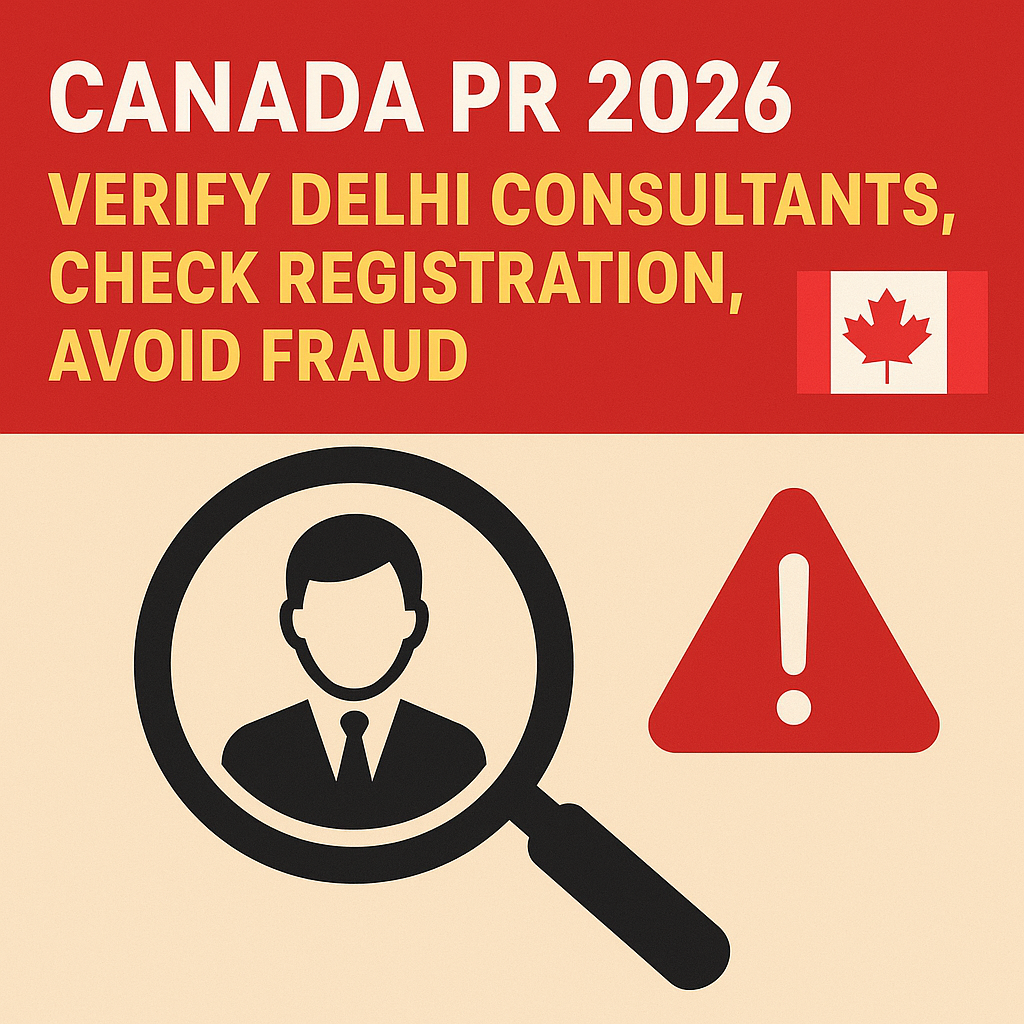
Planning your move to Canada and aiming for permanent residency in 2026 can be exciting, but it also comes with real risks—especially when you’re choosing an immigration consultant in Delhi. The demand for Canada PR has made the market crowded, and along with genuine professionals, there are also unregistered agents and fraud networks offering “guaranteed PR,” fake job offers, or shortcut pathways. If you’re serious about Canada PR 2026, the safest approach is to verify your Delhi consultant, check their registration, and follow a fraud-proof process from day one.
Canada PR 2026: Why verification matters more than ever
Canada immigration programs continue to evolve, with changing invitation trends, targeted draws, updated documents, and stricter checks on misrepresentation. In 2026, applicants are expected to face:
- More scrutiny on documentation: work experience proofs, reference letters, funds, and employment records.
- Higher risk of misrepresentation findings: even unintentional errors can lead to refusal or multi-year bans.
- Growing fraud attempts: fake LMIA/job offers, “backdoor” PR schemes, and impersonation of licensed consultants.
That’s why verifying your Delhi consultant’s credentials is not optional—it’s a core step in protecting your application, money, and future eligibility.
Who is legally allowed to represent you for Canada immigration?
For Canadian immigration applications (including Express Entry, PNPs, family sponsorship, and study/work routes that can lead to PR), only certain representatives are authorized to charge a fee. These typically include:
- Regulated Canadian Immigration Consultants (RCICs) who are licensed by the College of Immigration and Citizenship Consultants (CICC).
- Canadian lawyers or paralegals who are members in good standing of a Canadian provincial/territorial law society (and, in Ontario, paralegals under the appropriate regulator).
- Notaries in specific Canadian jurisdictions (e.g., Quebec) as permitted.
If a person or company in Delhi is taking money and claiming they will “file your Canada application,” they should have an authorized representative involved, and you should be able to verify that authorization independently.
How to verify Delhi consultants for Canada PR 2026
Fraud often succeeds because applicants skip basic checks. Use the steps below to confirm whether you’re dealing with a legitimate, accountable professional.
1) Ask for the representative’s official registration details
Don’t accept verbal claims like “we are registered” or “we have a license.” Request:
- Full legal name of the RCIC/lawyer representing you
- License/registration number (if applicable)
- Business email and official website profile
- A copy of the written retainer agreement/contract
If they hesitate, deflect, or provide unclear details, treat it as a warning sign.
2) Cross-check the license on the official regulator directory
Once you have the consultant’s details, verify them on the official regulator’s website directory. Ensure:
- The name matches exactly (spelling included)
- Status shows active/in good standing (not suspended, revoked, or inactive)
- Contact information appears consistent with what you were given
Be cautious of lookalike names and fake certificates—always rely on regulator directories, not screenshots.
3) Confirm who will actually sign and submit your application
A common fraud pattern is: a Delhi office markets services under a “licensed consultant,” but your file is actually handled by untrained staff. Ask directly:
- Who will prepare the forms and review documents?
- Who will sign as your representative?
- Who will communicate with IRCC (Canada immigration authorities)?
If the answer is vague or constantly changing, avoid proceeding.
4) Demand transparency on fees, timelines, and what’s included
Ethical consultants are specific about services and limitations. You should receive:
- A written breakdown of professional fees and government fees
- Clear refund terms (if any)
- A realistic timeline discussion based on your profile
- A checklist of your responsibilities (documents, tests, funds, etc.)
5) Insist on truthful profile-building—no fake documents, no “arrangements”
One of the fastest ways to get banned from Canada is misrepresentation. Avoid any consultant who suggests:
- Fake experience letters, salary slips, or bank statements
- Fabricated job offers or LMIA shortcuts
- Manipulating IELTS scores or “managed test outcomes”
- Fake education credentials or WES shortcuts
Even if an agent promises “everyone does it,” IRCC can refuse and ban applicants for years, and future applications can be affected permanently.
Common Canada PR frauds in Delhi (and how to spot them)
Fraud patterns repeat. Knowing the most common tactics helps you filter out risky operators quickly.
“Guaranteed PR in 6 months” claims
No consultant can guarantee PR because decisions depend on IRCC, eligibility, completeness, medical/security checks, and program conditions. Promising certainty is usually a sales tactic—or worse.
Fake job offers and LMIA scams
Some agents sell fake job offers, or claim they can “arrange LMIA.” Real LMIAs involve Canadian employers, strict advertising rules, and government approvals. If you’re being offered a job for a fee with no genuine employer process, it’s high-risk.
Unregistered “case managers” filing applications
A Delhi office might have strong marketing and fancy branding but no authorized representative. You may never know who is submitting your forms, which can create accountability issues and legal risks.
Document “editing” that becomes misrepresentation
There’s a difference between improving formatting and fabricating facts. If your consultant changes job duties, dates, or salary numbers to “match NOC,” that can cross the line into misrepresentation.
Pressure tactics and limited-time discounts
Scammers create urgency: “draw is next week,” “offer closes today,” “pay now to lock slot.” A legitimate professional will guide you with facts and deadlines, not panic-driven sales pressure.
Canada PR 2026: What a safe and legitimate process looks like
If you want to move confidently, focus on a process built on eligibility, documentation quality, and compliance. A responsible pathway typically includes:
- Profile assessment: CRS estimate, eligibility checks, and a program strategy (Express Entry, PNP, etc.).
- Document planning: education assessment, language tests, work proofs, funds, identity documents.
- Accurate NOC alignment: mapping your real duties and experience to the correct occupation code without falsification.
- Submission and follow-up: complete forms, timely uploads, response to IRCC requests, and interview preparation if needed.
- Post-approval guidance: travel planning, landing steps, and settlement basics.
Checklist: Questions to ask any Delhi consultant before you pay
- Are you an authorized representative for Canadian immigration, and what is your registration number?
- Can I verify you on the official regulator directory?
- Who will sign and submit my application to IRCC?
- What is the exact scope of services included in the contract?
- What documents will you need from me, and how will you verify them?
- What are the realistic risks in my profile (CRS, NOC, proof of funds, etc.)?
- Will you ever suggest or accept any document that is not genuine?
Why checking registration protects your money and your future
Working with a verified, accountable representative helps you avoid:
- Financial loss: upfront fees to agents who disappear or deliver fake documents.
- Application refusal: due to incorrect forms, missing documents, or inconsistent information.
- Misrepresentation bans: which can block you from Canada for years and affect other countries’ visa outcomes.
- Identity misuse: misuse of passport scans, bank details, or signatures.
Your Canada PR dream should not depend on shortcuts. Verification is your strongest tool.
Start your Canada PR 2026 process with a verified approach
If you want a structured and transparent start, you can begin your process or immigration journey with Esse India. The key is to prioritize clarity: written agreements, ethical guidance, accurate documentation, and a process that respects Canadian immigration rules from the first consultation to final submission.
FAQs
1) How can I verify if a Delhi consultant is registered for Canada immigration?
Ask for the full name and license/registration number of the authorized representative (such as an RCIC or Canadian lawyer), then verify those details directly on the official regulator’s online directory. Do not rely on screenshots, certificates shared on WhatsApp, or marketing claims.
2) Can a local agent in Delhi legally file my Canada PR application?
A local agent can assist with administrative support, but if they are charging a fee to represent you in the immigration process, they must be an authorized representative under Canadian rules (such as an RCIC or Canadian lawyer). Always confirm who is officially representing you before you sign or pay.
3) What are the biggest red flags of Canada PR fraud in Delhi?
Major red flags include guaranteed PR promises, offers of paid job offers or “arranged LMIA,” advice to use fake documents, refusal to share registration details, and pressure to pay immediately. Any suggestion of document fabrication is a strong sign to walk away.
4) What happens if my application includes fake documents arranged by a consultant?
IRCC may refuse the application and can find you inadmissible for misrepresentation, which may result in a multi-year ban from applying to Canada. Even if a consultant arranged it, the applicant is generally held responsible for the information submitted.
5) Where can I start a safer Canada PR 2026 consultation and process?
You can start your process or immigration journey with Esse India and ensure your pathway is built on verified guidance, transparent documentation requirements, and compliance-focused filing practices.