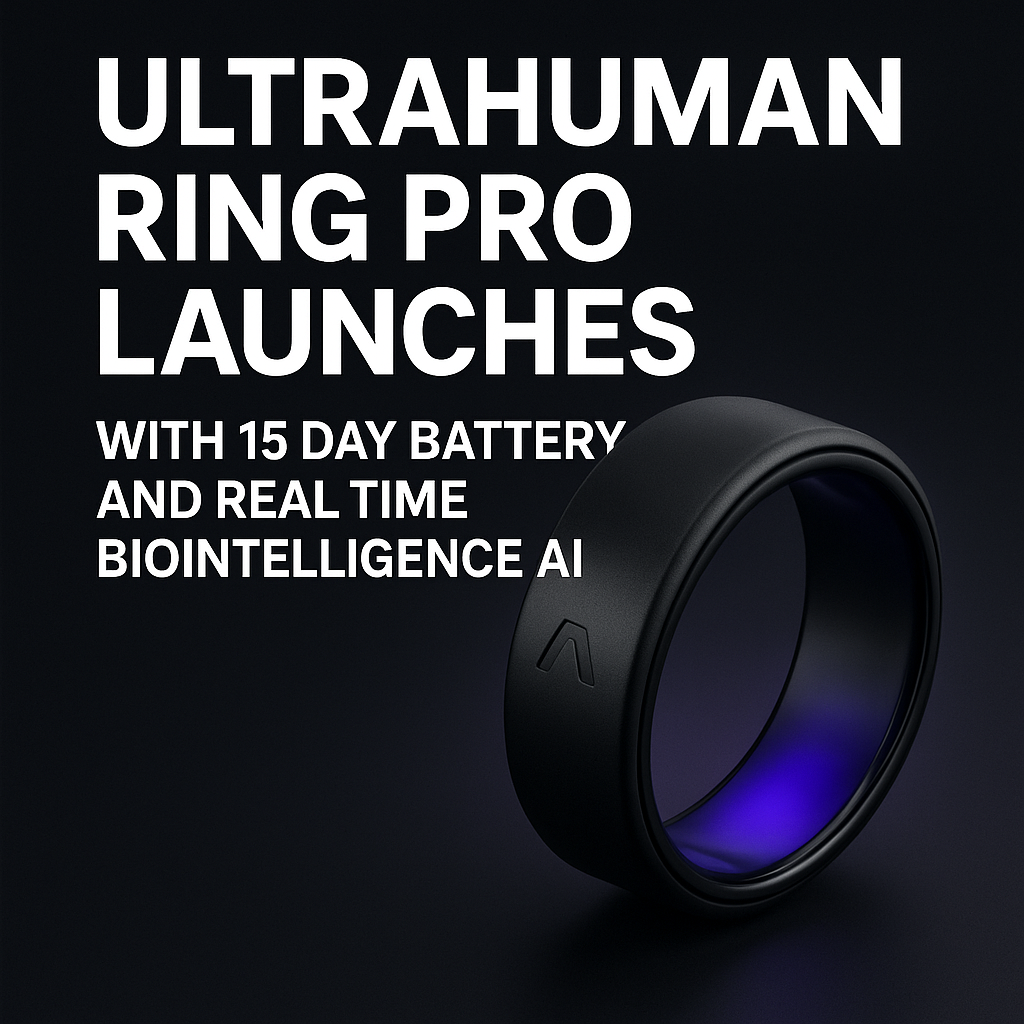
The wearable tech space just got a major jolt with the Ultrahuman Ring PRO launch, introducing a claimed 15-day battery life and real-time Biointelligence AI designed to turn everyday body signals into practical guidance. Smart rings have been steadily replacing bulky wrist wear for people who want sleep, recovery, and activity insights without a screen. With the Ring PRO, Ultrahuman is positioning itself as a premium, always-on health companion that emphasizes continuous sensing, longer time between charges, and more actionable feedback powered by on-device and cloud intelligence.
Ultrahuman Ring PRO: What’s New in This Launch
The Ultrahuman Ring PRO is aimed at users who care about metabolic health, recovery, and daily performance but prefer a minimal form factor. The headline upgrade is a 15-day battery claim, which—if it holds in real-world use—reduces the biggest friction point of most smart rings: frequent charging. The second big pillar is Real-Time Biointelligence AI, a feature set that focuses on interpreting signals (like sleep stages, stress proxies, and readiness indicators) faster and with more context than basic trend charts.
Key highlights at a glance
- Claimed 15-day battery life for extended wear and fewer charging interruptions.
- Real-time Biointelligence AI that turns biometric data into timely prompts and insights.
- Continuous health tracking focused on sleep, recovery, stress, and daily activity signals.
- Ring-first design for comfortable 24/7 use without a bright display.
- App-driven insights that prioritize clarity, patterns, and personalization.
Why a 15-Day Battery Matters for Smart Rings
Battery life is more than a convenience feature in a health wearable—it directly impacts data quality. The most valuable insights come from consistent long-term data, especially for sleep, recovery, and stress patterns that vary across weekdays, travel, training blocks, and seasonal shifts. When a wearable needs frequent charging, users often remove it overnight or forget to put it back on, creating gaps that reduce confidence in the trends.
A smart ring with a longer battery can deliver:
- More complete sleep tracking across weeks, not just a few nights at a time.
- Better baseline accuracy because the system can learn your typical ranges with fewer missing days.
- Less “device management” fatigue, which is a major reason people abandon wearables.
- Improved travel readiness, since you can pack fewer chargers and worry less about daily charging routines.
For anyone using a ring as a recovery tool—especially athletes, busy professionals, or frequent travelers—extended battery life can be the difference between “interesting data” and genuinely reliable guidance.
Real-Time Biointelligence AI: What It Means in Practice
“AI” in wearables can be vague, but the promise of Ultrahuman’s Real-Time Biointelligence AI is straightforward: deliver insights when they matter, not hours later. Traditional wearable dashboards often summarize yesterday’s metrics after you wake up. Real-time intelligence aims to interpret signals as they shift—during the day, during a workout, or while you sleep—so recommendations can be more timely.
From raw metrics to actionable intelligence
Most wearables track similar foundations: heart rate, temperature trends, movement, and sleep signals. The differentiator is interpretation. Real-time Biointelligence AI is positioned to provide context-aware nudges such as:
- Recovery signals that reflect how ready your body appears for training or a demanding day.
- Stress and strain indicators that help you recognize when to slow down or prioritize breaks.
- Sleep quality insights that connect behaviors (late meals, travel, irregular sleep timing) to outcomes.
- Habit feedback loops that reinforce what’s working based on your personal trends.
The benefit of real-time intelligence is not simply “more data.” It’s the potential to reduce decision fatigue by translating complex trends into understandable, personalized guidance.
Health Tracking Focus: Sleep, Recovery, Stress, and Daily Performance
Smart rings have become popular because the finger is a strong site for consistent biometrics, particularly during sleep. Ultrahuman’s positioning with the Ring PRO leans into 24/7 health tracking where sleep and recovery are the foundation, and daily performance is the outcome.
Sleep tracking that supports better mornings
Sleep tracking is often the gateway metric that drives wearable adoption. A ring can capture nightly signals with minimal disturbance—no screen glare and fewer distractions than wrist devices. While every platform frames sleep differently, the value typically comes from:
- Sleep duration and consistency across weekdays and weekends.
- Sleep stages and continuity, helping identify fragmentation or restless nights.
- Nightly recovery indicators that correlate with how you feel the next day.
With a longer battery, sleep tracking becomes more dependable because you’re less likely to miss nights due to charging.
Recovery and readiness insights
Recovery features typically combine multiple signals into a simplified score or status. The point is not perfection; it’s direction. If readiness trends downward for several days, it can guide you to reduce training intensity, prioritize earlier bedtime, or adjust workload. Real-time Biointelligence AI aims to make these insights more responsive to what’s happening today rather than only reporting what happened yesterday.
Stress awareness without obsession
Wearables can help users recognize high-strain patterns, but the best experiences avoid turning health tracking into anxiety tracking. When done well, stress and strain features can encourage healthier pacing throughout the day—short walks, breathing breaks, hydration, or earlier wind-down routines—without forcing users to constantly check their phone.
Design and Comfort: Why Smart Rings Win for 24/7 Wear
A key reason people choose a smart ring over a smartwatch is comfort. Rings are discreet, lightweight, and do not compete with formal wear, jewelry preferences, or workplace dress codes. Comfort matters because the best wearable is the one you actually keep on.
In practice, a ring-first approach benefits users who:
- Dislike sleeping with a watch on their wrist.
- Want health data without notifications and screens.
- Prefer minimalism and subtle design.
- Need a wearable that fits seamlessly into daily routines.
The Ultrahuman Ring PRO’s battery claim also supports comfort indirectly: fewer charging sessions means fewer interruptions, fewer moments of “I’ll put it back on later,” and more consistent wear.
How Ultrahuman Ring PRO Fits Into the Smart Ring Market
The smart ring category is increasingly competitive, with buyers comparing battery life, accuracy, app experience, subscription models, and the usefulness of insights. The Ultrahuman Ring PRO’s launch message—15-day battery plus real-time Biointelligence AI—targets two of the most common buyer demands: longer endurance and smarter interpretation.
What buyers typically compare before choosing a smart ring
- Battery life (how often you need to charge and how that affects sleep tracking).
- Insight quality (does the app provide clear actions or just charts?).
- Comfort and durability for all-day wear, workouts, and sleep.
- App ecosystem (integration with fitness platforms and health apps).
- Cost structure (upfront price and any ongoing subscription fees).
For many users, the deciding factor is not one metric but a combination: “Does this ring fit my life?” Ultrahuman is betting that longer battery and real-time intelligence will make that answer easier.
Who Should Consider the Ultrahuman Ring PRO?
The Ring PRO is best suited for people who want continuous health tracking and are willing to use insights to guide habits. It may be especially attractive if you care about recovery and sleep but don’t want another screen on your body.
Ideal user profiles
- Fitness-focused users who want readiness guidance and long-term trend tracking.
- Busy professionals seeking stress awareness and better sleep consistency.
- Frequent travelers who benefit from longer battery life and routine stabilization insights.
- Minimalists who prefer discreet wearables over watches.
- Data-driven habit builders who enjoy experimenting with sleep schedules, meal timing, and recovery routines.
If you primarily want real-time notifications, apps on your wrist, or a fitness watch replacement, a ring may not be the best fit. But if your priority is 24/7 biometrics in a subtle form factor, the Ultrahuman Ring PRO is positioned as a compelling option.
Getting the Most Value: Tips for New Smart Ring Users
Smart rings deliver their best results when users focus on trends rather than obsessing over nightly fluctuations. The Ring PRO’s Biointelligence AI may help simplify this, but good habits still matter.
Practical ways to improve outcomes
- Wear it consistently for at least 2–3 weeks to establish your baseline.
- Use sleep timing consistency as your first lever before chasing perfect sleep stages.
- Watch multi-day trends in recovery or stress rather than reacting to one off night.
- Experiment thoughtfully (e.g., earlier dinner, reduced late caffeine) and observe changes.
- Keep expectations realistic: wearables estimate physiology; they don’t diagnose conditions.
With longer battery life, the biggest advantage is consistency—more uninterrupted data leads to better personalization and more reliable signals.
FAQs
What is the Ultrahuman Ring PRO?
The Ultrahuman Ring PRO is a smart ring designed for 24/7 health tracking, with a focus on sleep, recovery, stress, and daily performance insights. It pairs with a smartphone app to interpret biometric signals and provide guidance.
Does the Ultrahuman Ring PRO really have a 15-day battery life?
Ultrahuman claims up to 15 days of battery life. Real-world battery performance can vary based on ring size, usage patterns, sensor sampling, and ambient conditions, but the key promise is significantly fewer charging interruptions than typical wearables.
What is Real-Time Biointelligence AI in the Ring PRO?
Real-Time Biointelligence AI refers to Ultrahuman’s approach to interpreting biometric data quickly and contextually, aiming to provide timely insights rather than only end-of-day summaries. The goal is to make metrics more actionable through personalized prompts and trend-based guidance.
Is a smart ring better than a smartwatch for sleep tracking?
For many users, a smart ring can be more comfortable for overnight wear, which improves consistency. Watches may offer richer fitness features and real-time notifications, but rings often excel at subtle, always-on tracking with fewer distractions.
Who should buy the Ultrahuman Ring PRO?
The Ring PRO is a strong fit for people who want a discreet wearable for continuous sleep and recovery tracking, prefer fewer charging sessions, and value app-driven insights. It’s especially useful for habit builders, athletes focused on recovery, and users who don’t want a screen on their body.